







New Korean university rankings unveiled for international students
Published Sep 24, 2025 12:27 pm


At A Glance
- The number of international students in Korea surpassed 208,000 in 2024, according to the Ministry of Education. With the government aiming to attract 300,000 by 2027 under its Study Korea 300K Project, international students are becoming an increasingly vital part of the country's higher education landscape

Korean and international students hold a discussion at the campus of Korea University in Seoul. (Photo courtesy of Korea University)
By JUNG DA-HYUN
As global competition reshapes higher education, The Korea Times has announced the first-ever K-universities Global Excellence Rankings 2026, designed not only to assess universities’ global readiness but also to serve as a reliable reference for international students considering Korea as a study destination.
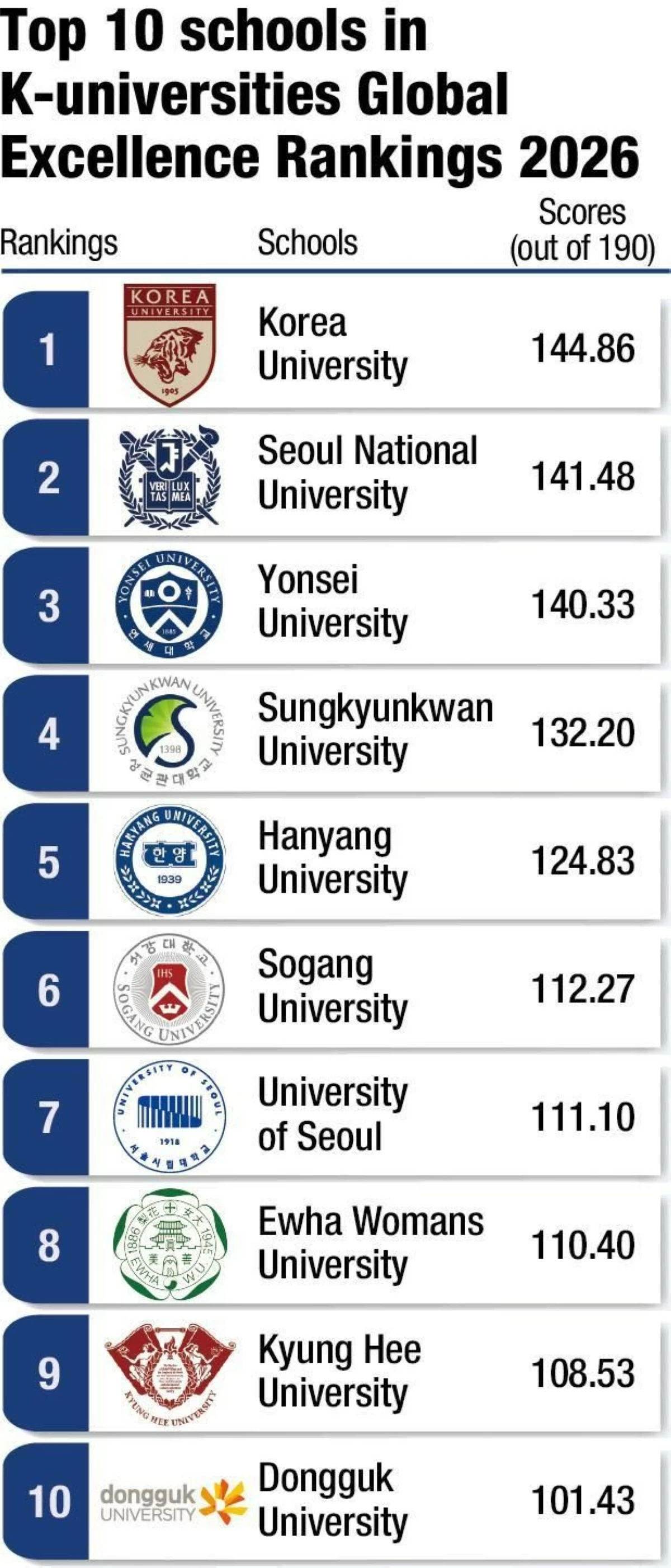
Korea University ranked first in the overall standings with 144.86 points, followed by Seoul National University with 141.48 and Yonsei University with 140.33. Sungkyunkwan University, Hanyang University, Sogang University, University of Seoul, Ewha Womans University, Kyung Hee University and Dongguk University rounded out the Top 10.
Although Seoul-based universities dominated the top tier, the rankings also highlighted notable performances by regional flagships and specialized institutions. Kyungpook National University, Pusan National University and Jeonbuk National University secured places within the Top 30, while Woosong University and Handong Global University were recognized for their strong globalization focus.
The rankings by each category highlighted the varied strengths of Korean universities. While the traditional top three universities known as “SKY” — Seoul National University, Korea Unversity and Yonsei University — continue to dominate overall, emerging players and regional institutions are building reputations in specialized fields.

The Seoul campus of Korea University, which ranked first in the K-universities Global Excellence Rankings 2026. (Photo courtesy of Korea University)
Unlike other evaluations, this ranking gives unprecedented weight — 63.2 percent — to globalization indicators, setting it apart as the most internationalization-focused benchmark to date. The evaluation covered 54 four-year universities nationwide, with a total of 190 points distributed across four categories: 60 for education, 50 for research, 40 for student support and 40 for graduate outcomes.
The evaluation was based on publicly available and verifiable data, drawing on sources such as Higher Education in Korea from the Ministry of Education and Naver Scholytics. The framework was developed by The Korea Times’ evaluation team in conjunction with six experts in university globalization, to ensure credibility and transparency.
Experts have recognized the rankings as a timely student-centered evaluation that takes into account the experiences of international students.
“The four evaluation areas are well-balanced, and the results could help guide international students while expanding opportunities for Korean universities,” said Seo Myeong-seok, managing director of the Korea Advancing Schools Foundation.
Korea University took the lead in education, followed by the University of Seoul and Yonsei University. The results underscored the strength of Seoul-based private universities, which have traditionally dominated in education.
Sejong University stood out in research, topping the list ahead of Yonsei and Sungkyunkwan universities. Notably, institutions outside Seoul also broke into the Top 10, including Hanyang University ERICA Campus, Yeungnam University and Gachon University, reflecting a wider spread of research competitiveness.
Meanwhile, Seoul National University ranked first in both student support and graduate outcomes.
In the student support category, Handong Global University made a surprise entry into the Top 10, recognized for its international student-friendly environment and high dormitory accommodation rate. The Catholic University of Korea also performed strongly, placing fourth.
In graduate outcomes, Seoul-based private universities once again showed their strength, with established players continuing to dominate through strong alumni networks and career support systems.
International students drive demand for guidance
The number of international students in Korea surpassed 208,000 in 2024, according to the Ministry of Education. With the government aiming to attract 300,000 by 2027 under its Study Korea 300K Project, international students are becoming an increasingly vital part of the country’s higher education landscape.
Yet existing university rankings have largely focused on domestic students, leaving few credible resources for foreigners seeking reliable information about where to study. This lack of accessible guidance highlighted the need for an evaluation tailored to the concerns of international students.
Against this backdrop, The Korea Times launched the K-universities Global Excellence Rankings, a first-of-its-kind assessment designed to reflect the realities of a globalizing campus environment. The rankings for 2026 are based on a broad set of indicators, with particular weight given to factors that matter most to international students, including diversity of nationality, scholarships, dormitory capacity and academic retention.
“The rankings stand out by giving international students practical criteria, rather than focusing only on research output and reputation,” said Jung Min-chul, a partner at Samil PwC.
The rankings were released following the Korea Times Global Conference on Sept. 17, held under the theme “Beyond Borders: Strengthening Global Competitiveness of Korean Universities.” The conference brought together policymakers, university leaders and international education experts to explore strategies for sustaining global engagement amid demographic decline and financial strain.
By linking the rankings to the international forum, The Korea Times underscored that the project is not just an academic exercise but a tool for reform, aimed at guiding universities and government toward concrete strategies.
The evaluation spotlights universities that are moving quickly to adapt, while revealing the gaps that must be addressed. By putting globalization at the center of its criteria, the initiative aims to reshape the definition of excellence in Korean higher education and provide international students with credible, Korea-specific guidance. It further underscores higher education’s role as a driving force of national competitiveness in an increasingly borderless world.