








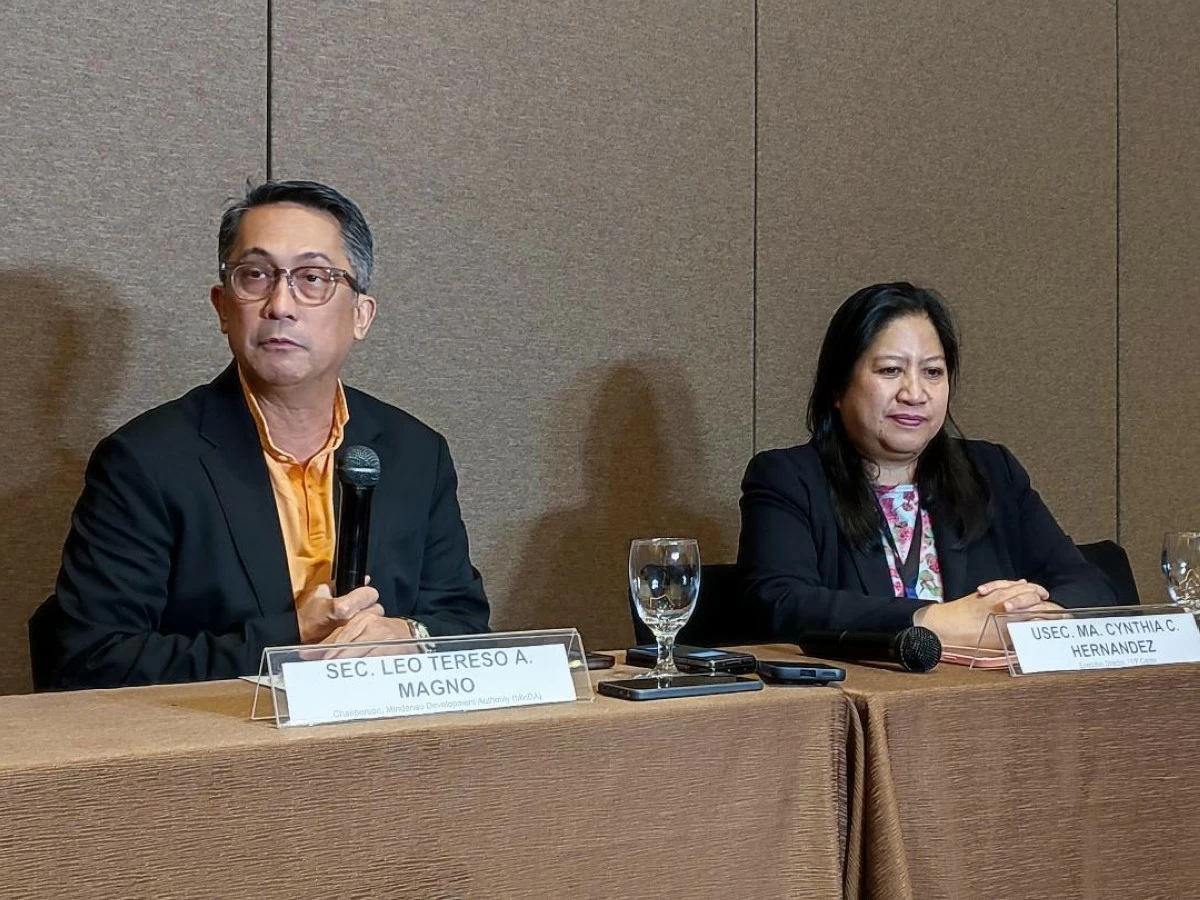
MINDANAO Development Authority Chairman Secretary Leo Tereso A. Magno and Public-Private Partnership Center Executive Director Undersecretary Maria Cynthia Hernandez underscore PPP's role in addressing infrastructure gaps in Mindanao during a press briefing at Acacia Hotel in Davao City on Tuesday, Sept. 23, 2025. (Ivy Tejano)
DAVAO CITY – The Mindanao Development Authority launched the Mindanao Public-Private Partnership Desk on Tuesday, Sept. 23, at the Acacia Hotel here.
It is a new technical hub aimed at helping local governments plan and implement projects through partnerships with the private sector.
PPP Desk organizes program activities with the Mindanao internal affairs service, the PPP Center, private sector partners, and other interested parties. The desk offers both online and in-person assistance for PPP issues throughout Mindanao.
In a press briefing on Tuesday afternoon, MinDA Chair Secretary Leo Tereso Magno and PPP Center Executive Director Undersecretary Maria Cynthia Hernandez underscored that PPPs are key to fixing infrastructure gaps in Mindanao and reduce reliance on national funds.
Magno said the PPP Desk will enable local government units to know more about the PPP Code, obtain their commitment to engage in the capacity development plan, and gain an initial understanding of PPP prospects in their areas.
“The desire is to bring development to Mindanao,” Magno said. “Now that we enjoy peace and order, one way to sustain this program is by ensuring people from various cities/municipalities in provinces have jobs, food, and opportunities.”
Magno said PPPs offer an alternative financing mechanism to supplement the limited funds provided by the national government. He explained that with this development, the local executives now know they could legally partner with private investors.
“We are re-educating the local government units and the private sectors that PPP is not just about high-value projects—it can be as basic as finding investors to provide water systems in underserved areas,” he said, noting about 60 potential projects, including water and electricity.
MinDA Deputy Executive Director Assistant Secretary Romeo Montenegro said the agency includes basic needs, such as water, as half of the island’s municipalities still lack access to a Level 3 water network—one of the most vital needs that PPP can address in the region.
The desk is expected to streamline procedures by providing technical assistance locally instead of requiring LGUs to coordinate in Manila. “This will save time, energy, and resources for LGUs, many of which travel to Manila only to find their project documents incomplete,” Magno said.
After the pandemic, Montenegro said the MinDA rolled out initial capacity-building involving LGUs to enable them to understand the PPP concept and how to tap into this government policy to source funding for critical catalytic projects in their respective local government areas.
Magno stressed that the initiative will prioritize areas with the greatest need. “You don’t build a water project in a city with a good water supply. We will put it where there is none,” he said, assuring that LGUs are accountable to ensure services remain accessible to their constituents.
He also said that safety nets will be in place to address corruption concerns, and there are processes for checking and counter-checking. “The government should never use PPP projects for corruption. If an LGU makes things difficult for the private sector, they can move to another.”
Hernandez said that efficiency and accountability are inherent in PPP arrangements. She said the private sector shoulders the cost and will find it difficult to recover if they overprice, as the government only pays once the project is delivered and operational.
The PPP Code of the Philippines, signed into law in December 2023, also sets a maximum 120-day timeline for project approvals, with provisions that automatically deem applications approved if not acted upon, subject to liability of approving bodies, the PPP Center Executive Director said.
“The maximum approval time is now 120 days. If the approving body fails to act, the project is deemed approved—without absolving them of liability. Thus, it compels concerned agencies to act swiftly,” Hernandez said.
Abdul Khayr Alonto II, head of the Bataan PPP and Investment Center, shared their experience managing P4-billion worth of PPP projects and securing P160 billion in investment pledges for the province.
“We’ve entered into several PPPs already, one of which is our flagship government center in the province of Bataan in Balanga City, a P900-million infrastructure project for our government center. It has served as our one-stop shop in the province,” Alonto said.
He added they have constructed the government center without any cost to the province, something they are encouraging other LGUs to consider the PPP, as it really contributes to further development in their governed areas.
“We used our land as equity. A private developer built the government center at their own cost, and we lease it from them while subleasing to other tenants, allowing the province to earn revenue. So, it’s a win-win for everyone,” said Alonto, a native of Marawi City.
Magno assured that the PPP Desk, established under MinDA’s facilitation initiative, will act as a coordination and resource center for LGUs, providing technical guidance in project planning, legal compliance, and investor engagement.