ADVERTISEMENT

Aklan's piña fabric becomes PH's third product with GI tag

Published Sep 23, 2025 10:15 am
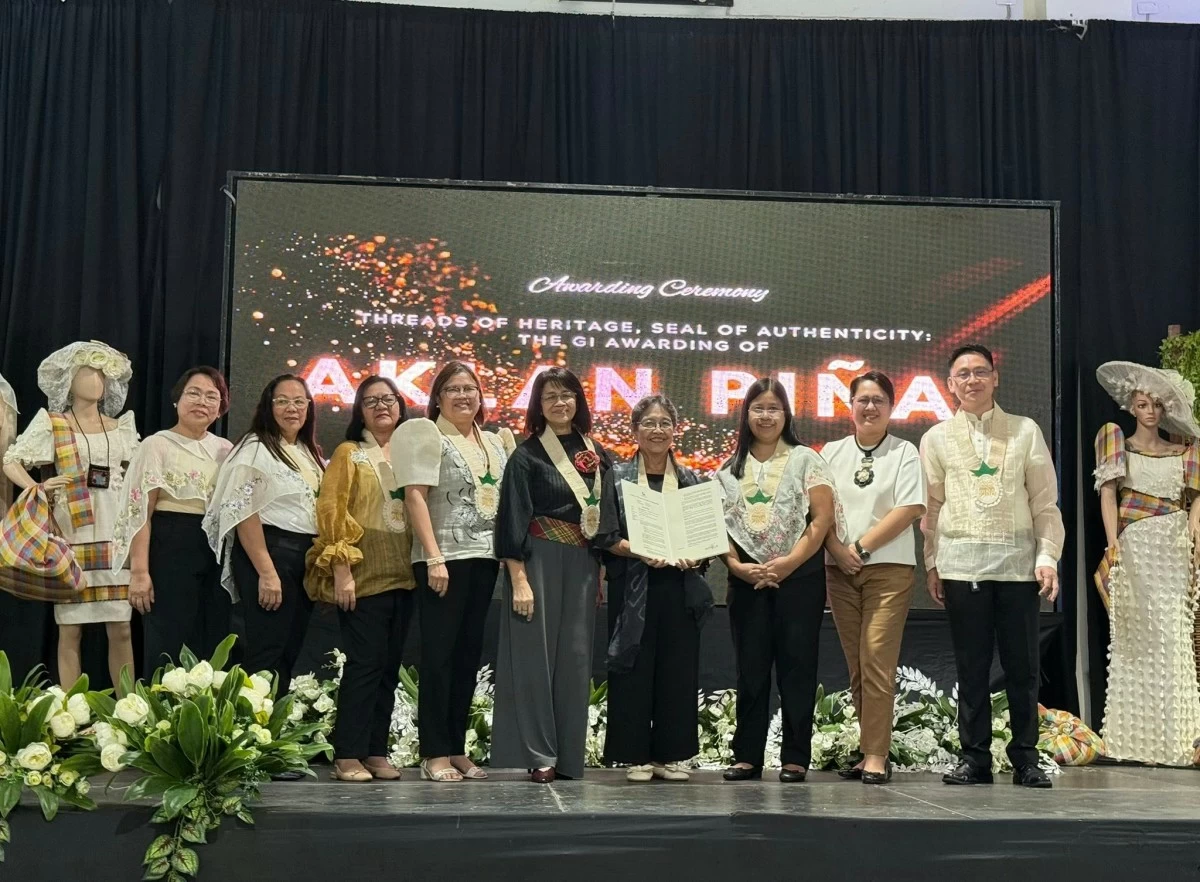
THE ceremony for the Geographical Indication (GI) certification of Aklan piña fabric in Kalibo, Aklan.  (DTI Region 6)
ILOILO CITY — The Aklan piña fabric has become the third product in the Philippines registered as a Geographical Indication (GI), an international tag that specifies the geographic origin of a product. 
 The Intellectual Property Office of the Philippines (IPOPHL), an attached agency under the Department of Trade and Industry (DTI), formally issued the GI certificate for Aklan piña fabric last Sept. 19 in a ceremony in Kalibo town, Aklan province.
The GI tag certifies the authenticity of Aklan piña fabric—from its raw form, extraction, weaving method, and product labeling.
“Piña is synonymous with Aklan. This GI tag is a label of the artisans’ craft and the enduring culture that also embodies the geographical attributes of Aklan and the Aklanons,” said DTI-6 OIC Regional Director Maria Dinda R. Tamayo
The GI designation of Aklan piña fabric is expected to enhance export competitiveness while providing higher earnings for artisans and farmers. It also aims to protect the Aklan piña fabric industry from cheap imitations.
“This will open opportunities not just for Aklan, but for the Philippines because of the recipcoral GIs with other countries,” added IPOPHL Director General Atty. Brigitte da Costa-Villaluz.
The GI certificate was given to Aklan Piña & Indigenous Fibers Manufacturers and Traders Association Inc. (Aklan Piña Mantra) represented by president Anna India Legaspi.
The road to earning the GI tag for Aklan piña fabric was mostly the work of DTI-Aklan led by Provincial Director Romel Amihan.  
DTI-Aklan coordinated with local weaving associations in preparing documentation, setting product specifications, and gathering stakeholder support for submission to IPOPHL.
“This is a tribute to the diligence, creativity, and craftsmanship of our Aklanon weavers—an enduring legacy of our cultural heritage, now rightfully recognized and celebrated on both national and global stages,” noted Amihan.
With the GI tag for Aklan piña fabric, Western Visayas now is home to two of the three GI tags in the country.  
The first GI tag in the country was awarded to the sweet mangoes in the island province of Guimaras.

Related Tags

Piña fabric Aklan Geographical Indication
ADVERTISEMENT
.most-popular .layout-ratio{ padding-bottom: 79.13%; } @media (min-width: 768px) and (max-width: 1024px) { .widget-title { font-size: 15px !important; } }

{{ articles_filter_1561_widget.title }}

.most-popular .layout-ratio{ padding-bottom: 79.13%; } @media (min-width: 768px) and (max-width: 1024px) { .widget-title { font-size: 15px !important; } }

{{ articles_filter_1562_widget.title }}

.most-popular .layout-ratio{ padding-bottom: 79.13%; } @media (min-width: 768px) and (max-width: 1024px) { .widget-title { font-size: 15px !important; } }

{{ articles_filter_1563_widget.title }}

{{ articles_filter_1564_widget.title }}

.mb-article-details { position: relative; } .mb-article-details .article-body-preview, .mb-article-details .article-body-summary{ font-size: 17px; line-height: 30px; font-family: "Libre Caslon Text", serif; color: #000; } .mb-article-details .article-body-preview iframe , .mb-article-details .article-body-summary iframe{ width: 100%; margin: auto; } .read-more-background { background: linear-gradient(180deg, color(display-p3 1.000 1.000 1.000 / 0) 13.75%, color(display-p3 1.000 1.000 1.000 / 0.8) 30.79%, color(display-p3 1.000 1.000 1.000) 72.5%); position: absolute; height: 200px; width: 100%; bottom: 0; display: flex; justify-content: center; align-items: center; padding: 0; } .read-more-background a{ color: #000; } .read-more-btn { padding: 17px 45px; font-family: Inter; font-weight: 700; font-size: 18px; line-height: 16px; text-align: center; vertical-align: middle; border: 1px solid black; background-color: white; } .hidden { display: none; }
function initializeAllSwipers() { // Get all hidden inputs with cms_article_id document.querySelectorAll('[id^="cms_article_id_"]').forEach(function (input) { const cmsArticleId = input.value; const articleSelector = '#article-' + cmsArticleId + ' .body_images'; const swiperElement = document.querySelector(articleSelector); if (swiperElement && !swiperElement.classList.contains('swiper-initialized')) { new Swiper(articleSelector, { loop: true, pagination: false, navigation: { nextEl: '#article-' + cmsArticleId + ' .swiper-button-next', prevEl: '#article-' + cmsArticleId + ' .swiper-button-prev', }, }); } }); } setTimeout(initializeAllSwipers, 3000); const intersectionObserver = new IntersectionObserver( (entries) => { entries.forEach((entry) => { if (entry.isIntersecting) { const newUrl = entry.target.getAttribute("data-url"); if (newUrl) { history.pushState(null, null, newUrl); let article = entry.target; // Extract metadata const author = article.querySelector('.author-section').textContent.replace('By', '').trim(); const section = article.querySelector('.section-info ').textContent.replace(' ', ' '); const title = article.querySelector('.article-title h1').textContent; // Parse URL for Chartbeat path format const parsedUrl = new URL(newUrl, window.location.origin); const cleanUrl = parsedUrl.host + parsedUrl.pathname; // Update Chartbeat configuration if (typeof window._sf_async_config !== 'undefined') { window._sf_async_config.path = cleanUrl; window._sf_async_config.sections = section; window._sf_async_config.authors = author; } // Track virtual page view with Chartbeat if (typeof pSUPERFLY !== 'undefined' && typeof pSUPERFLY.virtualPage === 'function') { try { pSUPERFLY.virtualPage({ path: cleanUrl, title: title, sections: section, authors: author }); } catch (error) { console.error('ping error', error); } } // Optional: Update document title if (title && title !== document.title) { document.title = title; } } } }); }, { threshold: 0.1 } ); function showArticleBody(button) { const article = button.closest("article"); const summary = article.querySelector(".article-body-summary"); const body = article.querySelector(".article-body-preview"); const readMoreSection = article.querySelector(".read-more-background"); // Hide summary and read-more section summary.style.display = "none"; readMoreSection.style.display = "none"; // Show the full article body body.classList.remove("hidden"); } document.addEventListener("DOMContentLoaded", () => { let loadCount = 0; // Track how many times articles are loaded const offset = [1, 2, 3, 4, 5, 6, 7, 8, 9, 10]; // Offset values const currentUrl = window.location.pathname.substring(1); let isLoading = false; // Prevent multiple calls if (!currentUrl) { console.log("Current URL is invalid."); return; } const sentinel = document.getElementById("load-more-sentinel"); if (!sentinel) { console.log("Sentinel element not found."); return; } function isSentinelVisible() { const rect = sentinel.getBoundingClientRect(); return ( rect.top < window.innerHeight && rect.bottom >= 0 ); } function onScroll() { if (isLoading) return; if (isSentinelVisible()) { if (loadCount >= offset.length) { console.log("Maximum load attempts reached."); window.removeEventListener("scroll", onScroll); return; } isLoading = true; const currentOffset = offset[loadCount]; window.loadMoreItems().then(() => { let article = document.querySelector('#widget_1690 > div:nth-last-of-type(2) article'); intersectionObserver.observe(article) loadCount++; }).catch(error => { console.error("Error loading more items:", error); }).finally(() => { isLoading = false; }); } } window.addEventListener("scroll", onScroll); });

Sign up by email to receive news.