








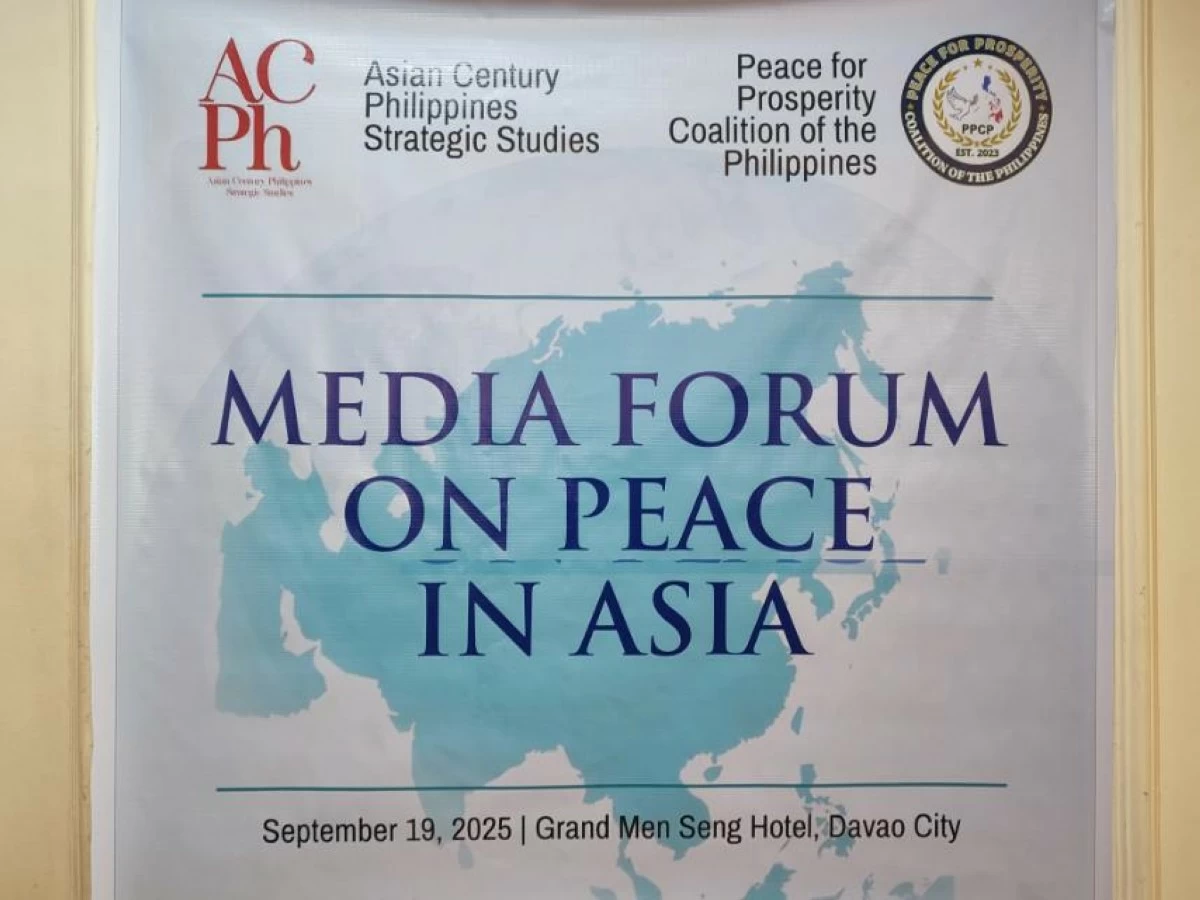
DAVAO CITY – A longtime diplomat-turned-peace advocate on Friday slammed the government's approach to the West Philippine Sea issue.
Asian Century Philippines President Adolfo Quizon Paglinawan, speaking at the Media Forum on Peace in Asia here, described the approach as disguised lawfare and information war.
Paglinawan’s argument stemmed from a collision between a Chinese navy vessel and a Philippine Coast Guard ship near Scarborough Shoal on Aug. 11.
“According to reports, the PCG is supposed to give supplies to our fishermen. So, it means that China has allowed Filipinos to fish in the area,” said Paglinawan who questioned claims that Chinese vessels were harassing local fishermen.
However, Paglinawan said, the Coast Guard’s actions provoked a false confrontation, pointing out that patrol vessels often maneuver close to Chinese ships to create tension. He added that the incident was of a different nature.
The peace advocate said the government was conflating sovereignty with sovereign rights in asserting claims over the South China Sea, arguing that the Philippines cannot exercise such powers under international law.
Paglinawan questioned the reliability of the United States as an ally, citing Henry Kissinger’s view that the Mutual Defense Treaty does not cover South China Sea disputes.
He emphasized that the US foreign policy under President Donald Trump has shifted focus toward homeland security and the Western Hemisphere, raising doubts about Washington’s commitment to the Philippines.
Taiwan
Joshua Pasion, a civil engineer pursuing law studies at the University of the Philippines, criticized the Marcos government’s drift to interfere in Taiwan during the forum.
Pasion feared that the Philippines would become like a devastated Ukraine. It said the President’s pronouncement is a dangerous misreading of the Constitution.
With the recent territorial and political developments, the peace advocates urged the government to pursue diplomacy, warning that military action would only lead to destruction.
“Military solutions are never a solution toward peace and development,” he said.
He questioned the loyalty of the Armed Forces, suggesting they might be beholden to foreigners, saying the country must go “back to basics” and “call a spade a spade.” War, he said, should not be dramatized.
Paglinawan appealed to Filipinos to critically examine government pronouncements and conduct their own research. “Do not take anything from anyone just because it comes from the government,” he said. “The truth will set us free.”