ADVERTISEMENT

DEPDev chief Balisacan: AI can transform governance, economy

Published Sep 18, 2025 02:59 pm
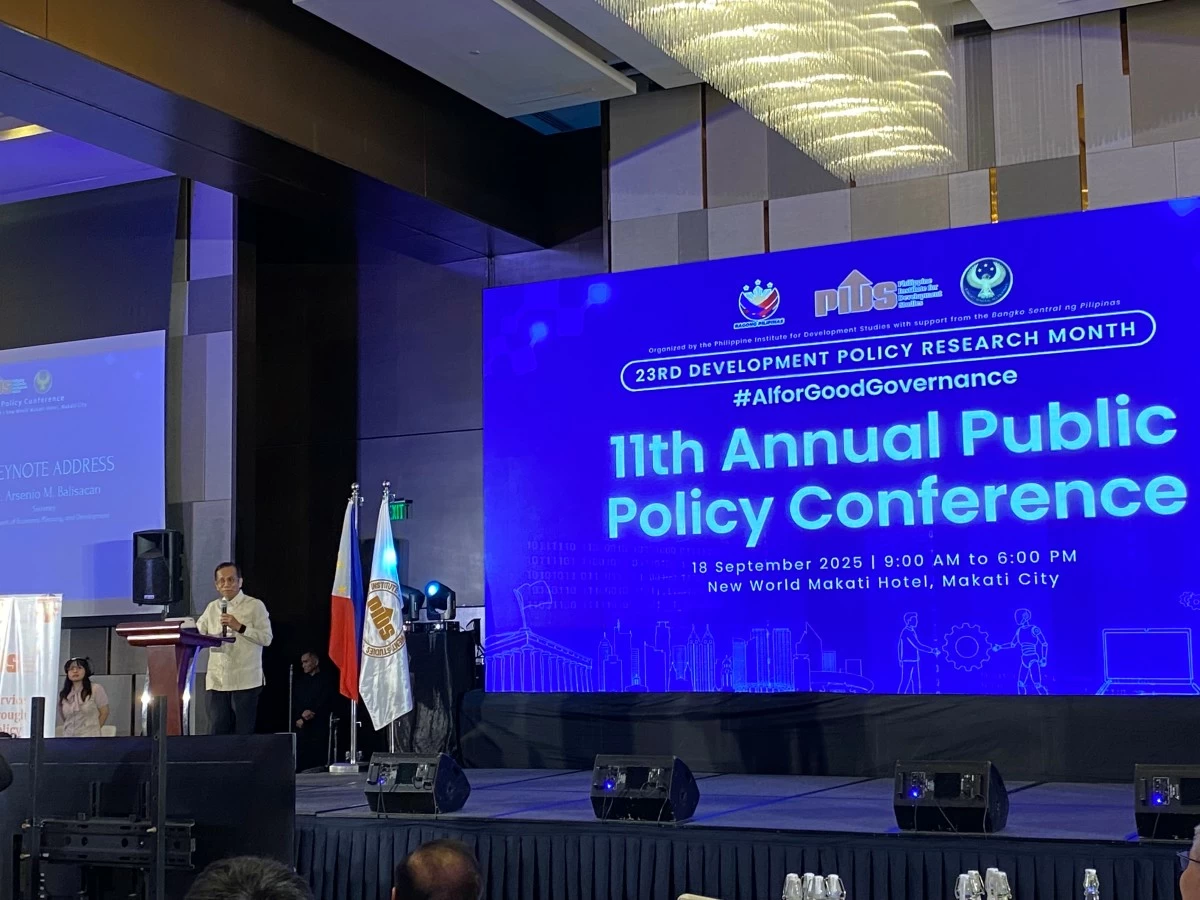
Artificial intelligence (AI) is no longer a distant prospect but a reality shaping economies, transforming governments, and influencing daily life, according to Department of Economy, Planning, and Development (DEPDev) Secretary Arsenio M. Balisacan.
“AI is a tool that can enhance governance, such as by analyzing data,” Balisacan said during the Philippine Institute for Development Studies’ (PIDS) 11th Annual Public Policy Conference on Thursday, Sept. 18.
As there are many valuable applications of AI, Balisacan noted that governments worldwide are already learning to harness AI for smarter services.
Balisacan cited PIDS president Philip Arnold P. Tuaño, who pointed to projections by the Geneva-based World Economic Forum (WEF) that integrating digital technologies into public administration could unlock $9.8 trillion in value by boosting efficiency, transparency, and sustainability.
“The Philippines is prepared to be part of this transformation,” Balisacan said.
He said the National Innovation Agenda and Strategy Document (NIASD) positions innovation as a central driver of growth under the Philippine Development Plan (PDP) 2023-2028, the Marcos Jr. administration’s medium-term socioeconomic blueprint.
The DEPDev chief also pointed out that the country’s digital economy grew from ₱1.6 trillion in 2018 to ₱2.1 trillion in 2024, surpassing many traditional industries.
Additionally, Balisacan noted that the Philippines climbed nine places in the Oxford Global AI Readiness Index in 2024, scoring 58.5, which is well above the global average of 47.6. “These gains affirm that Filipinos are not only adapting technology—we are shaping it to secure our future,” he said.
Balisacan also noted that several government agencies are already pushing AI initiatives.
He emphasized that the Department of Trade and Industry’s (DTI) AI Roadmap 2.0 led to the establishment of the Center for AI Research (CAIR); the Department of Education (DepEd) is integrating AI knowledge into schools; the Department of Science and Technology’s (DOST) Democratized Intelligent Model Exchange Repository (DIMER) project provides ready-to-use AI models for agriculture, disaster response, and industry; and the Department of Information and Communications Technology’s (DICT) Strengthening the Philippine Workforce through Adaptive and Responsive Digital Knowledge (SPARK) initiative, with partners like Google and Coursera, is scaling up free AI training nationwide.
Despite these advances, Balisacan warned that three urgent challenges must be addressed: fragmented governance across agencies, inconsistent data practices that weaken innovation, and a workforce not fully prepared for an AI-driven economy.
“Technology alone cannot fix governance gaps,” Balisacan added.
Balisacan stressed the importance of expanding digital infrastructure through projects like eGovPH, the National Fiber Backbone, satellite internet, and the Konektadong Pinoy Act.
Over 88.5 million Filipinos now have access to the digital national ID, with 55 million physical cards already delivered, Balisacan said.
He added that the National Fiber Backbone links six regions and 70 million people, while satellite services connect remote islands.
Konektadong Pinoy also pushes reforms to boost competition, cut costs, and expand access, ensuring connectivity reaches even the country’s most remote communities, he said.
Balisacan also emphasized investing in people by implementing the National AI Upskilling Roadmap to equip students and workers with in-demand skills.
He also added the importance of governing with ethics and trust by enforcing the DICT-Civil Service Commission (CSC) guidelines on responsible AI use in the government to uphold transparency, accountability, and democracy.
Balisacan pointed to AI’s potential across key sectors: in energy, to optimize power grids while promoting green and efficient practices; in governance, to detect anomalies and curb fraud through stronger oversight systems; and in addressing an aging society, to enhance healthcare and social inclusion with AI-enabled assistive technologies, supported by subsidies and reskilling for older workers.
The DEPDev chief concluded by outlining five commitments: expanding inclusive digital infrastructure, strengthening human capital, enhancing governance with ethics, fostering collaboration across sectors, and ensuring AI narrows divides instead of deepening them.
“The age of AI is not about replacing humanity, it is about enriching it,” Balisacan said. “It is about combining human and artificial intelligence to make governance inclusive, transparent, and resilient.”
“Let us not remain spectators as the world advances. Let us lead with vision, build with purpose, and innovate with heart,” he added.
(Ricardo M. Austria)
ADVERTISEMENT
.most-popular .layout-ratio{ padding-bottom: 79.13%; } @media (min-width: 768px) and (max-width: 1024px) { .widget-title { font-size: 15px !important; } }

{{ articles_filter_1561_widget.title }}

.most-popular .layout-ratio{ padding-bottom: 79.13%; } @media (min-width: 768px) and (max-width: 1024px) { .widget-title { font-size: 15px !important; } }

{{ articles_filter_1562_widget.title }}

.most-popular .layout-ratio{ padding-bottom: 79.13%; } @media (min-width: 768px) and (max-width: 1024px) { .widget-title { font-size: 15px !important; } }

{{ articles_filter_1563_widget.title }}

{{ articles_filter_1564_widget.title }}

.mb-article-details { position: relative; } .mb-article-details .article-body-preview, .mb-article-details .article-body-summary{ font-size: 17px; line-height: 30px; font-family: "Libre Caslon Text", serif; color: #000; } .mb-article-details .article-body-preview iframe , .mb-article-details .article-body-summary iframe{ width: 100%; margin: auto; } .read-more-background { background: linear-gradient(180deg, color(display-p3 1.000 1.000 1.000 / 0) 13.75%, color(display-p3 1.000 1.000 1.000 / 0.8) 30.79%, color(display-p3 1.000 1.000 1.000) 72.5%); position: absolute; height: 200px; width: 100%; bottom: 0; display: flex; justify-content: center; align-items: center; padding: 0; } .read-more-background a{ color: #000; } .read-more-btn { padding: 17px 45px; font-family: Inter; font-weight: 700; font-size: 18px; line-height: 16px; text-align: center; vertical-align: middle; border: 1px solid black; background-color: white; } .hidden { display: none; }
function initializeAllSwipers() { // Get all hidden inputs with cms_article_id document.querySelectorAll('[id^="cms_article_id_"]').forEach(function (input) { const cmsArticleId = input.value; const articleSelector = '#article-' + cmsArticleId + ' .body_images'; const swiperElement = document.querySelector(articleSelector); if (swiperElement && !swiperElement.classList.contains('swiper-initialized')) { new Swiper(articleSelector, { loop: true, pagination: false, navigation: { nextEl: '#article-' + cmsArticleId + ' .swiper-button-next', prevEl: '#article-' + cmsArticleId + ' .swiper-button-prev', }, }); } }); } setTimeout(initializeAllSwipers, 3000); const intersectionObserver = new IntersectionObserver( (entries) => { entries.forEach((entry) => { if (entry.isIntersecting) { const newUrl = entry.target.getAttribute("data-url"); if (newUrl) { history.pushState(null, null, newUrl); let article = entry.target; // Extract metadata const author = article.querySelector('.author-section').textContent.replace('By', '').trim(); const section = article.querySelector('.section-info ').textContent.replace(' ', ' '); const title = article.querySelector('.article-title h1').textContent; // Parse URL for Chartbeat path format const parsedUrl = new URL(newUrl, window.location.origin); const cleanUrl = parsedUrl.host + parsedUrl.pathname; // Update Chartbeat configuration if (typeof window._sf_async_config !== 'undefined') { window._sf_async_config.path = cleanUrl; window._sf_async_config.sections = section; window._sf_async_config.authors = author; } // Track virtual page view with Chartbeat if (typeof pSUPERFLY !== 'undefined' && typeof pSUPERFLY.virtualPage === 'function') { try { pSUPERFLY.virtualPage({ path: cleanUrl, title: title, sections: section, authors: author }); } catch (error) { console.error('ping error', error); } } // Optional: Update document title if (title && title !== document.title) { document.title = title; } } } }); }, { threshold: 0.1 } ); function showArticleBody(button) { const article = button.closest("article"); const summary = article.querySelector(".article-body-summary"); const body = article.querySelector(".article-body-preview"); const readMoreSection = article.querySelector(".read-more-background"); // Hide summary and read-more section summary.style.display = "none"; readMoreSection.style.display = "none"; // Show the full article body body.classList.remove("hidden"); } document.addEventListener("DOMContentLoaded", () => { let loadCount = 0; // Track how many times articles are loaded const offset = [1, 2, 3, 4, 5, 6, 7, 8, 9, 10]; // Offset values const currentUrl = window.location.pathname.substring(1); let isLoading = false; // Prevent multiple calls if (!currentUrl) { console.log("Current URL is invalid."); return; } const sentinel = document.getElementById("load-more-sentinel"); if (!sentinel) { console.log("Sentinel element not found."); return; } function isSentinelVisible() { const rect = sentinel.getBoundingClientRect(); return ( rect.top < window.innerHeight && rect.bottom >= 0 ); } function onScroll() { if (isLoading) return; if (isSentinelVisible()) { if (loadCount >= offset.length) { console.log("Maximum load attempts reached."); window.removeEventListener("scroll", onScroll); return; } isLoading = true; const currentOffset = offset[loadCount]; window.loadMoreItems().then(() => { let article = document.querySelector('#widget_1690 > div:nth-last-of-type(2) article'); intersectionObserver.observe(article) loadCount++; }).catch(error => { console.error("Error loading more items:", error); }).finally(() => { isLoading = false; }); } } window.addEventListener("scroll", onScroll); });

Sign up by email to receive news.