

ADVERTISEMENT

Rapu-Rapu Polymetallic Project receives certificate of Final Relinquishment

First mining project under the Mining Act of 1995 to complete final mine rehabilitation and receive Certificate of Final Relinquishment

Published Sep 17, 2025 08:29 am

At A Glance

  • The Rapu-Rapu Polymetallic Project (RRPP) has achieved a historic milestone in the Philippine mining industry by becoming the first company under Republic Act 7942, or the Philippine Mining Act of 1995, to successfully complete its Final Mine Rehabilitation and/or Decommissioning Plan (FMR/DP).
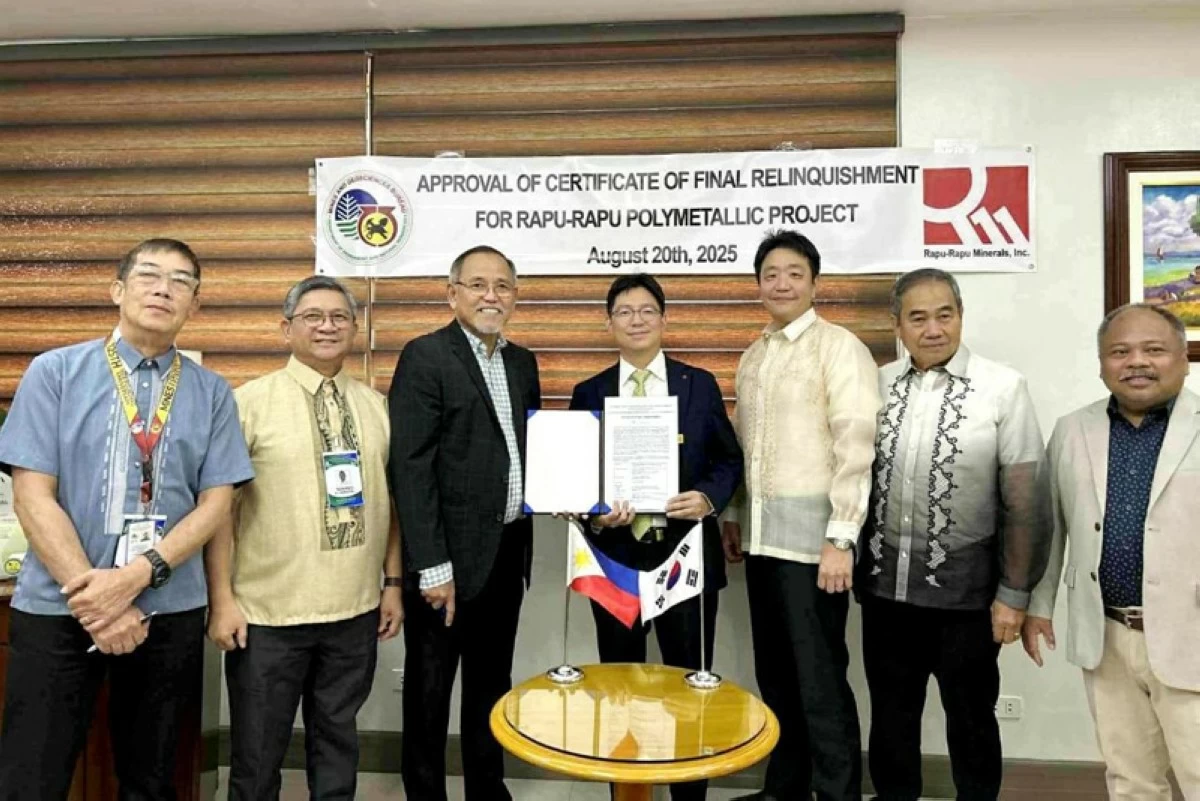
Taken during the signing of the Approval of Certificate of Final Relinquishment for Rapu-Rapu Polymetallic Project. From the left: Engr. Romualdo D. Aguilos, MGB Chief of Mineral Economics, Information and Publication Division; Engr. Teodorico A. Sandoval, OIC Assistant Director; ASEC Engr. Michael V. Cabalda, Assistant Secretary for Mining Concerns and Concurrent OIC-MGB Director; Kwang Min Kim, RRPP Director; Joon Taek Lee, RRPP Chief Operating Officer; Engr. Rogelio E. Corpus, RRPP President; and Engr. Marcial H. Mateo, Chief Mine Safety, Environment and Social Development Division.
The Rapu-Rapu Polymetallic Project (RRPP) has achieved a historic milestone in the Philippine mining industry by becoming the first company under Republic Act 7942, or the Philippine Mining Act of 1995, to successfully complete its Final Mine Rehabilitation and/or Decommissioning Plan (FMR/DP).
The company has officially been awarded the Certificate of Final Relinquishment denominated as 002-2025-01, granted to RRPP1) dated August 20, 2025. The certificate was issued by the Department of Environment and Natural Resources – Mines and Geosciences Bureau (DENR-MGB), following the approval of the company’s Final Rehabilitation Report with third-party Environmental Audit (FRR with EA) conducted by Permata Resources, Inc.
This approval was granted pursuant to the provisions of related law and regulation2), and as per CLRFSC Resolution No. 2025-12, “A Resolution Approving the Final Rehabilitation Report with Third-party Environmental Audit as basis for the issuance of Certificate of Final Relinquishment on the Implementation of the Final Mine Rehabilitation and/or Decommissioning Plan of Rapu-Rapu Polymetallic Project located in Rapu-Rapu Island, Province of Albay.”
The FMR/DP is a comprehensive program that ensures mined-out areas are rehabilitated and restored to a sustainable and environmentally safe condition. By completing this plan, RRPP has demonstrated its commitment to responsible mining and environmental stewardship, fulfilling its legal, social, and environmental obligations even after the cessation of mining operations.
Mr. Joon Taek Lee, Chief Operating Officer (COO) of RRPP and Chief Representative of LX International Manila Office, emphasized the collaborative effort behind this milestone: “This achievement is the result of the collective hard work of our employees, partner communities, and government agencies. It proves that responsible mining does not end when operations stop—it extends to rehabilitation, sustainability, and environmental care. We hope this sets a benchmark for other companies in the mining industry to follow.”
Adding to this, “This achievement reflects not only compliance with the law but also our dedication to leaving a positive legacy for future generations. We are proud to be the first mining company in the Philippines to set this precedent under the Mining Act of 1995,” said Engr. Rogelio E. Corpus, President of RRPP.
The issuance of the Certificate of Final Relinquishment marks the culmination of years of environmental management, rehabilitation work, and close coordination with stakeholders, host communities, and regulatory agencies. It signifies that the company’s former mining areas are now considered safe, stable, and suitable for other productive land uses.
The Rapu-Rapu Polymetallic Project’s achievement serves as a model for the Philippine mining industry, proving that with proper planning, transparency, and responsibility, mining can coexist with sustainable development and environmental protection.

Related Tags

mining
ADVERTISEMENT
.most-popular .layout-ratio{ padding-bottom: 79.13%; } @media (min-width: 768px) and (max-width: 1024px) { .widget-title { font-size: 15px !important; } }

{{ articles_filter_1561_widget.title }}

.most-popular .layout-ratio{ padding-bottom: 79.13%; } @media (min-width: 768px) and (max-width: 1024px) { .widget-title { font-size: 15px !important; } }

{{ articles_filter_1562_widget.title }}

.most-popular .layout-ratio{ padding-bottom: 79.13%; } @media (min-width: 768px) and (max-width: 1024px) { .widget-title { font-size: 15px !important; } }

{{ articles_filter_1563_widget.title }}

{{ articles_filter_1564_widget.title }}

.mb-article-details { position: relative; } .mb-article-details .article-body-preview, .mb-article-details .article-body-summary{ font-size: 17px; line-height: 30px; font-family: "Libre Caslon Text", serif; color: #000; } .mb-article-details .article-body-preview iframe , .mb-article-details .article-body-summary iframe{ width: 100%; margin: auto; } .read-more-background { background: linear-gradient(180deg, color(display-p3 1.000 1.000 1.000 / 0) 13.75%, color(display-p3 1.000 1.000 1.000 / 0.8) 30.79%, color(display-p3 1.000 1.000 1.000) 72.5%); position: absolute; height: 200px; width: 100%; bottom: 0; display: flex; justify-content: center; align-items: center; padding: 0; } .read-more-background a{ color: #000; } .read-more-btn { padding: 17px 45px; font-family: Inter; font-weight: 700; font-size: 18px; line-height: 16px; text-align: center; vertical-align: middle; border: 1px solid black; background-color: white; } .hidden { display: none; }
function initializeAllSwipers() { // Get all hidden inputs with cms_article_id document.querySelectorAll('[id^="cms_article_id_"]').forEach(function (input) { const cmsArticleId = input.value; const articleSelector = '#article-' + cmsArticleId + ' .body_images'; const swiperElement = document.querySelector(articleSelector); if (swiperElement && !swiperElement.classList.contains('swiper-initialized')) { new Swiper(articleSelector, { loop: true, pagination: false, navigation: { nextEl: '#article-' + cmsArticleId + ' .swiper-button-next', prevEl: '#article-' + cmsArticleId + ' .swiper-button-prev', }, }); } }); } setTimeout(initializeAllSwipers, 3000); const intersectionObserver = new IntersectionObserver( (entries) => { entries.forEach((entry) => { if (entry.isIntersecting) { const newUrl = entry.target.getAttribute("data-url"); if (newUrl) { history.pushState(null, null, newUrl); let article = entry.target; // Extract metadata const author = article.querySelector('.author-section').textContent.replace('By', '').trim(); const section = article.querySelector('.section-info ').textContent.replace(' ', ' '); const title = article.querySelector('.article-title h1').textContent; // Parse URL for Chartbeat path format const parsedUrl = new URL(newUrl, window.location.origin); const cleanUrl = parsedUrl.host + parsedUrl.pathname; // Update Chartbeat configuration if (typeof window._sf_async_config !== 'undefined') { window._sf_async_config.path = cleanUrl; window._sf_async_config.sections = section; window._sf_async_config.authors = author; } // Track virtual page view with Chartbeat if (typeof pSUPERFLY !== 'undefined' && typeof pSUPERFLY.virtualPage === 'function') { try { pSUPERFLY.virtualPage({ path: cleanUrl, title: title, sections: section, authors: author }); } catch (error) { console.error('ping error', error); } } // Optional: Update document title if (title && title !== document.title) { document.title = title; } } } }); }, { threshold: 0.1 } ); function showArticleBody(button) { const article = button.closest("article"); const summary = article.querySelector(".article-body-summary"); const body = article.querySelector(".article-body-preview"); const readMoreSection = article.querySelector(".read-more-background"); // Hide summary and read-more section summary.style.display = "none"; readMoreSection.style.display = "none"; // Show the full article body body.classList.remove("hidden"); } document.addEventListener("DOMContentLoaded", () => { let loadCount = 0; // Track how many times articles are loaded const offset = [1, 2, 3, 4, 5, 6, 7, 8, 9, 10]; // Offset values const currentUrl = window.location.pathname.substring(1); let isLoading = false; // Prevent multiple calls if (!currentUrl) { console.log("Current URL is invalid."); return; } const sentinel = document.getElementById("load-more-sentinel"); if (!sentinel) { console.log("Sentinel element not found."); return; } function isSentinelVisible() { const rect = sentinel.getBoundingClientRect(); return ( rect.top < window.innerHeight && rect.bottom >= 0 ); } function onScroll() { if (isLoading) return; if (isSentinelVisible()) { if (loadCount >= offset.length) { console.log("Maximum load attempts reached."); window.removeEventListener("scroll", onScroll); return; } isLoading = true; const currentOffset = offset[loadCount]; window.loadMoreItems().then(() => { let article = document.querySelector('#widget_1690 > div:nth-last-of-type(2) article'); intersectionObserver.observe(article) loadCount++; }).catch(error => { console.error("Error loading more items:", error); }).finally(() => { isLoading = false; }); } } window.addEventListener("scroll", onScroll); });

Sign up by email to receive news.