






Manila Bulletin
 Business
The Stock Market
PSEi jumps on remittance, rate cut hope, JP Morgan index inclusion
Business
The Stock Market
PSEi jumps on remittance, rate cut hope, JP Morgan index inclusion
Business
The Stock Market
PSEi jumps on remittance, rate cut hope, JP Morgan index inclusion
PSEi jumps on remittance, rate cut hope, JP Morgan index inclusion
Published Sep 16, 2025 05:03 pm


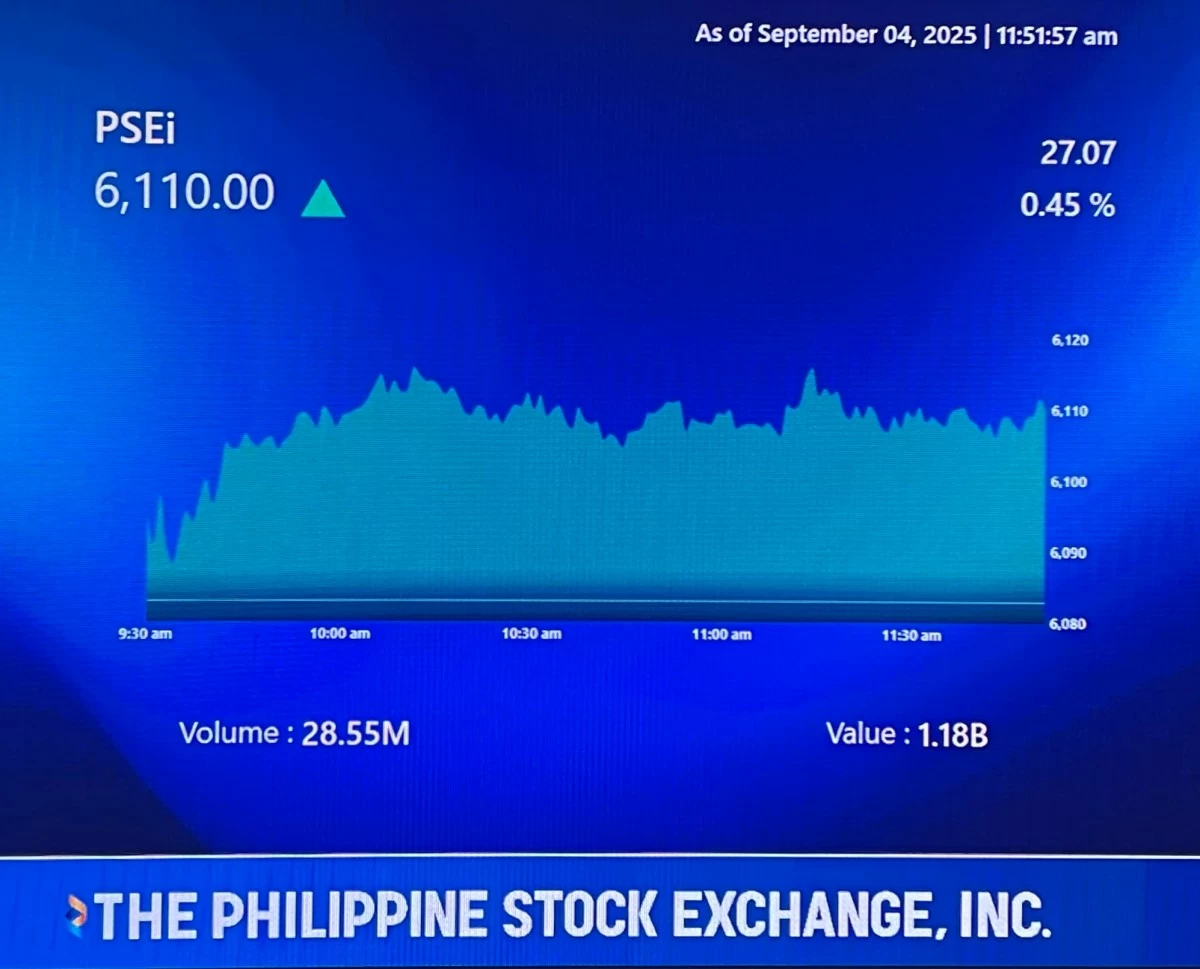
The Philippine Stock Exchange index (PSEi) made a strong bounce on Tuesday, Sept. 16, as investors started bargain hunting, sparked by the possible inclusion of the Philippines in a JPMorgan bond index as well as the expected United States (US) rate cut.
The main index surged by 91.31 points, or 1.51 percent, to close at 6,148.74. Banks led the charge, although the property sector got left behind.
Volume improved slightly to 3.69 billion shares worth ₱6.54 billion, as gainers outnumbered losers—101 to 93, with 59 unchanged.
“After the market closed in the red yesterday, buyers took control of today’s session as bargain hunting persisted,” said Regina Capital Development Corp. managing director Luis Limlingan.
He noted though that, “firm catalysts are still needed to determine whether this marks the beginning of a true market recovery.”
US stocks climbed on Monday, Sept. 15, with the Nasdaq and S&P 500 closing at record highs while the Dow ended just below its peak. Investor sentiment was lifted by expectations of an upcoming interest rate cut from the US Federal Reserve (Fed), which slightly offset the concerns about slowing job growth.
Philstocks Financial research manager Japhet Tantiangco said, “The local market bounced back on the back of the positive cues from Wall Street, the decline in local yields, and the improvement of the peso’s position against the US dollar.”
He added that, “This comes amid hopes of a Fed rate cut in their meeting this week. Investors also digested the Philippines’ latest overseas Filipinos’ cash remittance data, which posted good figures.”
Rizal Commercial Banking Corp. (RCBC) chief economist Michael Ricafort said, “The PSEi corrected higher amid improved market sentiment on the Philippines, which is being considered for inclusion in JPMorgan’s emerging market (EM) government bond index that could help attract more foreign investments, increase liquidity, and lower borrowing costs.”
He also cited the peso, which rose to its best in the week, and the continued growth in overseas Filipino workers’ (OFWs) remittances to the third highest on record on a monthly basis that could still support consumer spending, which accounts for nearly 70 percent of the local economy.