






Manila Bulletin
 Philippines
National
DepEd's 2026 budget breakdown: Where will nearly P1 trillion go?
Philippines
National
DepEd's 2026 budget breakdown: Where will nearly P1 trillion go?
Philippines
National
DepEd's 2026 budget breakdown: Where will nearly P1 trillion go?
DepEd's 2026 budget breakdown: Where will nearly P1 trillion go?
P928.52-billion budget for next year to be spent on classrooms, meals, laptops, and teacher career growth
Published Sep 16, 2025 01:37 pm


At A Glance
- DepEd targets a P928.52-billion 2026 budget for rectifying classroom overcrowding, malnutrition, and resource shortages while funding educational reforms
- Funds will focus on building 4,900 classrooms, expanding feeding programs, equipping teachers with laptops and schools with internet, and fostering teacher career advancement
- To ensure accountability, DepEd will implement monthly dashboards and open platforms for public and legislative scrutiny of its educational initiatives

The Department of Education (DepEd) seeks a P928.52-billion budget for 2026 to build classrooms, fund school meals, provide teacher laptops, and support career growth for educators. (DepEd / MB Visual Content Group)
The Department of Education (DepEd) is eyeing a historic P928.52-billion budget for 2026, the closest the agency has come to breaching the P1-trillion mark.
In a statement issued Tuesday, September 16, DepEd said the proposed allocation will go toward building more classrooms, expanding school-based feeding programs, providing laptops and digital tools, and boosting career opportunities for teachers—key measures aimed at tackling overcrowding, hunger, and resource gaps in the country’s public schools.
Make a tangible impact
DepEd said the proposed budget for 2026, equivalent to four percent of the country’s Gross Domestic Product (GDP), reflects the urgency of addressing overcrowded classrooms, child malnutrition, and resource shortages in public schools while investing in long-term education reforms.
DepEd Secretary Sonny Angara said the proposed allocation, presented to the Senate finance subcommittee, is designed to make a direct impact on learners and teachers nationwide. He also affirmed that “every peso is intended to make a tangible impact.”
“Malaki pa ang hamon na hinaharap natin sa sektor ng edukasyon, ngunit malinaw ang direksyon — bawat pondo ay para sa mga guro at mag-aaral (We still face major challenges in the education sector, but the direction is clear — every fund is for teachers and students),” Angara said.

Backed by President Marcos, DepEd Secretary Sonny Angara emphasizes the urgent need for intensified government support to tackle pressing challenges in the education sector and to lay a stronger foundation for both teachers and learners. (Photo from DepEd)
“Mahalagang puhunan ang suporta ng ating Pangulo at ng ating mga mambabatas upang tugunan ang mga agarang pangangailangan habang binubuo natin ang matibay na pundasyon ng edukasyon (The support of our President and lawmakers is a crucial investment to address urgent needs as we build a strong foundation for education),” he added.
Key allocations in DepEd’s 2026 budget
Angara stressed that government support is vital in meeting immediate needs while strengthening the foundation of education.
DepEd said the proposed budget for 2026 will be used to build more classrooms, improve nutrition initiatives for learners, empower teachers with digital tools, and support the career growth of educators.
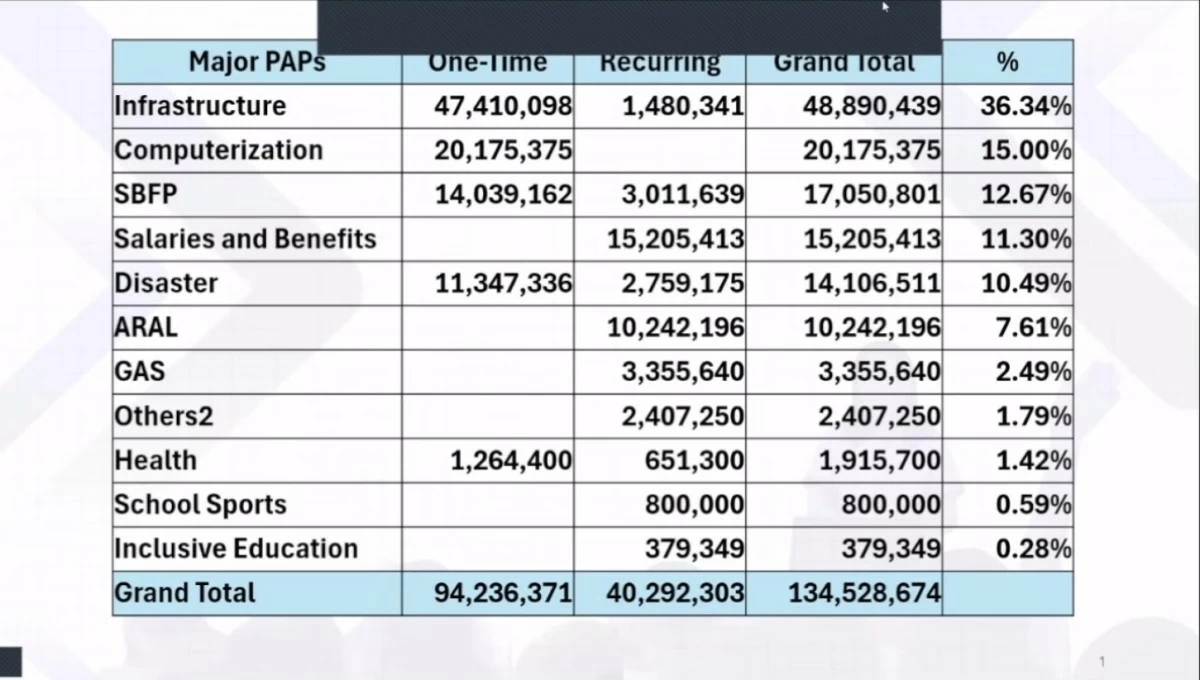
Of the proposed 2026 budget, DepEd said the key allocations include:
- P13.2 billion will fund the construction of nearly 4,900 new classrooms in 2026. DepEd also aims to deliver 40,000 classrooms by 2028 through partnerships with local governments and the private sector.
- P11.8 billion will sustain the School-Based Feeding Program, which provides nutritious meals to all Kindergarten pupils and malnourished Grade 1–6 students.
- P16 billion will go toward laptops for educators and internet connectivity for offline schools, strengthening the digital learning system.
- P6 billion will support the career progression of about 113,000 teachers and school heads, ensuring better livelihood opportunities for educators.
(Courtesy of DepEd)
For DepEd’s attached agencies, the proposed allocations include P840.9 million for the National Museum of the Philippines, P251.1 million for the National Academy of Sports, P207.5 million for the Teacher Education Council, P160.7 million for the Philippine High School for the Arts, P156.6 million for the National Book Development Board, and P72.6 million for the National Council for Children’s Television.
Ensuring transparency and accountability
DepEd said it will use monthly public dashboards and open-government platforms to track the progress of its programs.
These tools will provide real-time updates on classroom construction, meals served, and digital resources distributed, ensuring accountability to lawmakers and the public, DepEd added.
Meanwhile, Angara thanked senators for their support and expressed confidence that Congress will create fiscal space for the proposed budget, calling it a crucial investment in the country’s learners and teachers.
“Ang edukasyon ay hindi natatapos sa isang taon o sa isang budget cycle (Education does not end in a year or within a single budget cycle),” Angara said. “Ito ay pangmatagalang laban na nangangailangan ng matatag na suporta ng pamahalaan, ng pribadong sektor, at ng bawat Pilipino (It is a long-term struggle that requires steadfast support from the government, the private sector, and every Filipino),” he added.
Under the proposed Fiscal Year 2026 national budget, a total of P1.224 trillion has been earmarked for the education sector, marking the first time the Philippines has allocated four percent of its GDP to education in line with the standards set by the United Nations Educational, Scientific, and Cultural Organization (UNESCO).
Based on the 2026 National Expenditure Program (NEP) submitted to Congress, the Department of Education (DepEd) will receive the largest share at P928.52 billion, followed by State Universities and Colleges (SUCs) with P134.99 billion.
Meanwhile, the Commission on Higher Education (CHED) is set to receive P34 billion, and the Technical Education and Skills Development Authority (TESDA) will be allotted P20.24 billion.