ADVERTISEMENT

Bayer highlights Asia-Pacific health innovations targeting diseases affecting Filipino lives

Published Sep 16, 2025 02:18 pm
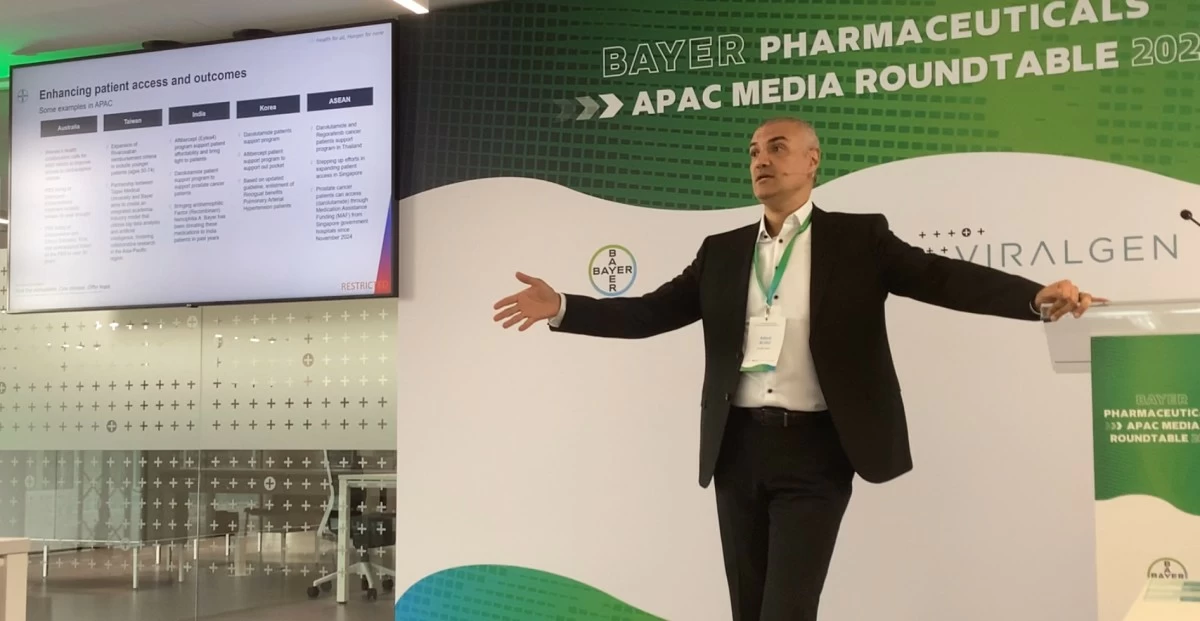
Ashraf Al-Ouf, Head of Pharmaceutical Commercial Operations for Bayer in Asia-Pacific, speaks at Bayer’s annual media roundtable in San Sebastian, Spain on Sept. 15, 2025, where he highlighted the company’s commitment to innovative healthcare solutions. (Ellalyn De Vera-Ruiz)
SPAIN—Global pharmaceutical company Bayer reaffirmed its commitment to addressing rising healthcare challenges in the Asia-Pacific region, including the Philippines, by showcasing its latest medical research and innovations during its annual media roundtable held in San Sebastian.
Bayer executives, along with representatives from the company’s subsidiaries AskBio and Viralgen, presented updates on Bayer’s research and development (R&D) strategy, focusing on cardiovascular diseases, oncology, women’s health, and emerging gene and cell therapies.
According to Bayer, the number of people in the Asia-Pacific region affected by heart failure is expected to rise to 74.5 million by 2050, representing a 127 percent increase from 2025.
In the Philippines, cardiovascular disease remains a leading cause of death, placing a continued burden on the public healthcare system.
“Amid these concerning projections, we are poised to address healthcare needs and bring new therapeutic options for patients across countries in East Asia, South Asia, Southeast Asia, and Oceania,” said Ashraf Al-Ouf, head of Pharmaceutical Commercial Operations for Bayer in Asia-Pacific.
During the event, Bayer showcased the role of its San Sebastián gene therapy facility operated by Viralgen in developing potential treatments for chronic and currently incurable conditions such as congestive heart failure, Parkinson’s disease, and inherited retinal diseases.
AskBio is conducting advanced clinical trials for investigational gene and cell therapies, including those for Parkinson’s disease.
Some of these studies are already underway in Asia-Pacific countries such as Australia.
Bayer also received Fast Track designation from the US Food and Drug Administration (FDA) for a new cell therapy targeting inherited retinal diseases, which is a major step forward in regenerative medicine.
In total, Bayer is conducting 34 clinical trials across the Asia-Pacific region.
Its two major life science incubators, Bayer Co.Lab Kobe (Japan) and Bayer Co.Lab Shanghai (China), are also supporting biotech startups in areas like oncology and advanced therapies.
Access, affordability in the Philippines
While Bayer’s R&D is based in global hubs, the company says its innovations are designed to benefit patients across Asia-Pacific, including the Philippines.
Al-Ouf confirmed that Bayer is working with local patient organizations in the Philippines to raise awareness about critical health issues such as contraception.
The company also has access programs in place for key treatments, including its ophthalmology product for age-related macular degeneration (AMD).
“We have access programs in the Philippines to make our new medications more affordable for many patients,” Al-Ouf said.
“That’s something we are doing across the region, and also specifically in the Philippines,” he added.
Bayer’s product portfolio in the region includes therapies for cancer, eye diseases, women’s health, and diagnostic imaging, with more treatments expected to enter the Philippine market in the coming years.
Among its pipeline updates include a low-dose MRI contrast agent submitted for global regulatory approval; a hormone-free treatment for menopausal symptoms; and a new therapy for advanced prostate cancer.
Eleven journalists from across Asia-Pacific, including the Philippines, visited Bayer’s Viralgen gene therapy facility on Sept. 15–16 to learn firsthand about the company’s innovative technologies and ongoing clinical programs.
Al-Ouf said these advancements align with Bayer’s global mission, “Health for All, Hunger for None,” and reinforce its long-term strategy to invest in local partnerships and tailored healthcare solutions in Asia-Pacific.

Related Tags

BAYER VIRALGEN ASKBIO GENE THERAPY
ADVERTISEMENT
.most-popular .layout-ratio{ padding-bottom: 79.13%; } @media (min-width: 768px) and (max-width: 1024px) { .widget-title { font-size: 15px !important; } }

{{ articles_filter_1561_widget.title }}

.most-popular .layout-ratio{ padding-bottom: 79.13%; } @media (min-width: 768px) and (max-width: 1024px) { .widget-title { font-size: 15px !important; } }

{{ articles_filter_1562_widget.title }}

.most-popular .layout-ratio{ padding-bottom: 79.13%; } @media (min-width: 768px) and (max-width: 1024px) { .widget-title { font-size: 15px !important; } }

{{ articles_filter_1563_widget.title }}

{{ articles_filter_1564_widget.title }}

.mb-article-details { position: relative; } .mb-article-details .article-body-preview, .mb-article-details .article-body-summary{ font-size: 17px; line-height: 30px; font-family: "Libre Caslon Text", serif; color: #000; } .mb-article-details .article-body-preview iframe , .mb-article-details .article-body-summary iframe{ width: 100%; margin: auto; } .read-more-background { background: linear-gradient(180deg, color(display-p3 1.000 1.000 1.000 / 0) 13.75%, color(display-p3 1.000 1.000 1.000 / 0.8) 30.79%, color(display-p3 1.000 1.000 1.000) 72.5%); position: absolute; height: 200px; width: 100%; bottom: 0; display: flex; justify-content: center; align-items: center; padding: 0; } .read-more-background a{ color: #000; } .read-more-btn { padding: 17px 45px; font-family: Inter; font-weight: 700; font-size: 18px; line-height: 16px; text-align: center; vertical-align: middle; border: 1px solid black; background-color: white; } .hidden { display: none; }
function initializeAllSwipers() { // Get all hidden inputs with cms_article_id document.querySelectorAll('[id^="cms_article_id_"]').forEach(function (input) { const cmsArticleId = input.value; const articleSelector = '#article-' + cmsArticleId + ' .body_images'; const swiperElement = document.querySelector(articleSelector); if (swiperElement && !swiperElement.classList.contains('swiper-initialized')) { new Swiper(articleSelector, { loop: true, pagination: false, navigation: { nextEl: '#article-' + cmsArticleId + ' .swiper-button-next', prevEl: '#article-' + cmsArticleId + ' .swiper-button-prev', }, }); } }); } setTimeout(initializeAllSwipers, 3000); const intersectionObserver = new IntersectionObserver( (entries) => { entries.forEach((entry) => { if (entry.isIntersecting) { const newUrl = entry.target.getAttribute("data-url"); if (newUrl) { history.pushState(null, null, newUrl); let article = entry.target; // Extract metadata const author = article.querySelector('.author-section').textContent.replace('By', '').trim(); const section = article.querySelector('.section-info ').textContent.replace(' ', ' '); const title = article.querySelector('.article-title h1').textContent; // Parse URL for Chartbeat path format const parsedUrl = new URL(newUrl, window.location.origin); const cleanUrl = parsedUrl.host + parsedUrl.pathname; // Update Chartbeat configuration if (typeof window._sf_async_config !== 'undefined') { window._sf_async_config.path = cleanUrl; window._sf_async_config.sections = section; window._sf_async_config.authors = author; } // Track virtual page view with Chartbeat if (typeof pSUPERFLY !== 'undefined' && typeof pSUPERFLY.virtualPage === 'function') { try { pSUPERFLY.virtualPage({ path: cleanUrl, title: title, sections: section, authors: author }); } catch (error) { console.error('ping error', error); } } // Optional: Update document title if (title && title !== document.title) { document.title = title; } } } }); }, { threshold: 0.1 } ); function showArticleBody(button) { const article = button.closest("article"); const summary = article.querySelector(".article-body-summary"); const body = article.querySelector(".article-body-preview"); const readMoreSection = article.querySelector(".read-more-background"); // Hide summary and read-more section summary.style.display = "none"; readMoreSection.style.display = "none"; // Show the full article body body.classList.remove("hidden"); } document.addEventListener("DOMContentLoaded", () => { let loadCount = 0; // Track how many times articles are loaded const offset = [1, 2, 3, 4, 5, 6, 7, 8, 9, 10]; // Offset values const currentUrl = window.location.pathname.substring(1); let isLoading = false; // Prevent multiple calls if (!currentUrl) { console.log("Current URL is invalid."); return; } const sentinel = document.getElementById("load-more-sentinel"); if (!sentinel) { console.log("Sentinel element not found."); return; } function isSentinelVisible() { const rect = sentinel.getBoundingClientRect(); return ( rect.top < window.innerHeight && rect.bottom >= 0 ); } function onScroll() { if (isLoading) return; if (isSentinelVisible()) { if (loadCount >= offset.length) { console.log("Maximum load attempts reached."); window.removeEventListener("scroll", onScroll); return; } isLoading = true; const currentOffset = offset[loadCount]; window.loadMoreItems().then(() => { let article = document.querySelector('#widget_1690 > div:nth-last-of-type(2) article'); intersectionObserver.observe(article) loadCount++; }).catch(error => { console.error("Error loading more items:", error); }).finally(() => { isLoading = false; }); } } window.addEventListener("scroll", onScroll); });

Sign up by email to receive news.