ADVERTISEMENT

DSWD: 'Walang Gutom' program encourages productivity, not dependency

Published Sep 12, 2025 10:11 am
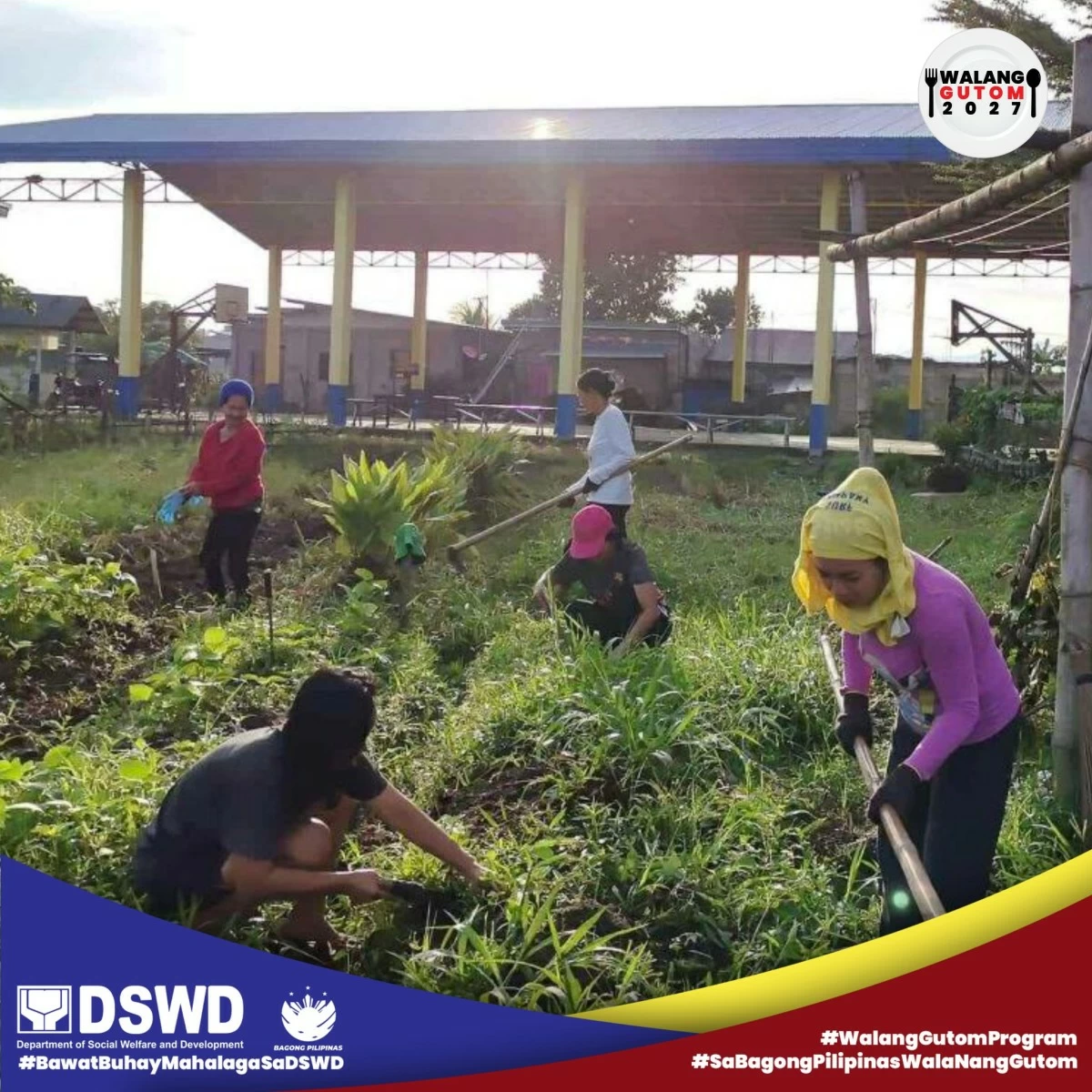
A key part of the Walang Gutom Program’s best practices is the collective gardening effort by beneficiaries in Barangay San Jose, E.B. Magalona, Negros Island Region. They dedicated a plot of land for the WGP Gulayan, where they grow a variety of vegetables. Through this unity, households, especially those in the program, are ensured a steady source of fresh and nutritious food. (DSWD)
The Department of Social Welfare and Development (DSWD) said its flagship “Walang Gutom Program” (WGP) aims to foster self-sufficiency among beneficiaries, not long-term reliance on government aid.
WGP Deputy Program Manager Camille Anne Taguba on Sept. 11 said the program is time-bound and designed to encourage productivity.
“Nire-require po natin sila na magtrabaho. Alam po nila na ang programa ay tatlong taon lamang (We require them to work. They are aware that the program only lasts for three years),” Taguba said.
“Sa current design po ng program, based po sa Executive Order 44, maximum of three years lang sila (Under the current design of the program, based on Executive Order 44, they can only stay for a maximum of three years),” she added.
As part of its conditions, the program requires beneficiaries to attend skills and livelihood training sessions conducted in partnership with the Department of Labor and Employment and the Technical Education and Skills Development Authority, which help facilitate access to job fairs and short-term training programs.
Taguba noted that the program also allows flexibility within households.
“Hindi naman po kailangan na ‘yung mismong head of the family ang mag-attend sa mga enhancement productivity sessions o ang maghanap ng trabaho (It’s not necessary for the head of the family to be the one to attend the productivity enhancement sessions or to look for a job),” she said.
“Kung may isang anak na employable, pwedeng sila ang mag-attend ng mga sessions, trainings upang magkaroon sila ng sustainable livelihoods (If there is an employable child, they can be the one to attend the sessions and trainings so the family can have sustainable livelihoods),” she added.
DSWD plans to expand the program to cover 600,000 families by 2025, with a target of 750,000 households by 2026.
Under the program, beneficiaries receive electronic benefit transfer cards preloaded with P3,000 worth of food credits every month.
These credits are non-convertible to cash and may only be used to purchase food items from registered and accredited partner retailers.
To ensure a balanced and healthy diet, 50 percent of food credits are allocated to carbohydrate-rich foods like rice and bread (P1,500), 30 percent to proteins like chicken or pork (P900), and 20 percent to vegetables, fruits, oil, salt, and condiments (P600).

Related Tags

DSWD WALANG GUTOM PROGRAM
ADVERTISEMENT
.most-popular .layout-ratio{ padding-bottom: 79.13%; } @media (min-width: 768px) and (max-width: 1024px) { .widget-title { font-size: 15px !important; } }

{{ articles_filter_1561_widget.title }}

.most-popular .layout-ratio{ padding-bottom: 79.13%; } @media (min-width: 768px) and (max-width: 1024px) { .widget-title { font-size: 15px !important; } }

{{ articles_filter_1562_widget.title }}

.most-popular .layout-ratio{ padding-bottom: 79.13%; } @media (min-width: 768px) and (max-width: 1024px) { .widget-title { font-size: 15px !important; } }

{{ articles_filter_1563_widget.title }}

{{ articles_filter_1564_widget.title }}

.mb-article-details { position: relative; } .mb-article-details .article-body-preview, .mb-article-details .article-body-summary{ font-size: 17px; line-height: 30px; font-family: "Libre Caslon Text", serif; color: #000; } .mb-article-details .article-body-preview iframe , .mb-article-details .article-body-summary iframe{ width: 100%; margin: auto; } .read-more-background { background: linear-gradient(180deg, color(display-p3 1.000 1.000 1.000 / 0) 13.75%, color(display-p3 1.000 1.000 1.000 / 0.8) 30.79%, color(display-p3 1.000 1.000 1.000) 72.5%); position: absolute; height: 200px; width: 100%; bottom: 0; display: flex; justify-content: center; align-items: center; padding: 0; } .read-more-background a{ color: #000; } .read-more-btn { padding: 17px 45px; font-family: Inter; font-weight: 700; font-size: 18px; line-height: 16px; text-align: center; vertical-align: middle; border: 1px solid black; background-color: white; } .hidden { display: none; }
function initializeAllSwipers() { // Get all hidden inputs with cms_article_id document.querySelectorAll('[id^="cms_article_id_"]').forEach(function (input) { const cmsArticleId = input.value; const articleSelector = '#article-' + cmsArticleId + ' .body_images'; const swiperElement = document.querySelector(articleSelector); if (swiperElement && !swiperElement.classList.contains('swiper-initialized')) { new Swiper(articleSelector, { loop: true, pagination: false, navigation: { nextEl: '#article-' + cmsArticleId + ' .swiper-button-next', prevEl: '#article-' + cmsArticleId + ' .swiper-button-prev', }, }); } }); } setTimeout(initializeAllSwipers, 3000); const intersectionObserver = new IntersectionObserver( (entries) => { entries.forEach((entry) => { if (entry.isIntersecting) { const newUrl = entry.target.getAttribute("data-url"); if (newUrl) { history.pushState(null, null, newUrl); let article = entry.target; // Extract metadata const author = article.querySelector('.author-section').textContent.replace('By', '').trim(); const section = article.querySelector('.section-info ').textContent.replace(' ', ' '); const title = article.querySelector('.article-title h1').textContent; // Parse URL for Chartbeat path format const parsedUrl = new URL(newUrl, window.location.origin); const cleanUrl = parsedUrl.host + parsedUrl.pathname; // Update Chartbeat configuration if (typeof window._sf_async_config !== 'undefined') { window._sf_async_config.path = cleanUrl; window._sf_async_config.sections = section; window._sf_async_config.authors = author; } // Track virtual page view with Chartbeat if (typeof pSUPERFLY !== 'undefined' && typeof pSUPERFLY.virtualPage === 'function') { try { pSUPERFLY.virtualPage({ path: cleanUrl, title: title, sections: section, authors: author }); } catch (error) { console.error('ping error', error); } } // Optional: Update document title if (title && title !== document.title) { document.title = title; } } } }); }, { threshold: 0.1 } ); function showArticleBody(button) { const article = button.closest("article"); const summary = article.querySelector(".article-body-summary"); const body = article.querySelector(".article-body-preview"); const readMoreSection = article.querySelector(".read-more-background"); // Hide summary and read-more section summary.style.display = "none"; readMoreSection.style.display = "none"; // Show the full article body body.classList.remove("hidden"); } document.addEventListener("DOMContentLoaded", () => { let loadCount = 0; // Track how many times articles are loaded const offset = [1, 2, 3, 4, 5, 6, 7, 8, 9, 10]; // Offset values const currentUrl = window.location.pathname.substring(1); let isLoading = false; // Prevent multiple calls if (!currentUrl) { console.log("Current URL is invalid."); return; } const sentinel = document.getElementById("load-more-sentinel"); if (!sentinel) { console.log("Sentinel element not found."); return; } function isSentinelVisible() { const rect = sentinel.getBoundingClientRect(); return ( rect.top < window.innerHeight && rect.bottom >= 0 ); } function onScroll() { if (isLoading) return; if (isSentinelVisible()) { if (loadCount >= offset.length) { console.log("Maximum load attempts reached."); window.removeEventListener("scroll", onScroll); return; } isLoading = true; const currentOffset = offset[loadCount]; window.loadMoreItems().then(() => { let article = document.querySelector('#widget_1690 > div:nth-last-of-type(2) article'); intersectionObserver.observe(article) loadCount++; }).catch(error => { console.error("Error loading more items:", error); }).finally(() => { isLoading = false; }); } } window.addEventListener("scroll", onScroll); });

Sign up by email to receive news.