







Davao City residents benefit from flood control projects
By Ivy Tejano
Published Sep 12, 2025 02:57 pm


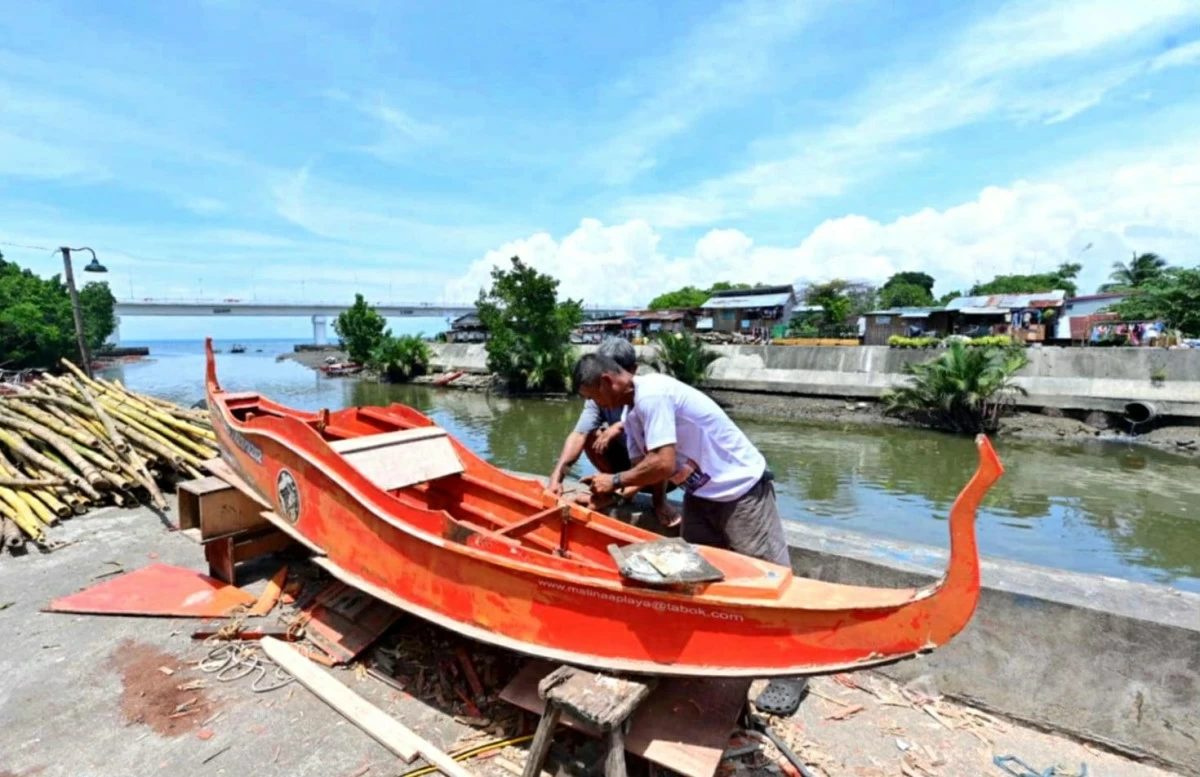
FISHERMEN secure their boats on a dike on a river in Matina Aplaya in Davao City where new mitigation structures have reduced flooding. (Photo via Ivy Tejano)
DAVAO CITY – Despite online criticism that Davao City’s first district continues to suffer from flooding, long-time Bangkal and Matina Aplaya coastal and riverside residents said seawalls and other flood control projects have reduced the problem in their areas.
Fifty-year-old fisherman Jarin Idao of the Muslim Village, a coastal community in Bangkal, said in an interview that he has been a resident in the area for decades. He recalled residents had to evacuate to a church whenever it rained hard here or somewhere in the province.
“The flooding stopped when the government built a seawall to address the flood concern, which I believe is not only here in our village but also in the neighboring area. So far, even with heavy rains, the water no longer reaches us,” Idao said in the vernacular.
Noria Sabai, 64, and Esnera Sadical, 53, residents of the village under Barangay Talomo Proper, shared a similar account. They said the seawall keeps the tides out. Even if the sea rises and the river swells during storms, the water no longer reaches them.
“When it rains in the mountains, the Talomo River’s flow strengthens since it connects to the sea. But if the Matina River, the Talomo River, and the seawater rise simultaneously since they are all connected, I hope it won’t be like what happened in 2011,” Sadical said.
Eighty-seven-year-old Alfonso Bergado remembered the destruction in 2011 before the government built the seawall and dike. “Many houses were swept away when both rivers overflowed into the sea. Now, the water flows well, and I can even tend to my garden without worrying about floods,” he said.
The National Disaster Risk Reduction and Management Council reported a flash flood in Davao City on June 28, 2011, affecting barangays Matina Pangi, Matina Crossing, Talomo Proper, and Matina Aplaya, and noted deaths and casualties due to heavy rains resulting in the rivers overflowing.
In Matina Aplaya, just across the village from Bangkal, where their water flow is already part of the Matina River, 50-year-old fisherman Alexander Eborde recalled how floods once reached chest-level.
He said the flood mitigation structure in Matina Aplaya was of great help to them.
“Before, our boats would get stuck, and we could not fish. Everything was a mess every time it flooded. Now, the water no longer overflows the streets and enters the houses. We can park our boats well without worrying too much and go to sea easily the next day,” Eborde said.
Data from Davao City Disaster Risk Reduction and Management Office presented by the City Engineer’s Office during the city council’s regular session two weeks ago said up to 265 areas in the city are prone to street flooding during heavy rains.
City Engineer OIC Janis Louis Esparcia said the city government has carried out 62 flood control and drainage projects since 2022. About 67 percent of the 265 flood-prone areas are on national roads managed by the DPWH.
The DPWH Davao City District Engineering Office noted that flooding on some downtown streets worsens during high tide because the primary and secondary drainage systems cannot discharge water efficiently.
DPWH Flood Control Unit head Janine May Diente explained that the leading causes of flooding include heavy and prolonged rainfall, insufficient storm drains, and blocked outlets due to debris and sediment accumulation.
The department recommends constructing retarding basins as outlined in the JICA Master Plan, which can temporarily store excess runoff, reduce downstream flooding, and improve overall drainage performance.
Amid criticisms over perceived overspending on flood control nationwide, the DPWH-11 assured that entire Davao City’s allocations are “well-monitored” and diversified across key infrastructure needs.
DPWH-11 spokesperson Dean Ortiz, grateful to the public’s vigilance, explained that the billion-peso budget allotted to the first district alone from 2020 to 2022 funded diverse infrastructure projects, not only flood control, addressing reports scrutinized in recent inquiries.
Official records from the DPWH Davao City District Engineering Office showed that the first district, under the leadership of Rep. Paolo Duterte, only received P49.8 billion in infrastructure allocations, including for the “big-ticket projects,” from 2020 to 2022.
In an interview with GMA Regional TV on Wednesday, Sept. 10, Ortiz confirmed the amount funded for 710 infrastructure projects, most of which were considered “big-ticket” infrastructure developments, rather than purely flood control systems.
He noted that for the Davao Coastal Road, the department received P15.3 billion from 2020 to 2022, spread across three years for the ongoing project. The Maa-Magtuod Flyover had a P2-billion budget, and the Ulas Viaduct had a P2.7-billion budget.
“Of the three-year budget, only P8 billion went to flood control,” Ortiz said. “Between 2016 and 2022, the district received a total of P68.6 billion for 1,221 projects, but just 206 of those — worth P10.5 billion — were for flood control, a small portion compared to other infrastructure works.”
The ongoing Davao City Coastal Road and Maa-Magtuod flyover projects are among the most significant developments still under construction, with DPWH-11 maintaining that these investments aim to address mobility and other infrastructure mitigation challenges in the city.
Ortiz said they plan to complete the flyover structure by the first quarter of 2026. The Maa-Magtuod Flyover has been fully funded since 2022, with 82.5 percent of civil works already completed.
The DPWH-11 assured the public that Davao City’s infrastructure projects, including bypass roads, bridges, and public buildings, are closely supervised by the department, especially those concerning flood control, which remains a hot national issue.
Rep. Duterte on Tuesday, Sept. 9, slammed the House infrastructure committee for diverting its investigation on anomalous flood control projects to the P51-billion infrastructure allocation for his district during the term of his father, former President Rodrigo Duterte.
The Davao City lawmaker specifically criticized Rep. Joel Chua of Manila, among others, saying they used the Duterte family and Davao City as diversions to cover up irregularities involving other government officials.
“Corruption is right before you, but you still keep looking for Duterte,” Rep. Duterte said. “Stop dragging my family to cover up your mess. Focus on the real issues—flood control anomalies, payola, and the officials who admitted they bribed.”
Rep. Duterte challenged Congress members to disclose their budget allocations and show projects in their districts. “Let the people see who really serves and who steals,” he said, adding that all projects funded for Davao were “visible, built, and used by the people.”
DPWH Undersecretary Maria Catalina Cabral said at the hearing that around P51 billion was allocated to Davao City’s congressional district in 2020, 2021, and 2022—during the final term of former President Duterte—sparking questions on supposed “favoritism” in infrastructure funding.
Chua began his questioning of Cabral by citing a 2024 Politiko report, which she affirmed, stating that Rep. Duterte’s district received P51 billion in allocations from 2020 to 2022—a period he pointed out coincided with the height of the pandemic. Cabral added she would check their records.
Rep. Duterte called on government officials to be transparent about alleged ghost flood control projects, warning taxpayers nationwide deserve accountability for every peso spent. “If there are really ghost projects, let’s show them to the public