ADVERTISEMENT

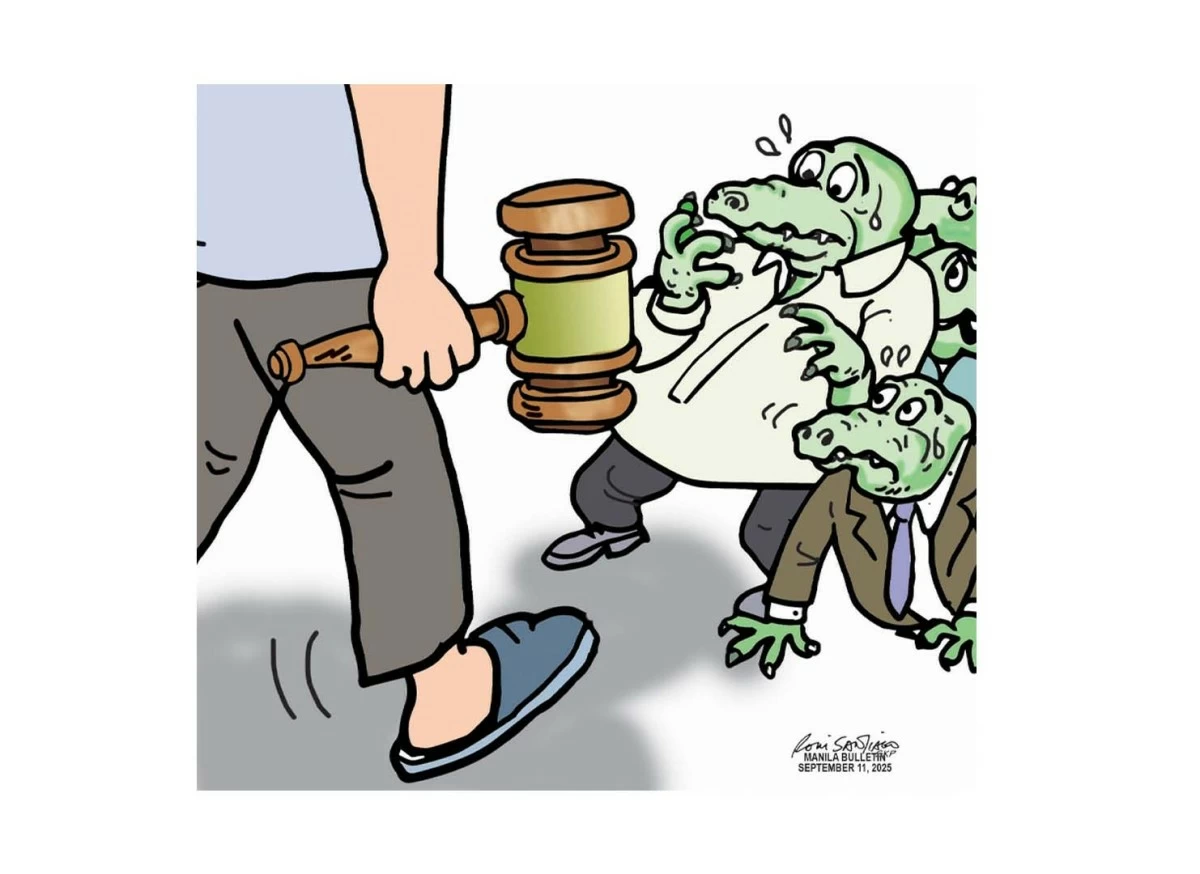
Flood of corruption: Filipino people demand accountability and justice

Published Sep 11, 2025 12:01 am  |  Updated Sep 11, 2025 08:08 am
We have reached the tipping point. The Filipino people no longer merely expect accountability — they demand it. The latest revelations of massive corruption in the Department of Public Works and Highways (DPWH), in-volving so-called "ghost" flood control projects, have shaken public trust to its core.
More than 100 anomalous flood control projects across the country have been reported in just one week into the agency’s internal investigation led by newly-installed Secretary Vince Dizon. Some are not just reports of substandard work — they are of non-existent projects, paid for in full, with no concrete laid, no canals built. Public money — hundreds of millions of pesos — vanished, while communities remain vulnerable to flooding.
Secretary Dizon’s candid admission of the agency’s chaos has only confirmed what citizens have long sus-pected: this isn’t a case of a few bad actors. It is an entrenched system of plunder. As Dizon puts it, the situation is “overwhelming” — and for good reason. The scale and audacity of the corruption are breathtaking, if not heartbreaking for taxpayers earning only enough to give their families food, shelter and education.
Then came Senator Panfilo Lacson’s bombshell on Tuesday. In a privilege speech titled “Flooded Gates of Hell,” he not only revealed more cases of ghost projects and falsified documents, but also money-laundering schemes in casinos. He also unmasked a group of DPWH insiders who frequent casinos, and based on records obtained from the Philippine Amusement and Gaming Corporation (PAGCOR), had incurred gross losses of ₱950 million in casinos across Metro Manila, Cebu, and Pampanga. Despite these staggering losses, they also report-ed massive winnings, which Lacson suggested may have been part of a money-laundering scheme. Mind-boggling, to say the least, was the Lacson's report that they had turned ₱1.4 billion cash to chips, and ₱1.38 bil-lion chips to cash.
The people’s outrage is now reaching a dangerous boil. This isn’t just about stolen money — it’s about be-trayal. We are told that the taxes we pay are the lifeblood of the nation. But what happens when that lifeblood is siphoned off by the very people sworn to serve? What happens when the rule-followers — the taxpayers — are left dry, while rule-breakers enrich themselves with impunity?
The insult is just as cutting as the injury. These crimes were carried out in broad daylight, in collusion with contractors, engineers, and possibly higher-ups. And worse, these acts were committed with the belief that nothing would happen — that no real consequence would follow. We’ve seen the pattern before: exposés grab headlines, hearings are televised, speeches are made — and then, silence.
This time, the cycle must break.
President Marcos has promised that he will establish an independent commission to investigate these anomalies — free of politicians, armed with subpoena powers, and composed of lawyers and investigators. He insists this will be a “technical exercise,” not a political performance. The question now is: Will this body be empowered enough to break past bureaucratic inertia and pursue real justice?
The people are watching. The evidence is mounting. The anger is growing. What happens next will define this administration’s integrity.
Accountability must no longer be postponed. Public officials, engineers, contractors — anyone found guilty of orchestrating or benefiting from these schemes — must be removed, prosecuted, and held financially liable. The government must also revisit the Procurement Law and Anti-Money Laundering regulations to close the loopholes exploited in these schemes.
This is not a time for shallow reforms or scapegoats. It is time for systemic change.
ADVERTISEMENT
.most-popular .layout-ratio{ padding-bottom: 79.13%; } @media (min-width: 768px) and (max-width: 1024px) { .widget-title { font-size: 15px !important; } }

{{ articles_filter_1561_widget.title }}

.most-popular .layout-ratio{ padding-bottom: 79.13%; } @media (min-width: 768px) and (max-width: 1024px) { .widget-title { font-size: 15px !important; } }

{{ articles_filter_1562_widget.title }}

.most-popular .layout-ratio{ padding-bottom: 79.13%; } @media (min-width: 768px) and (max-width: 1024px) { .widget-title { font-size: 15px !important; } }

{{ articles_filter_1563_widget.title }}

{{ articles_filter_1564_widget.title }}

.mb-article-details { position: relative; } .mb-article-details .article-body-preview, .mb-article-details .article-body-summary{ font-size: 17px; line-height: 30px; font-family: "Libre Caslon Text", serif; color: #000; } .mb-article-details .article-body-preview iframe , .mb-article-details .article-body-summary iframe{ width: 100%; margin: auto; } .read-more-background { background: linear-gradient(180deg, color(display-p3 1.000 1.000 1.000 / 0) 13.75%, color(display-p3 1.000 1.000 1.000 / 0.8) 30.79%, color(display-p3 1.000 1.000 1.000) 72.5%); position: absolute; height: 200px; width: 100%; bottom: 0; display: flex; justify-content: center; align-items: center; padding: 0; } .read-more-background a{ color: #000; } .read-more-btn { padding: 17px 45px; font-family: Inter; font-weight: 700; font-size: 18px; line-height: 16px; text-align: center; vertical-align: middle; border: 1px solid black; background-color: white; } .hidden { display: none; }
function initializeAllSwipers() { // Get all hidden inputs with cms_article_id document.querySelectorAll('[id^="cms_article_id_"]').forEach(function (input) { const cmsArticleId = input.value; const articleSelector = '#article-' + cmsArticleId + ' .body_images'; const swiperElement = document.querySelector(articleSelector); if (swiperElement && !swiperElement.classList.contains('swiper-initialized')) { new Swiper(articleSelector, { loop: true, pagination: false, navigation: { nextEl: '#article-' + cmsArticleId + ' .swiper-button-next', prevEl: '#article-' + cmsArticleId + ' .swiper-button-prev', }, }); } }); } setTimeout(initializeAllSwipers, 3000); const intersectionObserver = new IntersectionObserver( (entries) => { entries.forEach((entry) => { if (entry.isIntersecting) { const newUrl = entry.target.getAttribute("data-url"); if (newUrl) { history.pushState(null, null, newUrl); let article = entry.target; // Extract metadata const author = article.querySelector('.author-section').textContent.replace('By', '').trim(); const section = article.querySelector('.section-info ').textContent.replace(' ', ' '); const title = article.querySelector('.article-title h1').textContent; // Parse URL for Chartbeat path format const parsedUrl = new URL(newUrl, window.location.origin); const cleanUrl = parsedUrl.host + parsedUrl.pathname; // Update Chartbeat configuration if (typeof window._sf_async_config !== 'undefined') { window._sf_async_config.path = cleanUrl; window._sf_async_config.sections = section; window._sf_async_config.authors = author; } // Track virtual page view with Chartbeat if (typeof pSUPERFLY !== 'undefined' && typeof pSUPERFLY.virtualPage === 'function') { try { pSUPERFLY.virtualPage({ path: cleanUrl, title: title, sections: section, authors: author }); } catch (error) { console.error('ping error', error); } } // Optional: Update document title if (title && title !== document.title) { document.title = title; } } } }); }, { threshold: 0.1 } ); function showArticleBody(button) { const article = button.closest("article"); const summary = article.querySelector(".article-body-summary"); const body = article.querySelector(".article-body-preview"); const readMoreSection = article.querySelector(".read-more-background"); // Hide summary and read-more section summary.style.display = "none"; readMoreSection.style.display = "none"; // Show the full article body body.classList.remove("hidden"); } document.addEventListener("DOMContentLoaded", () => { let loadCount = 0; // Track how many times articles are loaded const offset = [1, 2, 3, 4, 5, 6, 7, 8, 9, 10]; // Offset values const currentUrl = window.location.pathname.substring(1); let isLoading = false; // Prevent multiple calls if (!currentUrl) { console.log("Current URL is invalid."); return; } const sentinel = document.getElementById("load-more-sentinel"); if (!sentinel) { console.log("Sentinel element not found."); return; } function isSentinelVisible() { const rect = sentinel.getBoundingClientRect(); return ( rect.top < window.innerHeight && rect.bottom >= 0 ); } function onScroll() { if (isLoading) return; if (isSentinelVisible()) { if (loadCount >= offset.length) { console.log("Maximum load attempts reached."); window.removeEventListener("scroll", onScroll); return; } isLoading = true; const currentOffset = offset[loadCount]; window.loadMoreItems().then(() => { let article = document.querySelector('#widget_1690 > div:nth-last-of-type(2) article'); intersectionObserver.observe(article) loadCount++; }).catch(error => { console.error("Error loading more items:", error); }).finally(() => { isLoading = false; }); } } window.addEventListener("scroll", onScroll); });

Sign up by email to receive news.