

ADVERTISEMENT

UN chief argues that investing in fighting poverty instead of wars would make a more secure world

Published Sep 10, 2025 09:53 am
UNITED NATIONS (AP) — Soaring global military expenditures are reducing essential investments in health, education and job creation and don't guarantee peace, the United Nations chief warned on Tuesday.
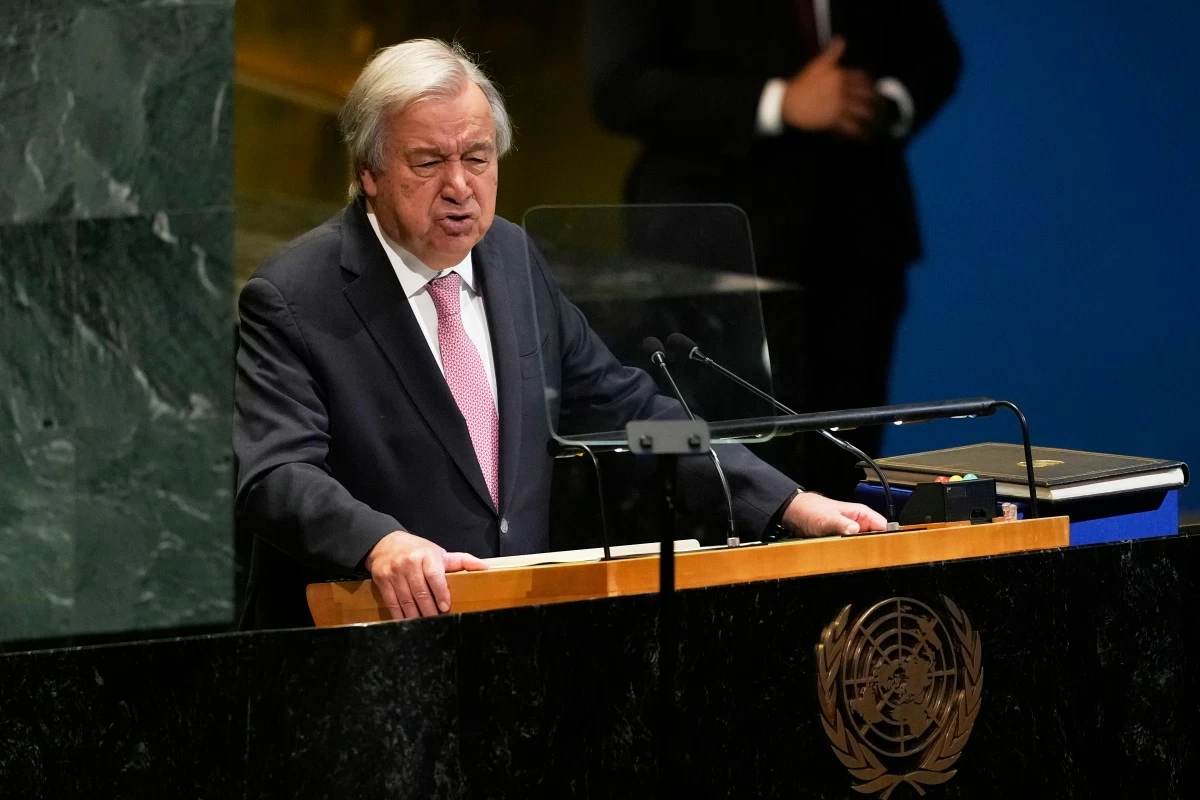
United Nations Secretary-General Antonio Guterres speaks at United Nations headquarters, Tuesday, Sept. 9, 2025. (AP Photo/Seth Wenig)
Secretary-General Antonio Guterres said the evidence is clear that heavy military spending often undermines peace by "fueling arms races, deepening mistrust and diverting resources from the very foundations of stability."
With military spending surging to a record $2.7 trillion following a decade-long military build-up, the U.N. studied the impact on U.N. development goals for 2030. The resulting report, "The Security We Need: Rebalancing Military Spending for a Sustainable and Peaceful Future," is expected to be discussed at the annual meeting of world leaders at the General Assembly starting Sept. 22.
The 17 goals adopted by world leaders in 2015 include ending global hunger, promoting good health and providing quality education for every child, while reducing inequalities in the world. In his July report on the status of the goals in 2025, Guterres said only 35% of them are on track.
He said Tuesday his report is a call to action to rebalance global budgets and spending, stressing that the current trajectory of military spending is "unsustainable."
"A more secure world begins by investing at least as much in fighting poverty as we do in fighting wars," Guterres told U.N. reporters.
His report said that, according to the Stockholm International Peace Research Institute, last year's $2.7 trillion in global military spending is projected to reach $6.6 trillion by 2035 if current trends persist. And increased military spending is widespread, with more than 100 countries boosting expenditures last year.
"Redirecting even a fraction of today's military spending could close vital gaps," Guterres said, "Putting children in school, strengthening primary health care, expanding clean energy and resilient infrastructure, and protecting the most vulnerable."
Only $93 million — less than 4% of the $2.7 trillion in military spending last year — is needed annually to end hunger by 2030, the report said. And $5 trillion could fund 12 years of quality education for every child in low- and lower-middle-income countries.
While $1 billion in military spending can create approximately 11,200 jobs in the military, the report said the same amount of money can create 26,700 jobs in education, 16,800 in clean energy and 17,200 in health care.
U.N. disarmament chief Izumi Nakamitsu told reporters that "rebalancing global priorities is not optional – it is an imperative for humanity's survival."
Haoliang Xu, the U.N. Development Program's acting administrator, stressed that development is indispensable for maintaining international peace and security.
"When people live healthy, educated and fulfilling lives in dignity, their societies are often more peaceful," he said. "And vice versa, societies with high poverty rates and underdevelopment often experience insecurity and violent conflicts."
Nakamitsu was asked how the U.N. can convince countries to reduce their military spending and spend more on improving the lives of the world's more than 8 billion people. "There is no one single silver bullet," she said.
The aim of the report, Nakamitsu said, is to start a very serious conversation by the U.N.'s 193 member nations, and in the public, on rethinking how global security can be achieved by investing more in development and economic growth.

Related Tags

World news
ADVERTISEMENT
.most-popular .layout-ratio{ padding-bottom: 79.13%; } @media (min-width: 768px) and (max-width: 1024px) { .widget-title { font-size: 15px !important; } }

{{ articles_filter_1561_widget.title }}

.most-popular .layout-ratio{ padding-bottom: 79.13%; } @media (min-width: 768px) and (max-width: 1024px) { .widget-title { font-size: 15px !important; } }

{{ articles_filter_1562_widget.title }}

.most-popular .layout-ratio{ padding-bottom: 79.13%; } @media (min-width: 768px) and (max-width: 1024px) { .widget-title { font-size: 15px !important; } }

{{ articles_filter_1563_widget.title }}

{{ articles_filter_1564_widget.title }}

.mb-article-details { position: relative; } .mb-article-details .article-body-preview, .mb-article-details .article-body-summary{ font-size: 17px; line-height: 30px; font-family: "Libre Caslon Text", serif; color: #000; } .mb-article-details .article-body-preview iframe , .mb-article-details .article-body-summary iframe{ width: 100%; margin: auto; } .read-more-background { background: linear-gradient(180deg, color(display-p3 1.000 1.000 1.000 / 0) 13.75%, color(display-p3 1.000 1.000 1.000 / 0.8) 30.79%, color(display-p3 1.000 1.000 1.000) 72.5%); position: absolute; height: 200px; width: 100%; bottom: 0; display: flex; justify-content: center; align-items: center; padding: 0; } .read-more-background a{ color: #000; } .read-more-btn { padding: 17px 45px; font-family: Inter; font-weight: 700; font-size: 18px; line-height: 16px; text-align: center; vertical-align: middle; border: 1px solid black; background-color: white; } .hidden { display: none; }
function initializeAllSwipers() { // Get all hidden inputs with cms_article_id document.querySelectorAll('[id^="cms_article_id_"]').forEach(function (input) { const cmsArticleId = input.value; const articleSelector = '#article-' + cmsArticleId + ' .body_images'; const swiperElement = document.querySelector(articleSelector); if (swiperElement && !swiperElement.classList.contains('swiper-initialized')) { new Swiper(articleSelector, { loop: true, pagination: false, navigation: { nextEl: '#article-' + cmsArticleId + ' .swiper-button-next', prevEl: '#article-' + cmsArticleId + ' .swiper-button-prev', }, }); } }); } setTimeout(initializeAllSwipers, 3000); const intersectionObserver = new IntersectionObserver( (entries) => { entries.forEach((entry) => { if (entry.isIntersecting) { const newUrl = entry.target.getAttribute("data-url"); if (newUrl) { history.pushState(null, null, newUrl); let article = entry.target; // Extract metadata const author = article.querySelector('.author-section').textContent.replace('By', '').trim(); const section = article.querySelector('.section-info ').textContent.replace(' ', ' '); const title = article.querySelector('.article-title h1').textContent; // Parse URL for Chartbeat path format const parsedUrl = new URL(newUrl, window.location.origin); const cleanUrl = parsedUrl.host + parsedUrl.pathname; // Update Chartbeat configuration if (typeof window._sf_async_config !== 'undefined') { window._sf_async_config.path = cleanUrl; window._sf_async_config.sections = section; window._sf_async_config.authors = author; } // Track virtual page view with Chartbeat if (typeof pSUPERFLY !== 'undefined' && typeof pSUPERFLY.virtualPage === 'function') { try { pSUPERFLY.virtualPage({ path: cleanUrl, title: title, sections: section, authors: author }); } catch (error) { console.error('ping error', error); } } // Optional: Update document title if (title && title !== document.title) { document.title = title; } } } }); }, { threshold: 0.1 } ); function showArticleBody(button) { const article = button.closest("article"); const summary = article.querySelector(".article-body-summary"); const body = article.querySelector(".article-body-preview"); const readMoreSection = article.querySelector(".read-more-background"); // Hide summary and read-more section summary.style.display = "none"; readMoreSection.style.display = "none"; // Show the full article body body.classList.remove("hidden"); } document.addEventListener("DOMContentLoaded", () => { let loadCount = 0; // Track how many times articles are loaded const offset = [1, 2, 3, 4, 5, 6, 7, 8, 9, 10]; // Offset values const currentUrl = window.location.pathname.substring(1); let isLoading = false; // Prevent multiple calls if (!currentUrl) { console.log("Current URL is invalid."); return; } const sentinel = document.getElementById("load-more-sentinel"); if (!sentinel) { console.log("Sentinel element not found."); return; } function isSentinelVisible() { const rect = sentinel.getBoundingClientRect(); return ( rect.top < window.innerHeight && rect.bottom >= 0 ); } function onScroll() { if (isLoading) return; if (isSentinelVisible()) { if (loadCount >= offset.length) { console.log("Maximum load attempts reached."); window.removeEventListener("scroll", onScroll); return; } isLoading = true; const currentOffset = offset[loadCount]; window.loadMoreItems().then(() => { let article = document.querySelector('#widget_1690 > div:nth-last-of-type(2) article'); intersectionObserver.observe(article) loadCount++; }).catch(error => { console.error("Error loading more items:", error); }).finally(() => { isLoading = false; }); } } window.addEventListener("scroll", onScroll); });

Sign up by email to receive news.