








“Here in Naneng, we don’t greet each other ‘good morning,’” Tabuk City Acting Supervising Tourism Officer Marjorie Amla-Lingbawan said in Tagalog. “When we greet someone, we say, ‘Have some coffee!”
About 45 minutes away by car from Tabuk City proper, Naneng Heritage Village is the oldest village in Tabuk. Established in the 1920s, it was once its seat of Tabuk’s municipal government.
A Naneng welcome
Visitors begin their visit at the Barangay Hall, where they are greeted by young men and women who perform traditional Kalinga dances, which culminates in an invitation for guests to join in. There might be snacks, but there will most definitely be coffee, which is drunk like water in Naneng.
On this particular visit, guests were served the local version of inandila, Kalinga’s most popular rice cake served in banana leaves and topped with toasted coconut, or latik. The rice cake takes its name from “inang dila,” or “mother tongue,” because of its tongue-like shape. Amla-Lingbawan explained that Naneng’s version is different, as the rice cake is thinner and it is topped with more latik, and that it traditionally takes hours to make, involving men and women from the community.
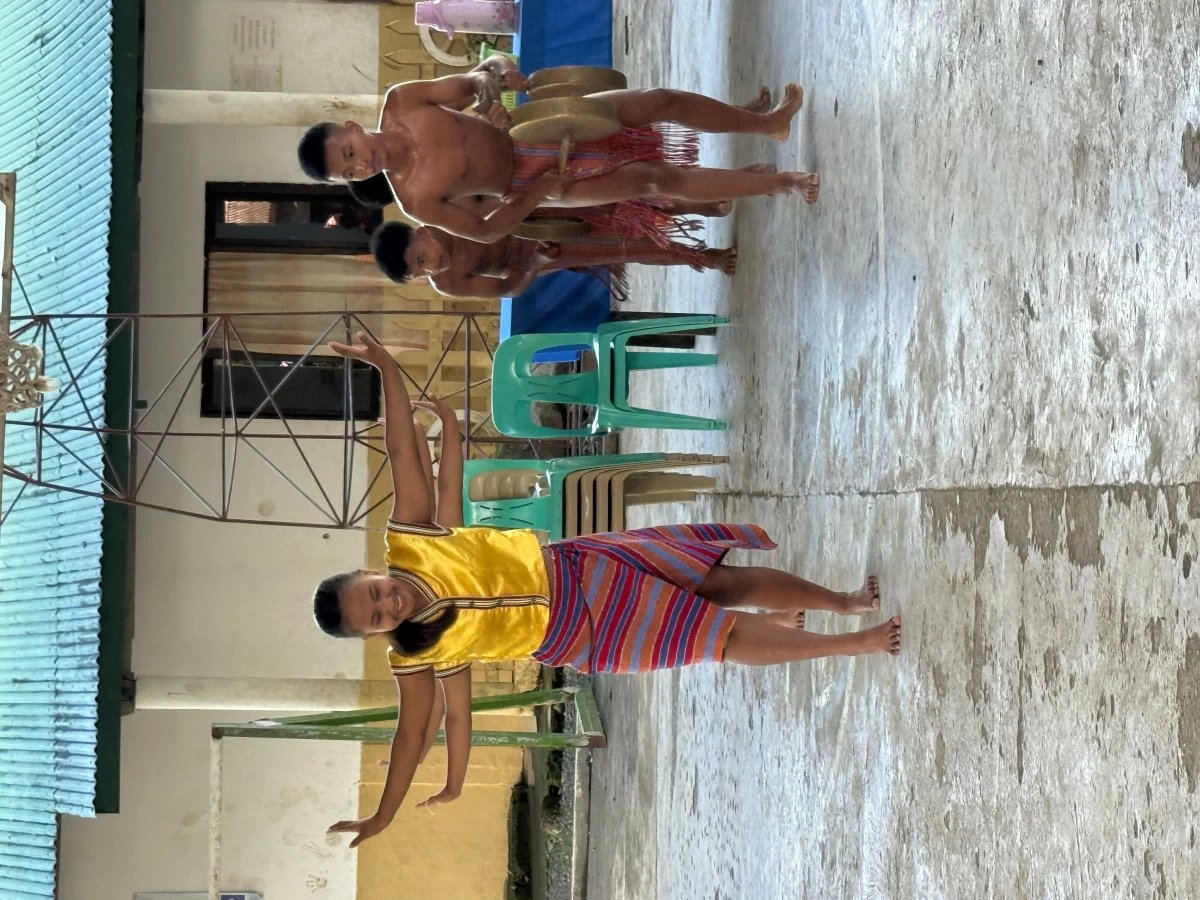
Children are taught Kalinga’s traditional dances in school as a way to preserve their culture. (Yvette Tan)
Naneng is so well-known for its inandila that they celebrate an Inandila Festival every April. The event draws around 10,000 people, all of whom congregate around tables of inandila laid out almost across the entire village.
Also available were what they called carabao bananas, foraged bananas as big as an early 2000s mobile phone. They looked like saba but tasted like lakatan. There were local goods for sale, including suka na basi, or vinegar made from sugarcane, coffee beans (of course), and woven textiles.
Naneng is very proud of its weaving culture. Visitors can witness and experience traditional backstrap weaving, where yarn is held taut by anchoring one end to a structure and having the other end wrap around the weaver’s waist. Naneng is known for their unique designs, called Laktob for men and Gittot for women. It can take one to two weeks to make a Ginamat, Kalinga’s traditional wraparound skirt, which is why they can be costly. “We want to protect this because it’s disappearing,” Amla-Lingbawa said.
Keeping tradition alive
Exiting the Barangay Hall, visitors are welcomed into the village proper. There is a main road with houses called Ginitob on the side, dating back to when the village was established. The two-storey houses are a combination of traditional Kalinga hardwood stilt houses on top and cement structures below. Amla-Lingbawa explained that they were designed by the Missionaries of the Congregatio Immaculati Cordis Mariae (Congregation of the Immaculate Heart of Mary), the Belgian congregation that also established St. Louis University in Baguio City.

Guests can witness traditional backstrap weaving. (MJ Suayan)
Some of the houses are available for homestay, with the entire village able to accommodate 40-50 people. This can be arranged through the Tabuk Tourism Office. “We can hold a bonfire. Sometimes we teach them our dances and hold storytelling sessions,” Amla-Lingbawa said. Depending on the package, visitors may also experience traditional activities such as crafts and coffee processing.
Naneng is also home to St. Joseph Catholic Church, the oldest church in Tabuk. First built in 1927 in Sitio Macapel, its current structure dates back to the 1930s. Beside are the graves of Fr. Leon Lindemans and Fr. Miguel Vays the church’s first two parish priests.
History amidst nature
A further walk down the main street will take visitors to the Naneng Mini Park and the Dawwang Spring. The park is parallel to the Chico River, which is a popular whitewater rafting spot, and was also a site of controversy in the 1970s, when initial plans to build what is now the Chico River Dam would have wiped out several villages in Bontoc and Kalinga, Naneng included. Residents proudly talk about how their elders resisted this encroachment to their traditional domain, and how Naneng still exists now because of their bravery.
Also visible from the park is Mount Mating-oy Dinayao, also called Sleeping Beauty Mountain. Aside from being a popular hiking destination, Amla-Lingbawa said that Emilio Aguinaldo may have passed through the mountain ridge on his way to Palanan, Isabela, where he was later captured by the Americans.
“We’re very proud of our culture, and we teach it to our children. We teach them the dances in school so the art doesn’t disappear,” Amla-Lingbawa said. “We also want to protect our weaving because our weavers are old and once they’re gone, our traditional weaving will go with them.”
If there’s one thing she wants outsiders to know about Naneng, it’s that they’re very proud of their hospitality. “You can walk down the street with a cup of coffee in hand,” she said. “The visitor of one person is the visitor of the entire village. We help each other here, and that’s what we want to preserve. A kind of bayanihan that isn’t found anywhere else.” (Photos by Yvette Tan and MJ Suayan)