






Manila Bulletin
 Philippines
National
PH Navy conducts first aerial launch of Spike NLOS missile in Zambales exercise
Philippines
National
PH Navy conducts first aerial launch of Spike NLOS missile in Zambales exercise
Philippines
National
PH Navy conducts first aerial launch of Spike NLOS missile in Zambales exercise
PH Navy conducts first aerial launch of Spike NLOS missile in Zambales exercise
Published Sep 10, 2025 01:44 pm


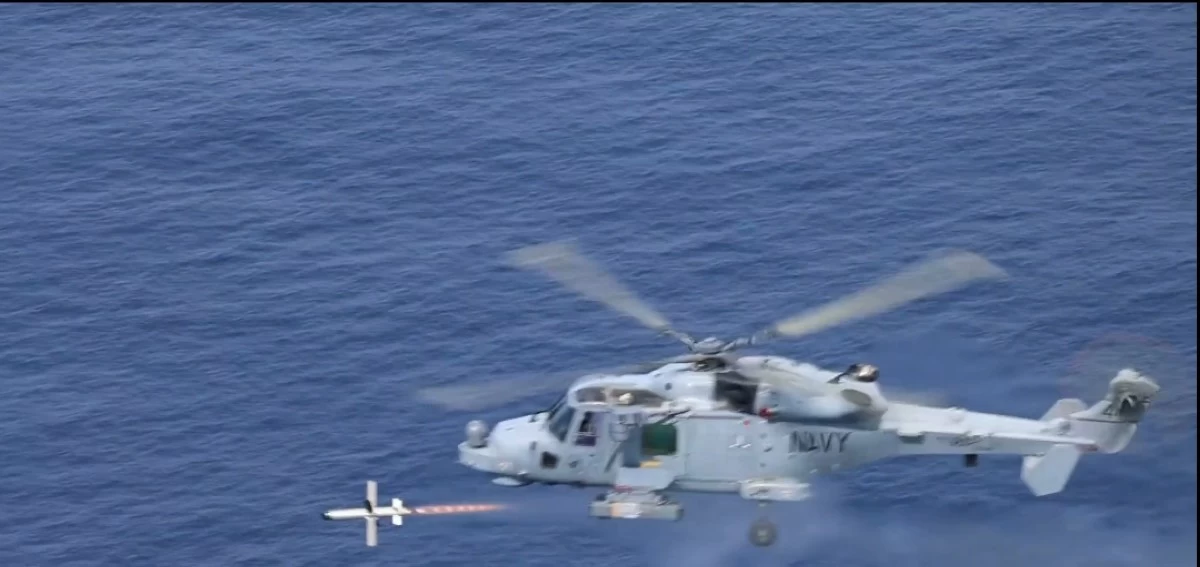
A Philippine Navy (PN) AgustaWestland AW159 Wildcat anti-submarine warfare helicopter successfully launches a Spike NLOS missile and destroyed its target during a live-fire exercise in San Antonio, Zambales on Sept. 9, 2025. (Courtesy of PN)
The Philippine Navy (PN) successfully carried out its first-ever aerial launch of a Spike Non-Line of Sight (NLOS) missile during a live-fire unilateral exercise in waters facing the West Philippine Sea (WPS) on Tuesday, Sept 9.
PN Acting Flag Officer in Command Rear Adm. Alan Javier witnessed the exercise spearheaded by the Philippine Fleet (PF) west of San Antonio, Zambales as an airborne AgustaWestland AW159 Wildcat anti-submarine warfare helicopter successfully launched a Spike NLOS missile and destroyed its target.
Meanwhile, BRP Tomas Campo, an Acero-class patrol gunboat, also carried out a coordinated launch that destroyed a separate objective.
The Spike NLOS is a precision-guided, multi-purpose missile system developed by Rafael Advanced Defense Systems (RADS) of Israel. It is designed to engage targets beyond visual range with pinpoint accuracy using advanced electro-optical and real-time video guidance. It empowers operators with full control from launch to impact.
“Its integration into the PN’s arsenal significantly enhances standoff strike capabilities, boosting maritime defense, strategic deterrence, and operational effectiveness,” said PF Commander Rear Adm. Joe Anthony C. Orbe.
In previous exercises, the Navy would test fire the Spike NLOS missile aboard its vessels.
Orbe said the first aerial launch of a Spike NLOS from the AW159 proved that missiles can be launched from both air and surface assets, streamlining flexibility and logistics.
“By integrating advanced missile technology into naval and air platforms, the Navy enhances its ability to defend key maritime chokepoints, deny hostile incursions, and project power across dispersed littoral and offshore areas,” he noted.
He said the Navy continues to advance its transformation into a modern, adaptive maritime force that is capable of protecting national sovereignty, preserving territorial integrity, and ensuring the security of vital sea lanes against conventional and asymmetric challenges.
Other capital assets of the PF provided critical support during the exercise such as BRP Miguel Malvar (FFG06), ScanEagle unmanned aerial vehicle (UAV), Fast Attack Interdiction Craft missile-capable BRP Albert Majini (PG909) and BRP Laurence Narag (PG907), and multi-purpose attack craft BA492 and BA488.
Supporting units from the Philippine Marine Corps’ Coast Defense Regiment and the Philippine Coast Guard’s BRP Suluan (MRRV-4406) were also involved.
Orbe said the successful live-fire exercise was part of the Armed Forces of the Philippines’ (AFP) Comprehensive Archipelagic Defense Concept (CADC), which underscores distributed lethality, domain awareness, and joint force integration.