






Manila Bulletin
 Philippines
National
PH-Japan Reciprocal Access Agreement enters into force Sept. 11
Philippines
National
PH-Japan Reciprocal Access Agreement enters into force Sept. 11
Philippines
National
PH-Japan Reciprocal Access Agreement enters into force Sept. 11
PH-Japan Reciprocal Access Agreement enters into force Sept. 11
Published Sep 10, 2025 03:27 pm


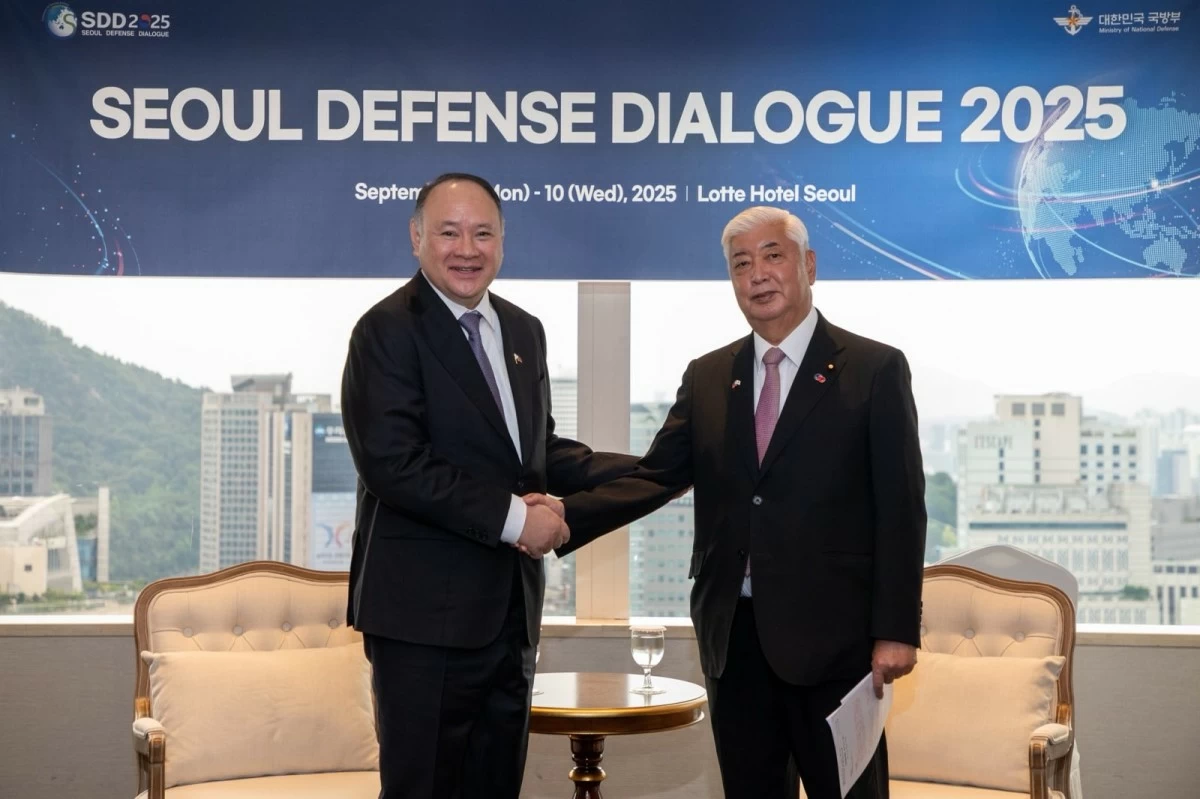
(L-R) Department of National Defense (DND) Secretary Gilberto Teodoro Jr. shakes the hand of Japanese Defense Minister Nakatani Gen during their bilateral meeting on the sidelines of the Seoul Defense Dialogue (SDD) 2025 in South Korea on Sept. 9, 2025. The meeting takes place ahead of the entry into force of the Philippines-Japan Reciprocal Access Agreement (RAA) on Sept. 11, 2025. (Photo: DND)
Department of National Defense (DND) Secretary Gilberto Teodoro Jr. held a meeting with Japanese Defense Minister Nakatani Gen ahead of the entry into force of the Philippines-Japan Reciprocal Access Agreement (RAA) on Thursday, Sept. 11.
Teodoro held a bilateral defense dialogue with Gen on the sidelines of the Seoul Defense Dialogue (SDD) 2025 in South Korea on Tuesday, Sept. 9.
Both officials welcomed the entry into force of the RAA as they noted it would facilitate enhanced cooperation, joint training, and operational activities between the Armed Forces of the Philippines (AFP) and the Japan Self-Defense Forces (JSDF).
“Preparations are underway for the formal approval of the Implementing Arrangements of the RAA,” Defense spokesperson Asst. Sec. Arsenio Andolong said on Wednesday, Sept. 10.
Prior to the RAA’s inception, the JSDF had already been conducting humanitarian assistance and disaster response (HADR) activities in the Philippines. Once it enters into force, the RAA will significantly deepen bilateral defense and security cooperation, allowing the AFP and JSDF to conduct joint training exercises, share best practices, and enhance interoperability.
In essence, it will allow troops from both countries to enter each other’s territories for training, humanitarian operations, and other agreed activities without the lengthy clearance procedures currently in place.
The RAA was signed in Manila on July 8, 2024 on the sidelines of the Philippines-Japan Foreign and Defense Ministerial Meeting or 2+2 Meeting. The Senate concurred in the ratification of the RAA on Dec. 16, 2024 while the House of Councillors of the Japanese Diet (parliament) approved the pact on June 6, 2025.
At Fort Bonifacio in Taguig City, AFP spokesperson Col. Francel Margareth Padilla told reporters that the entry into force of the RAA “is a very good development for both ends.”
“Right now, we already have a team in Japan for a humanitarian assistance and disaster response (HADR) training,” she revealed.
Abukuma-class vessels
AFP spokesperson for West Philippine Sea (WPS) Rear Admiral Roy Vincent Trinidad said the military has also submitted its recommendations to the DND regarding the possible transfer of six Japanese Abukuma-class destroyer escorts to the Philippine Navy (PN).
“The Philippine Navy has submitted the recommendation to higher headquarters. It is most likely under the deliberation at the level of the General Headquarters or the Department of National Defense,” Trinidad said. “Whatever the result of the deliberation, the appropriate public affairs announcement will be given.”
He said the AFP and DND will hold deliberations on the matter.
In August, the Navy sent a team of naval experts to Japan for a joint visual inspection (JVI) of the 109-meter warships. Composed of surface warfare officers, sea systems experts, financial analysts and logisticians, the team sought to determine the remaining service life or operational viability of the vessels.
Areas of cooperation
Meanwhile, Teodoro and Gen’s meeting also reviewed progress since the Defense Ministerial Meeting in February 2025, where both sides committed to enhancing information sharing, logistics cooperation, and defense technology collaboration.
They emphasized that maritime cooperation remains crucial amidst evolving regional security challenges and highlighted the importance of strengthening the Philippines’ defense capabilities in air and maritime domain awareness, cybersecurity, and communications.
According to the DND, Japan’s Official Security Assistance (OSA) program continues to support the Philippines through the transfer of maritime domain awareness capabilities.
At the same time, Teodoro and Gen also explored partnerships under the Self-Reliant Defense Posture (SRDP) Program, which aims to enable the country to produce weapons, small arms and ammunition, tactical communications equipment, basic land vehicles, and small sea craft using local materials.
This would decrease the dependency of the DND and AFP on foreign markets and help create a robust local defense sector.
Teodoro and Gen also discussed the Philippines’ and Japan’s leadership in multilateral defense initiatives within the Association of Southeast Asian Nations (ASEAN). As co-chairs of the ADMM-Plus Experts’ Working Group on Maritime Security, both countries are advancing regional efforts to address maritime security challenges while integrating climate and environmental considerations.