








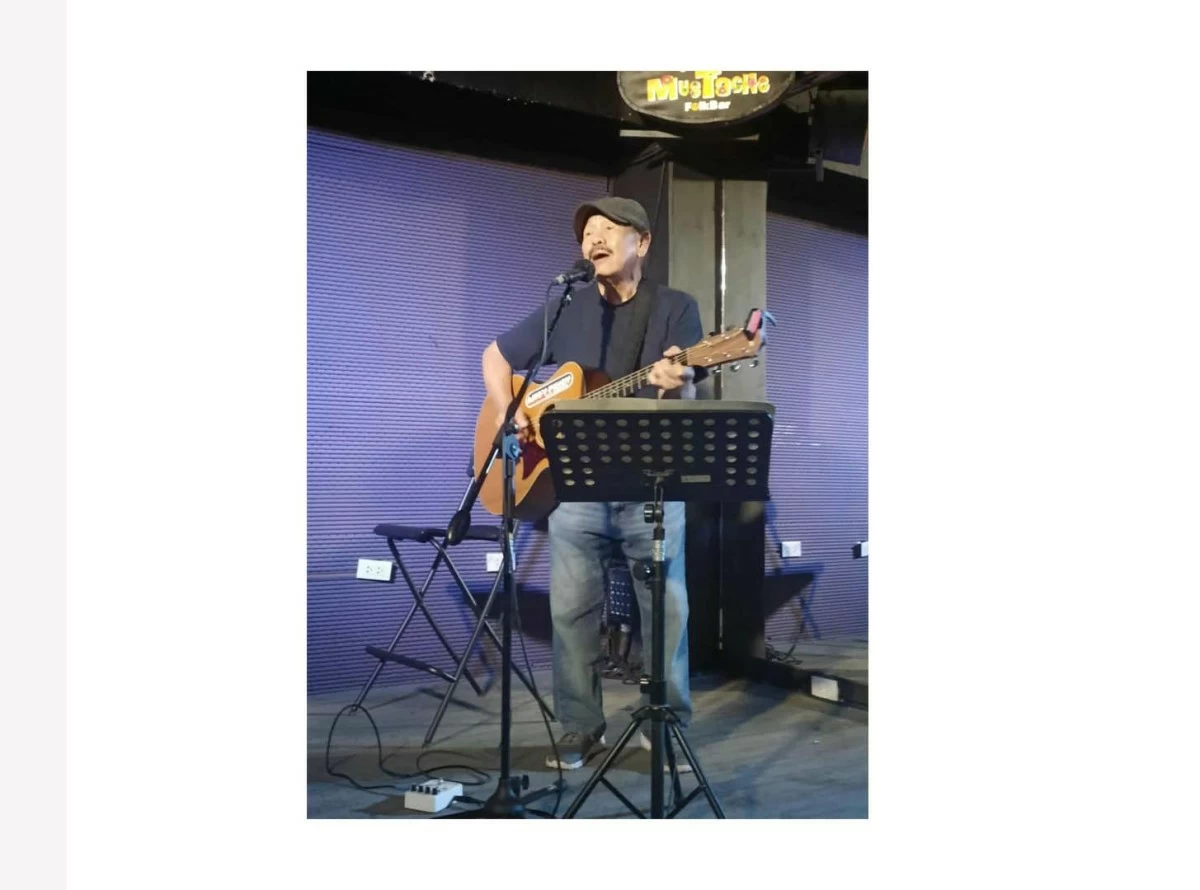
Florante de Leon
In the ‘70s, as he was in the process of completing his maiden album “Mga Tula At Awitin Ni Florante,” the ponytailed folk singer, who initially went by the full name Florante de Leon, had pushed for his first written composition “Pinay” to be his signature song. That one would introduce him to a wider audience apart from his busking days when he belted out Beatles hits.
But the man who had a say in promotions at JEM Recording that time, a guy named Danny Javier – yes, that one – leaned toward another piece for top billing, a material with less shades of melancholy and a touch more of nationalism. The song? “Ako’y Pinoy.”
Looking back, Florante says now, moments before he was to perform at My Brother’s Mustache Bar in Quezon City, “Maraming maganda don. Ini-insist ko ung “Pinay.” Kako, ‘di bebenta yan (Ako’y Pinoy). Una, hindi love song. Tapos medyo nationalistic pa. Mali pala ako, kasi pumutok siya e. (I told them that other song will not sell because the public prefers love themes. I was wrong, as it turned out.)”
With an uplifting lullaby and heartfelt message advocating love of country and pride for the national language, the song was a smashing success upon its release in 1977 and launched Florante to stardom in the Pinoy folk scene.
Fueled by the aggressive promotional effort behind “Ako’y Pinoy,” the album – loaded with 11 original, all-Filipino songs and collectively a virtual greatest hits collection – skyrocketed up the charts and stayed there for a long time, mesmerizing listeners with catchy tunes driven by a trusted Taylor acoustic and diverse tales of war with its harrowing consequence (Digmaan), his passion for playing the guitar (Daliri), the healing power of music (Musika), even a hilarious country style ode to an imaginary kutsero who pushes his horse to the brink of bewilderment and exhaustion (Si Tatang).
And then there’s his beloved “Pinay,” the “Love Me Do” of Florante’s glowing catalog of creations.
While three quarters of the serenade is offered as a paean to the Filipino woman and her attributes, Florante says he actually wrote the song for himself and the uncertain future he was facing back then.
Necessity is the mother of invention, and “Pinay” is the product of a dire need for the emerging folk hero to reinvent himself.
After spending long years playing lead for countless bands covering Top 40 hits in the late ‘60s, running himself ragged with endless practice and performing, Florante reached a dead end with the group setup and decided to go solo, doing requested James Taylor, John Denver and Cat Stevens songs in folk houses everywhere. It was fine at first, going at it alone, except for one problem: Everyone was doing the same stuff.
That’s when he came upon the idea of writing his own songs, and “Pinay” was born amid a burst of inspiration. Florante spent hard-earned savings to have it recorded on 45 single with “Rommel,” an English lyrics tribute to a departed cousin, on Side B.
He was in Japan for a gig in the middle of the ‘70s when he received a call from his fiancée and soon-to-be wife Ruth, telling him that a member of the Apo Hiking Society was trying to get in touch. It was Danny Javier, responsible for timeless hits like “Pumapatak Na Naman Ang Ulan,” “Kaibigan,””Kabilugan Ng Buwan,” “Princesa” and Di Na Natuto,” informing him that Jem Recording was interested in producing an album of his songs.
Florante leaped at the opportunity, prodigiously churning out 11 songs for his inaugural album. He fought fiercely to have “Pinay” given a major push, but Javier, a master at finding gems among the rough, apparently saw a clearer path to fan patronage in “Ako’y Pinoy” and chose nationalism over romance. It was a choice that delivered dividends for everybody.
The following year, Florante came out with his second album entitled “Puso, Diwa At Daliri Ni Florante.” Nestled near the middle of the 12-song compilation is perhaps one of the most beautifully crafted ballads in Philippine folk-rock history, the song “Handog,” which literally is a thank you card from the artist, an expression of gratitude to all the people who had helped him along the way.”
Another Jem Recording executive, Jim Paredes, of the famed APO, loved the melody but was understandably not too keen on the words, not to mention the original title (Langgam), and asked Florante to write lyrics that are more appealing to the senses and less about insects.
Florante is among the last of the Pinoy folk-rock scene of the ‘60s and ‘70s, with many of his contemporaries – Freddie Aguilar, Heber Bartolome, Coritha, Pepe Smith, Wally Gonzales – all gone.
He represents a bygone era, a space and time that exist no more except in places like My Brother’s Mustache.
He has brought his act almost everywhere, from Europe to Canada and Australia, and opened for global artists like America, Christoper Cross and Air Supply.
As he envisioned when he wrote “Pinay,” Florante had gone abroad and flourished, building a family there, putting up his own studio and blazing a trail future Pinoy artists could follow. He had also paid tribute to all those who helped him during his early days of struggle, giving a special nod to those who kept him off the streets, provided a venue for his music to be heard, and made his dreams come true.
His words aren’t Dylan, and his finger-picking style isn’t JT. They’re all Florante de Leon – original, personal, timeless, Pinoy folk at its quintessential.