ADVERTISEMENT

Camsur world-class capitol complex to rise in 2027

Inspired by the province's rich cultural heritage, the multi-functional capitol complex ushers in a new breed of civic buildings

Published Sep 10, 2025 02:24 pm
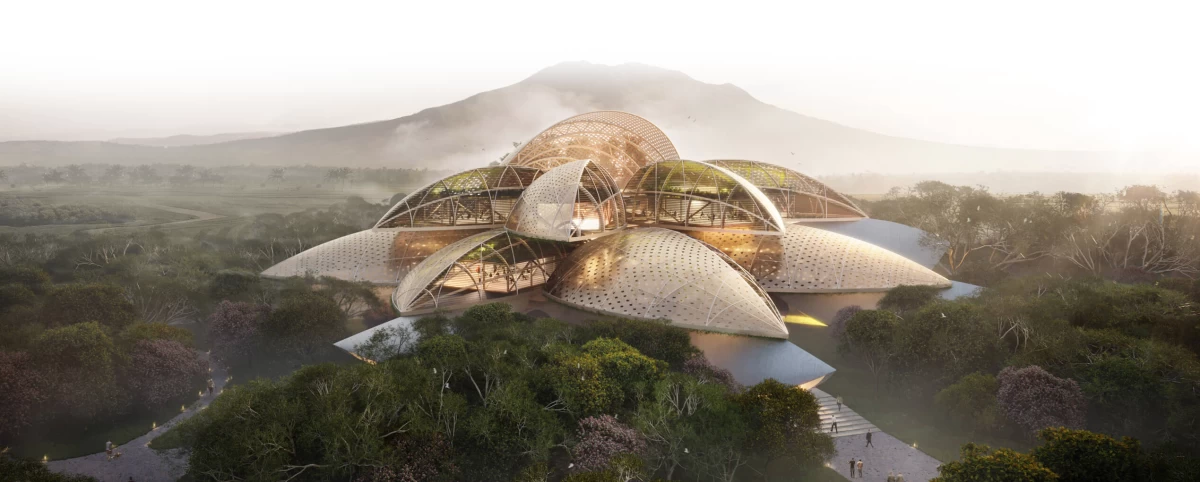
The Camarines Sur was designed to be an architectural icon in the province. (Artist's perspective/ Province of Camarines Sur website)
Combining form and function, the Camarines Sur Provincial Capitol complex promises to be a groundbreaking and unique structure that can be easily recognized as a symbol of the province. Scheduled for completion in 2027, the capitol complex is part of the global city master plan, dubbed “CamSur Uptown.”
The construction of the Camsur Capitol is conceived as part of a major public-private development initiative featuring affordable housing, new industries, and mass regional transit to communities.
Designed by architect and urban design consultant Carlos Arnaiz, the structure emphasizes eco-friendly features and design elements culled from the province’s celebrated history and cultural heritage. Under the Carlos Arnaiz Architects (CAZA), he led his team members, Laura del Pino, Alden Ching, Kate Sarmiento, Jun Deng, Ignacio Revenga, Gaby San Roman, Valentina Buratti, Haoran Wang, and Magdalena Fronska for this project. 
According to the Province of Camarines Sur website, “the Camsur Capitol builds on the possibility of designing a different future for architecture by repurposing the endangered material of indigenous cultures.” It also described its architectural shapes and the construction system that exemplifies a deep connection between the region’s landscape and its people.
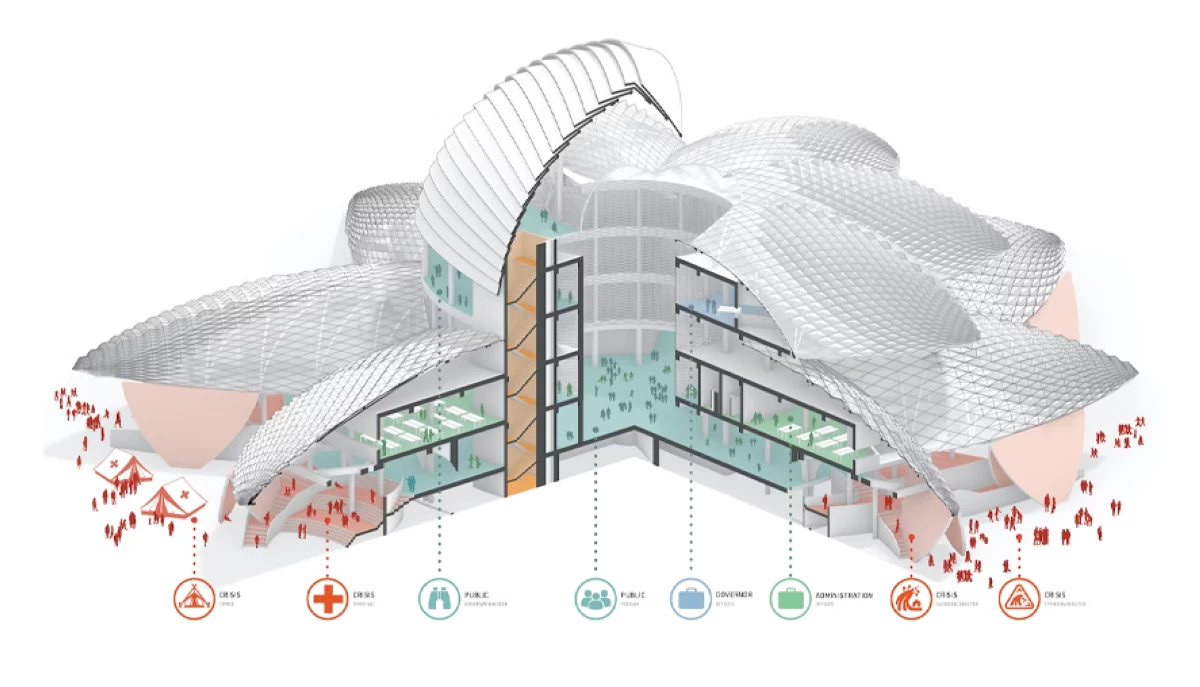
The Camsur capitol complex has four levels with different functions.
The Camsur Capitol is divided into four levels with distinct functions. The first is a crisis management center designed to accommodate approximately 3,000 evacuees and assist during emergencies.
The second is a multi-purpose plinth with an open-air atrium accessed through a web of public staircases.
At the third level, the administrative offices for the provincial government staff will be placed and outfitted with public amenities such as a library, a cafeteria, and a black box theater.
The fourth level will host the governor’s private quarters and the observation deck, wherein the public can view the panoramic vistas of Mt. Isarog.
The Achitizer website describes the design of the Camsur capitol as a “spiraling assembly of pili nut-shaped architectural husks made from a combination of solar panels and metal mesh. The husks are organized around a covered open-air atrium and terminate at the Mt. Isarog observation deck. The radial form pays homage to the long tradition of circular architecture.
The Camsur Capitol pushes the circular form outwards instead of focusing on centralization, enabling the building to connect with its surroundings in compound ways and remain adaptive to the ravages of nature."
In detail, “the branches come together at the atrium, from where staff and visitors can connect to any part of the building. A structural system that follows a progression of circumferential circles reinforces the radial organization.
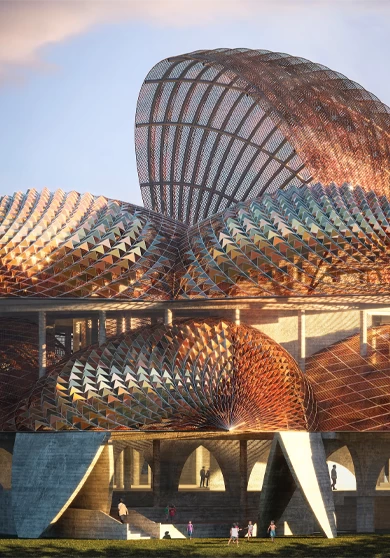
The rich cultural heritage of Camarines Sur is depicted in the architectural design of the capitol complex.
The Camsur Capitol will be situated in a lush park featuring palm-lined promenades, fountains, and a forest of native trees.
As a major tourist attraction, the capitol complex will also be fitted with a lifestyle public park and shopping center, in the hopes of generating more jobs and livelihood opportunities for the locals.

Related Tags

Camarines Sur
ADVERTISEMENT
.most-popular .layout-ratio{ padding-bottom: 79.13%; } @media (min-width: 768px) and (max-width: 1024px) { .widget-title { font-size: 15px !important; } }

{{ articles_filter_1561_widget.title }}

.most-popular .layout-ratio{ padding-bottom: 79.13%; } @media (min-width: 768px) and (max-width: 1024px) { .widget-title { font-size: 15px !important; } }

{{ articles_filter_1562_widget.title }}

.most-popular .layout-ratio{ padding-bottom: 79.13%; } @media (min-width: 768px) and (max-width: 1024px) { .widget-title { font-size: 15px !important; } }

{{ articles_filter_1563_widget.title }}

{{ articles_filter_1564_widget.title }}

.mb-article-details { position: relative; } .mb-article-details .article-body-preview, .mb-article-details .article-body-summary{ font-size: 17px; line-height: 30px; font-family: "Libre Caslon Text", serif; color: #000; } .mb-article-details .article-body-preview iframe , .mb-article-details .article-body-summary iframe{ width: 100%; margin: auto; } .read-more-background { background: linear-gradient(180deg, color(display-p3 1.000 1.000 1.000 / 0) 13.75%, color(display-p3 1.000 1.000 1.000 / 0.8) 30.79%, color(display-p3 1.000 1.000 1.000) 72.5%); position: absolute; height: 200px; width: 100%; bottom: 0; display: flex; justify-content: center; align-items: center; padding: 0; } .read-more-background a{ color: #000; } .read-more-btn { padding: 17px 45px; font-family: Inter; font-weight: 700; font-size: 18px; line-height: 16px; text-align: center; vertical-align: middle; border: 1px solid black; background-color: white; } .hidden { display: none; }
function initializeAllSwipers() { // Get all hidden inputs with cms_article_id document.querySelectorAll('[id^="cms_article_id_"]').forEach(function (input) { const cmsArticleId = input.value; const articleSelector = '#article-' + cmsArticleId + ' .body_images'; const swiperElement = document.querySelector(articleSelector); if (swiperElement && !swiperElement.classList.contains('swiper-initialized')) { new Swiper(articleSelector, { loop: true, pagination: false, navigation: { nextEl: '#article-' + cmsArticleId + ' .swiper-button-next', prevEl: '#article-' + cmsArticleId + ' .swiper-button-prev', }, }); } }); } setTimeout(initializeAllSwipers, 3000); const intersectionObserver = new IntersectionObserver( (entries) => { entries.forEach((entry) => { if (entry.isIntersecting) { const newUrl = entry.target.getAttribute("data-url"); if (newUrl) { history.pushState(null, null, newUrl); let article = entry.target; // Extract metadata const author = article.querySelector('.author-section').textContent.replace('By', '').trim(); const section = article.querySelector('.section-info ').textContent.replace(' ', ' '); const title = article.querySelector('.article-title h1').textContent; // Parse URL for Chartbeat path format const parsedUrl = new URL(newUrl, window.location.origin); const cleanUrl = parsedUrl.host + parsedUrl.pathname; // Update Chartbeat configuration if (typeof window._sf_async_config !== 'undefined') { window._sf_async_config.path = cleanUrl; window._sf_async_config.sections = section; window._sf_async_config.authors = author; } // Track virtual page view with Chartbeat if (typeof pSUPERFLY !== 'undefined' && typeof pSUPERFLY.virtualPage === 'function') { try { pSUPERFLY.virtualPage({ path: cleanUrl, title: title, sections: section, authors: author }); } catch (error) { console.error('ping error', error); } } // Optional: Update document title if (title && title !== document.title) { document.title = title; } } } }); }, { threshold: 0.1 } ); function showArticleBody(button) { const article = button.closest("article"); const summary = article.querySelector(".article-body-summary"); const body = article.querySelector(".article-body-preview"); const readMoreSection = article.querySelector(".read-more-background"); // Hide summary and read-more section summary.style.display = "none"; readMoreSection.style.display = "none"; // Show the full article body body.classList.remove("hidden"); } document.addEventListener("DOMContentLoaded", () => { let loadCount = 0; // Track how many times articles are loaded const offset = [1, 2, 3, 4, 5, 6, 7, 8, 9, 10]; // Offset values const currentUrl = window.location.pathname.substring(1); let isLoading = false; // Prevent multiple calls if (!currentUrl) { console.log("Current URL is invalid."); return; } const sentinel = document.getElementById("load-more-sentinel"); if (!sentinel) { console.log("Sentinel element not found."); return; } function isSentinelVisible() { const rect = sentinel.getBoundingClientRect(); return ( rect.top < window.innerHeight && rect.bottom >= 0 ); } function onScroll() { if (isLoading) return; if (isSentinelVisible()) { if (loadCount >= offset.length) { console.log("Maximum load attempts reached."); window.removeEventListener("scroll", onScroll); return; } isLoading = true; const currentOffset = offset[loadCount]; window.loadMoreItems().then(() => { let article = document.querySelector('#widget_1690 > div:nth-last-of-type(2) article'); intersectionObserver.observe(article) loadCount++; }).catch(error => { console.error("Error loading more items:", error); }).finally(() => { isLoading = false; }); } } window.addEventListener("scroll", onScroll); });

Sign up by email to receive news.