

ADVERTISEMENT

'Build with nature, not fight it': DENR proposes nature-based approach to flood mitigation

Published Sep 10, 2025 01:44 pm

At A Glance

  • The DENR urged a shift from the traditional flood control approach to a holistic, nature-based strategy, warning that poorly placed infrastructure can worsen flooding downstream.
An official of the Department of Environment and Natural Resources (DENR) on Wednesday, Sept. 10, pushed for a different, nature-based strategy when it comes to flood management.
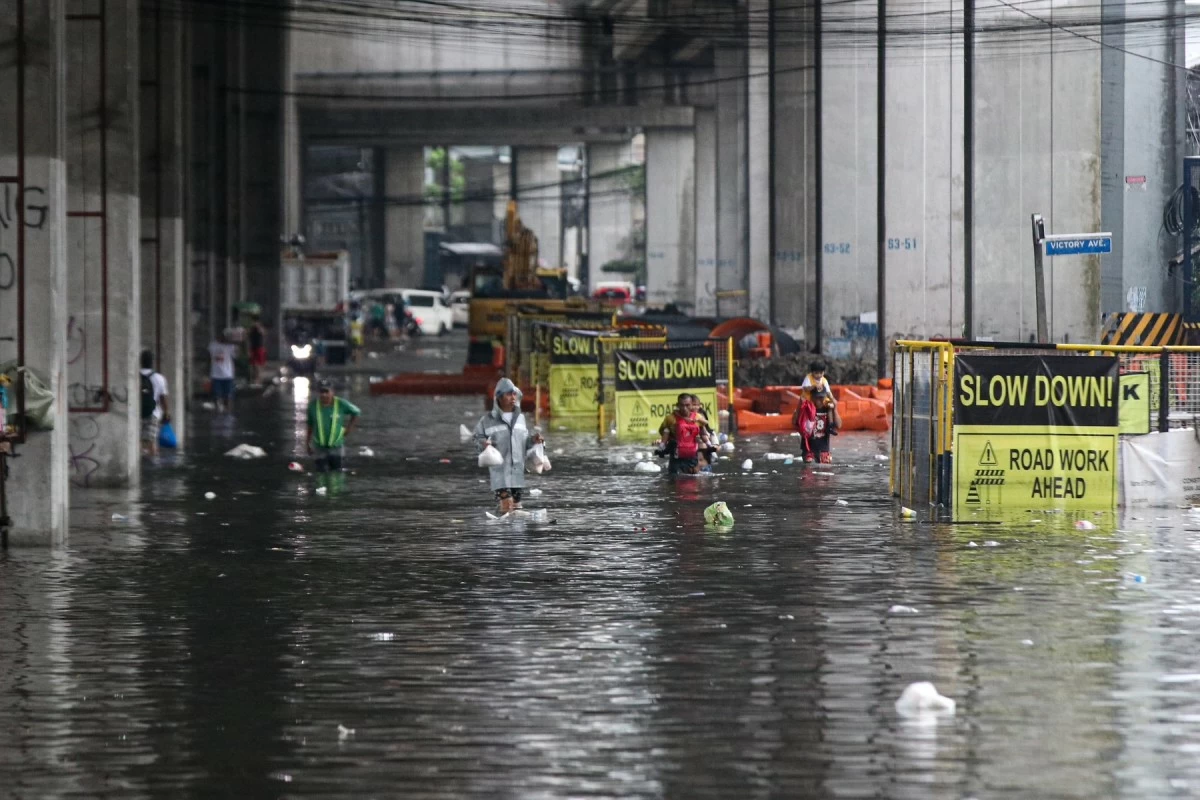
People wade through knee- to waist-deep floodwaters along Araneta Avenue in Quezon City on Monday, July 21, 2025, following heavy rains brought by the Southwest Monsoon (Habagat). (Santi San Juan)
During the Senate hearing of the Committee on Environment, Natural Resources and Climate Change, DENR Undersecretary for Integrated Environmental Science Carlos Primo David said the mandate for flood control rests on the Department of Public Works and Highways (DPWH), which naturally relies on grey infrastructure. However, he argued that the DENR’s proposed approach views excess water not merely as a hazard but as a vital resource.
“If we consider water even if it’s in excess and causes flooding and traffic and all these damages, water remains to be a vital resource of the country. If we consider it as a resource, our approach to flooding should not be to flush it out to the ocean as fast as possible by creating river dikes, but instead to impound; let the excess rain infiltrate into the ground by having our watersheds intact,” David said.
He warned that improperly placed infrastructure can intensify flooding.
“A natural waterway like a river will have a dry season flow and a wet season flow. Oftentimes, we only consider the river where the water is, and therefore, we put the flood control structure right next to the dry season flow. In other words constricting the entire channel of the river,” David explained.
“When the wet season flow comes in, it will now be constricted into this narrow canal instead of spreading into what we call as the flood plain, all that volume of water that’s been constricted will number one: increase in flow velocity, making it more erosive and that the entire volume of water that was supposed to spread out at that point will now be cascaded down further downstream causing higher floods downstream,” he added.
David said the DENR has drafted a National Flood Management Plan anchored on a holistic and nature-based strategy. This includes protecting watersheds, using excess water for irrigation, bulk water supply, hydropower, aquaculture, and ecotourism, and integrating land use planning.
Senator Erwin Tulfo earlier suggested that the Climate Change Commission and the Department of Agriculture, along with the DENR, be more involved in flood mitigation planning to ensure long-lasting infrastructure.
He added that they would come up with a resolution.
"So, I guess Madam Chair, my only suggestion to the Secretary is siguro to tightly coordinate with the Department of Public Works and Highways, not only po DPWH but also po the Department of Agriculture, kung saan nandun po yung National Irrigation Administration, para po masiguro na talagang yung infrastructures that we're building will last for a long time," he added.
Senator Camille Villar also noted the importance of DENR’s participation, saying the agency could guide contractors in creating better-designed projects.
David urged lawmakers to support the shift in perspective.
“Personally, if you will ask me Madam Chair, the infrastructure being built as flood control, if improperly placed, not only does it not help in exacerbating flooding, but oftentimes it actually intensifies flooding downstream,” he said.

Related Tags

Department of Environment and Natural Resources (DENR) flood control Camille Villar Erwin Tulfo
ADVERTISEMENT
.most-popular .layout-ratio{ padding-bottom: 79.13%; } @media (min-width: 768px) and (max-width: 1024px) { .widget-title { font-size: 15px !important; } }

{{ articles_filter_1561_widget.title }}

.most-popular .layout-ratio{ padding-bottom: 79.13%; } @media (min-width: 768px) and (max-width: 1024px) { .widget-title { font-size: 15px !important; } }

{{ articles_filter_1562_widget.title }}

.most-popular .layout-ratio{ padding-bottom: 79.13%; } @media (min-width: 768px) and (max-width: 1024px) { .widget-title { font-size: 15px !important; } }

{{ articles_filter_1563_widget.title }}

{{ articles_filter_1564_widget.title }}

.mb-article-details { position: relative; } .mb-article-details .article-body-preview, .mb-article-details .article-body-summary{ font-size: 17px; line-height: 30px; font-family: "Libre Caslon Text", serif; color: #000; } .mb-article-details .article-body-preview iframe , .mb-article-details .article-body-summary iframe{ width: 100%; margin: auto; } .read-more-background { background: linear-gradient(180deg, color(display-p3 1.000 1.000 1.000 / 0) 13.75%, color(display-p3 1.000 1.000 1.000 / 0.8) 30.79%, color(display-p3 1.000 1.000 1.000) 72.5%); position: absolute; height: 200px; width: 100%; bottom: 0; display: flex; justify-content: center; align-items: center; padding: 0; } .read-more-background a{ color: #000; } .read-more-btn { padding: 17px 45px; font-family: Inter; font-weight: 700; font-size: 18px; line-height: 16px; text-align: center; vertical-align: middle; border: 1px solid black; background-color: white; } .hidden { display: none; }
function initializeAllSwipers() { // Get all hidden inputs with cms_article_id document.querySelectorAll('[id^="cms_article_id_"]').forEach(function (input) { const cmsArticleId = input.value; const articleSelector = '#article-' + cmsArticleId + ' .body_images'; const swiperElement = document.querySelector(articleSelector); if (swiperElement && !swiperElement.classList.contains('swiper-initialized')) { new Swiper(articleSelector, { loop: true, pagination: false, navigation: { nextEl: '#article-' + cmsArticleId + ' .swiper-button-next', prevEl: '#article-' + cmsArticleId + ' .swiper-button-prev', }, }); } }); } setTimeout(initializeAllSwipers, 3000); const intersectionObserver = new IntersectionObserver( (entries) => { entries.forEach((entry) => { if (entry.isIntersecting) { const newUrl = entry.target.getAttribute("data-url"); if (newUrl) { history.pushState(null, null, newUrl); let article = entry.target; // Extract metadata const author = article.querySelector('.author-section').textContent.replace('By', '').trim(); const section = article.querySelector('.section-info ').textContent.replace(' ', ' '); const title = article.querySelector('.article-title h1').textContent; // Parse URL for Chartbeat path format const parsedUrl = new URL(newUrl, window.location.origin); const cleanUrl = parsedUrl.host + parsedUrl.pathname; // Update Chartbeat configuration if (typeof window._sf_async_config !== 'undefined') { window._sf_async_config.path = cleanUrl; window._sf_async_config.sections = section; window._sf_async_config.authors = author; } // Track virtual page view with Chartbeat if (typeof pSUPERFLY !== 'undefined' && typeof pSUPERFLY.virtualPage === 'function') { try { pSUPERFLY.virtualPage({ path: cleanUrl, title: title, sections: section, authors: author }); } catch (error) { console.error('ping error', error); } } // Optional: Update document title if (title && title !== document.title) { document.title = title; } } } }); }, { threshold: 0.1 } ); function showArticleBody(button) { const article = button.closest("article"); const summary = article.querySelector(".article-body-summary"); const body = article.querySelector(".article-body-preview"); const readMoreSection = article.querySelector(".read-more-background"); // Hide summary and read-more section summary.style.display = "none"; readMoreSection.style.display = "none"; // Show the full article body body.classList.remove("hidden"); } document.addEventListener("DOMContentLoaded", () => { let loadCount = 0; // Track how many times articles are loaded const offset = [1, 2, 3, 4, 5, 6, 7, 8, 9, 10]; // Offset values const currentUrl = window.location.pathname.substring(1); let isLoading = false; // Prevent multiple calls if (!currentUrl) { console.log("Current URL is invalid."); return; } const sentinel = document.getElementById("load-more-sentinel"); if (!sentinel) { console.log("Sentinel element not found."); return; } function isSentinelVisible() { const rect = sentinel.getBoundingClientRect(); return ( rect.top < window.innerHeight && rect.bottom >= 0 ); } function onScroll() { if (isLoading) return; if (isSentinelVisible()) { if (loadCount >= offset.length) { console.log("Maximum load attempts reached."); window.removeEventListener("scroll", onScroll); return; } isLoading = true; const currentOffset = offset[loadCount]; window.loadMoreItems().then(() => { let article = document.querySelector('#widget_1690 > div:nth-last-of-type(2) article'); intersectionObserver.observe(article) loadCount++; }).catch(error => { console.error("Error loading more items:", error); }).finally(() => { isLoading = false; }); } } window.addEventListener("scroll", onScroll); });

Sign up by email to receive news.