






Manila Bulletin
 Philippines
National
PH defense chief: Xi Jinping's idea of multipolarity is 'concerning'
Philippines
National
PH defense chief: Xi Jinping's idea of multipolarity is 'concerning'
Philippines
National
PH defense chief: Xi Jinping's idea of multipolarity is 'concerning'
PH defense chief: Xi Jinping's idea of multipolarity is 'concerning'
Published Sep 9, 2025 03:13 pm


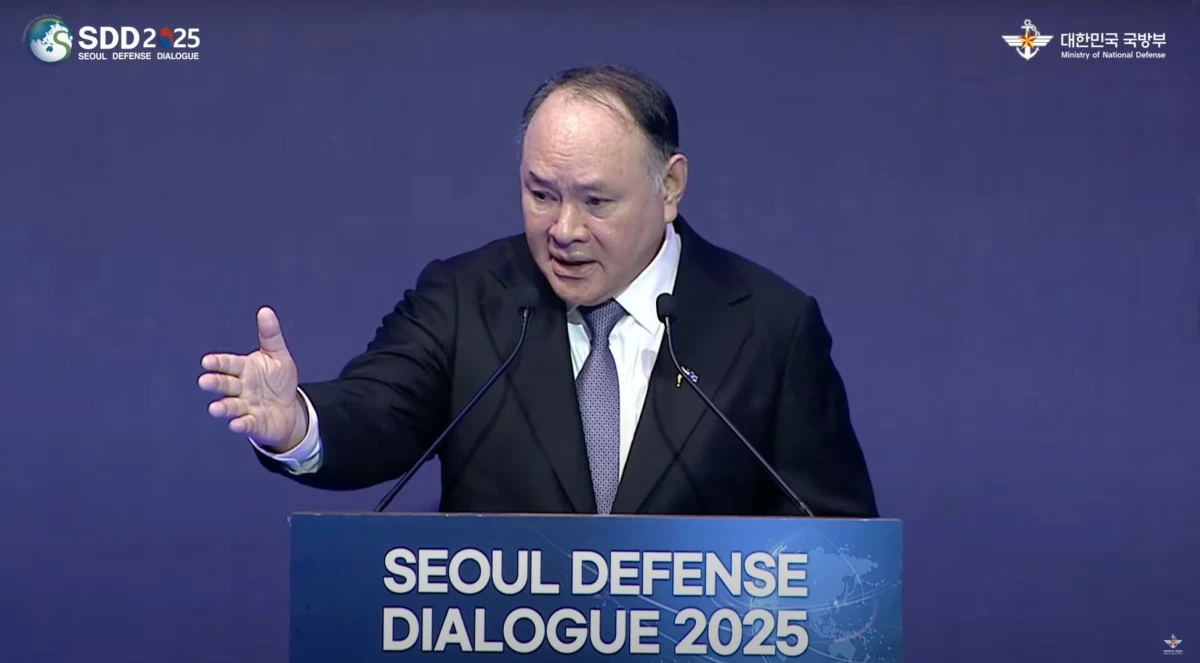
Department of National Defense (DND) Secretary Gilberto Teodoro Jr. delivers a speech during the opening ceremony of the Seoul Defense Dialogue in South Korea on Sept. 8, 2025. (Courtesy of South Korea Ministry of National Defense)
Department of National Defense (DND) Secretary Gilberto Teodoro Jr. on Monday, Sept. 8, criticized Chinese President Xi Jinping’s advocacy to create a Beijing-led “multipolar world” which is seen as a counter to the Western narrative of a United States-led international order.
Speaking at the opening ceremony of the Seoul Defense Dialogue in South Korea, Teodoro said the Sino-American strategic competition has intensified in recent years as geopolitical rivalries harden and mistrust deepens across oceans and continents.
He said a disproportionate focus on great power competition implies that smaller states like the Philippines and South Korea “are merely doing the bidding of so-called major countries as if we were pawns with no strategic agency.” Further, he said such framing “clouds the judgment” of the international community as it “masks the ambition of certain countries to reshape the global governance system for their own gain at the expense of the rest of the world.”
“Just last week, President Xi Jinping articulated his vision for a new global order. He enjoined his counterparts in the Shanghai Cooperation Organization to ‘advocate an equal and orderly multipolar world.’ The idea of multipolarity is concerning,” he added.
Citing a lecture from Finnish President Alexander Stubb, Teodoro defined the multipolar world as “one where nation-states engage in a transactional basis without clear international rules.”
“This is in contrast to what we know as multilateralism where nation-states cooperate within a framework of international law and institutions,” Teodoro stressed.
The defense chief said that a multipolar world, where one country cannot meddle with the actions of others, is “dangerous especially for smaller states.”
He used as an example the Chinese government’s claims in the South China Sea based on the nine-dash line which have already been invalidated by a 2016 arbitral award anchored on the 1982 United Nations Convention on the Law of the Sea (UNCLOS). China continues to ignore the ruling and Chinese vessels have maintained their presence in the West Philippine Sea (WPS).
Over the weekend, the Philippine Navy (PN) monitored nine Chinese vessels in Ayungin (Second Thomas) Shoal, a key maritime outpost guarded by BRP Sierra Madre just 105 nautical miles west of Palawan.
Thus, Teodoro said countries must recommit to enduring principles that have underwritten strategic stability, and resort to dialogues and communication to prevent escalation of tension.
“We encourage the use of any legally binding dispute resolution mechanism available under international law,” he said. He, however, noted that for dialogue to be effective, it must be coupled with trust.
“In that spirit, the greatest obstacle to fair and structured dispute resolution in our region, sadly, and particularly for the Philippines, is the Chinese government. They possess in our people the deficit in trust and credibility that arises from a mismatch between their words and their deeds,” he added.
Expanding cooperation
As opposed to multipolarity, Teodoro said the Philippines is expanding its network of partnerships with “like-minded” countries.
On the sidelines of the Seoul Defense Dialogue, he met with South Korean Defense Minister Ahn Gyu-Back, Sweden’s State Secretary to the Minister for Civil Defence Johan Berggren, and South Africa’s Minister of Defence and Military Veterans Angelina Motshekga.
During the meetings, Teodoro highlighted the importance of closer cooperation with allies and friendly nations to support the Philippines’ defense modernization and national resilience efforts.
The discussions centered on cooperation in logistics, technological exchange, defense industry cooperation, civil defense, crisis response, capacity building, defense education and training, technology and emerging security domains, military medicine, and safety of seafarers.