






Manila Bulletin
 Philippines
National
PH, Cambodia ink 3 agreements on police, education, air services
Philippines
National
PH, Cambodia ink 3 agreements on police, education, air services
Philippines
National
PH, Cambodia ink 3 agreements on police, education, air services
PH, Cambodia ink 3 agreements on police, education, air services
Published Sep 8, 2025 03:00 pm


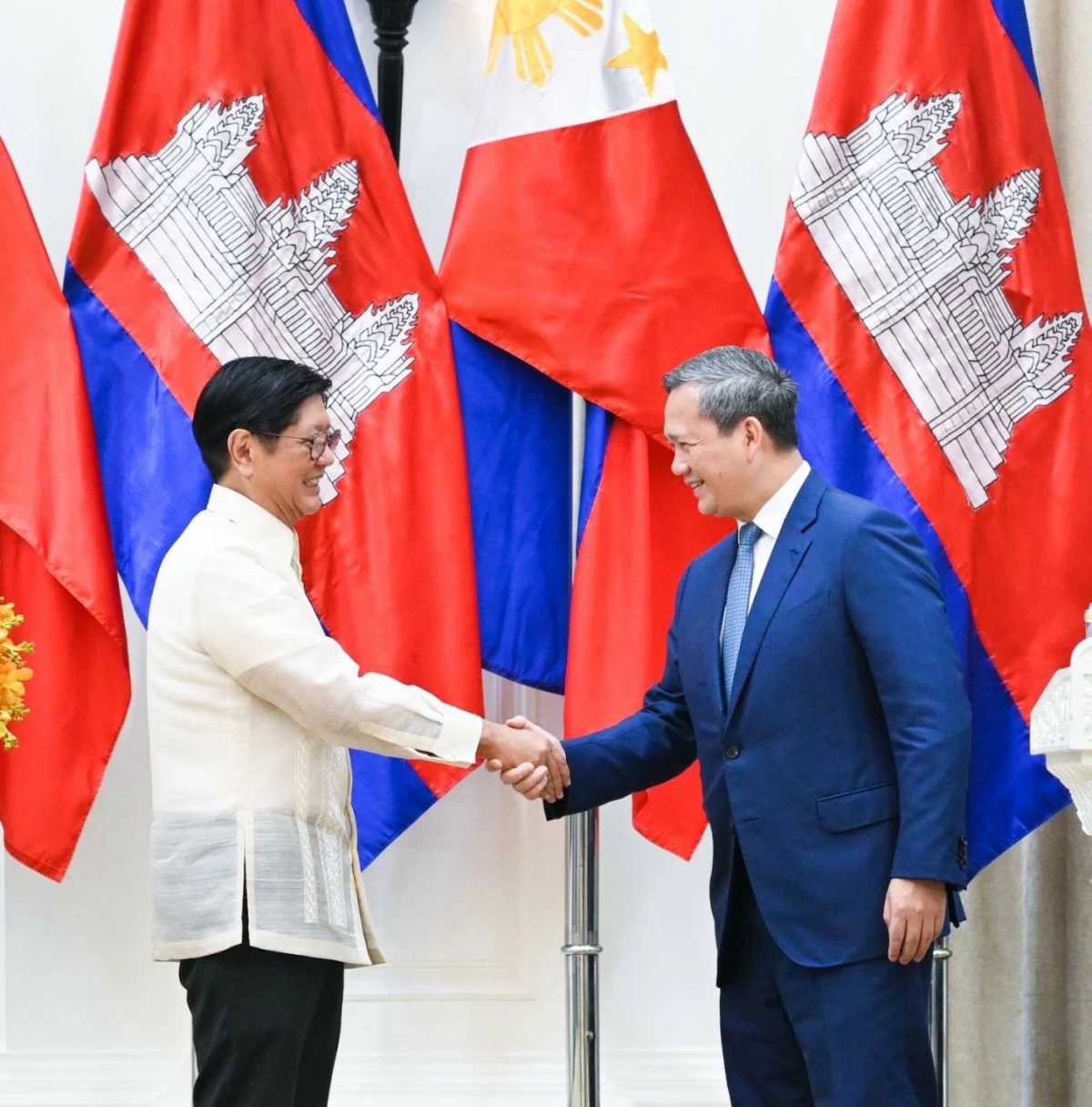
President Ferdinand R. Marcos Jr. holds a a joint press conference with Cambodian Prime Minister Hun Manet at the Malis Room, Peace Palace in Phnom Penh, Cambodia, on Sept. 8, 2025. (Photo courtesy of PPA)
The Philippines and Cambodia signed agreements covering police cooperation, higher education, and air connectivity.
President Marcos and Cambodian Prime Minister Hun Manet on Monday, Sept. 8, witnessed the signing of three key agreements between the two countries.
According to Malacañang, the first agreement was the amendment of the memorandum of understanding (MOU) between the Philippine National Police (PNP) and the Cambodian National Police of the Kingdom of Cambodia on cooperation in combating transnational crime.
The amendment specifies additional areas of cooperation between the existing MOU, such as human trafficking, arms trafficking, and cybercrime. It also includes an automatic renewal clause of the agreement.
The second agreement was an MOU between the Commission on Higher Education (CHED) and the Ministry of Education, Youth, and Sport of the Kingdom of Cambodia on cooperation in higher education.
The MOU provides for exchanges of officials between higher education institutions of both countries, exchanges of training programs, and facilitating cooperation in science, technology, and innovation, among others.
Moreover, the two countries forged the Air Services Agreement.
It allows designated airlines of the Philippines and Cambodia to enter into code-sharing alliances, operate charter flights, as well as exercise fifth freedom rights—to carry passengers and cargo between the two countries with an intermediate stop in a third destination.
In a joint press conference with the Cambodian Prime Minister, Marcos underscored the importance of broadening Manila's ties with Phnom Penh, saying it will further create more opportunities for both sides.
"We recognized that the growth and resilience of our economies depends on opening new avenues of cooperation, expanding opportunities in trade, agriculture, renewable energy, and the digital economy," Marcos said.
"By broadening these linkages, we give our peoples more opportunities. We also ensure that our region is less vulnerable to the effects of external uncertainties," he added.
The President also acknowledged pressing challenges across borders such as human trafficking, cybercrime, illicit drugs, and other transnational threats which, he said, "affect the safety of our citizens and the stability of our societies."
He stressed that the Philippines agreed to strengthen collaboration between the two countries' law enforcement and security institutions so that the collective response will be "swift, coordinated, and effective."
Marcos also emphasized the importance of strengthening ties between the two nations with the hope of facilitating more seamless and frequent travel between the two countries.
"Our discussions today signal a new phase in the partnership between the Philippines and Cambodia. One that embraces greater economic opportunities, deeper cooperation on matters of security, and the common resolve to uphold peace and stability in our region," Marcos said.
Marcos is in Phnom Penh for a three-day state visit.