






Manila Bulletin
 Business
Trade & Industry
Business leaders lose confidence in gov't anti-corruption fight
Business
Trade & Industry
Business leaders lose confidence in gov't anti-corruption fight
Business
Trade & Industry
Business leaders lose confidence in gov't anti-corruption fight
Business leaders lose confidence in gov't anti-corruption fight
Published Sep 8, 2025 06:35 pm


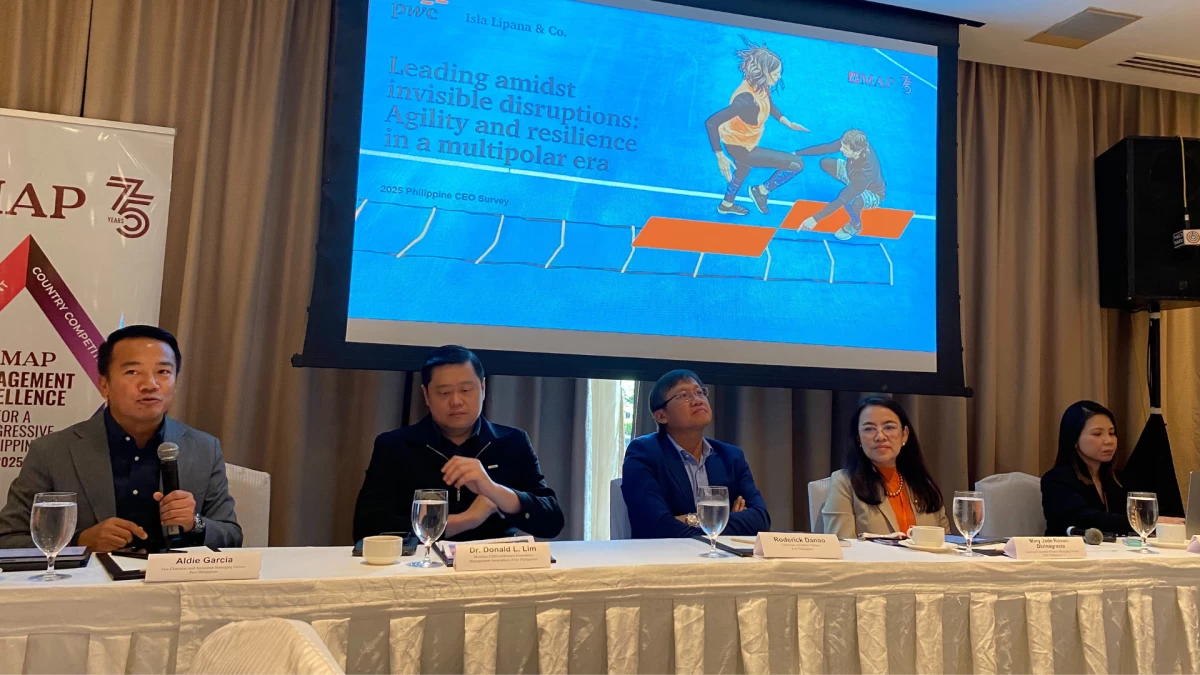
Philippine CEOs are closely monitoring the government's anti-corruption drive, with many expressing low confidence in its current efforts. Business leaders emphasized that while they remain optimistic about economic growth, concrete action on transparency and accountability is crucial for sustained investor confidence.
Filipino business executives are closely monitoring the government’s efforts to combat corruption, according to the 2025 Philippine CEO Survey released on Monday, Sept. 8.
The study, conducted by Isla Lipana & Co./PwC Philippines in partnership with the Management Association of the Philippines (MAP), found that only nine percent of business leaders consider the government effective in curbing corruption, a slight decrease from 10 percent last year.
Among the areas where the government’s performance was assessed, fighting corruption ranked lowest. In contrast, the government received higher approval ratings for its management of inflation (70 percent), infrastructure development (69 percent), and strengthening international relations (65 percent).
The survey, which polled 175 chief executives between July 22 and Aug. 25, revealed that 83 percent of CEOs remain confident about their industry’s outlook over the next 12 months. Despite global uncertainties, business leaders continue to invest in talent, technology, and processes to sustain growth.
The survey findings come as the Philippines ranks 114th out of 180 countries on the 2024 Corruption Perceptions Index, with a score of 33—below both the global average of 43 and the Asia-Pacific average of 44.
Mary Jane Roxas-Divinagracia, Deals and Corporate Finance Managing Partner at PwC Philippines, said that this presents a significant opportunity for the government to demonstrate its commitment to transparency and governance.
“Now that the public push is there, the business push is there, and the clamor is there, I think the government must take this seriously and conduct a credible investigation,” Divinagracia said.
She added that it is an opportunity to show both the Filipino public and international investors that the country is moving in the right direction.
“The business community will be watching in terms of the outcome of these investigations,” she added.
Roderick Danao, Chairman and Senior Partner of PwC Philippines, said the “Isumbong Mo sa Pangulo” (Report it to the President) program as a potential “game-changer.”
“There are already 12,000 complaints,” Danao said. “This is the most transparent the national government has ever been because everything is being exposed.”
He stressed that the next crucial step is for the government to show serious enforcement and legal actions. “And, we are watching what the government does in the future,” he added.
Trissy Rogacion, Deals and Corporate Finance Partner at PwC Philippines, cited the president’s recent disclosure that ₱100 billion worth of flood control projects had been awarded to only 15 contractors, some of whom lacked prior experience.
Rogacion noted that after uncovering substandard work, the administration is now reviewing all projects and has pledged to publish its findings.
“The president also promised to return any budget bills that don't align with the National Expenditure Program,” she added.
With public demonstrations rising over failed infrastructure projects, Rogacion said, “CEOs are closely watching and hoping that our administration succeeds in its fight against corruption.”
While CEOs are optimistic about business growth, they remain watchful of the government’s ability to back its promises with action. The survey highlights that for business leaders, transparency and accountability will be as critical as economic reforms in shaping investor confidence and sustaining the country’s growth.
(Ricardo M. Autria)