ADVERTISEMENT

Total lunar eclipse visible tonight amid partly cloudy skies

Published Sep 7, 2025 12:06 pm  |  Updated Sep 7, 2025 02:12 pm
A total lunar eclipse will cast a deep red glow over the Moon in the early hours of September 8, 2025, as seen from across the Philippines. The celestial event will reach maximum eclipse at 2:12 a.m. (PAGASA)
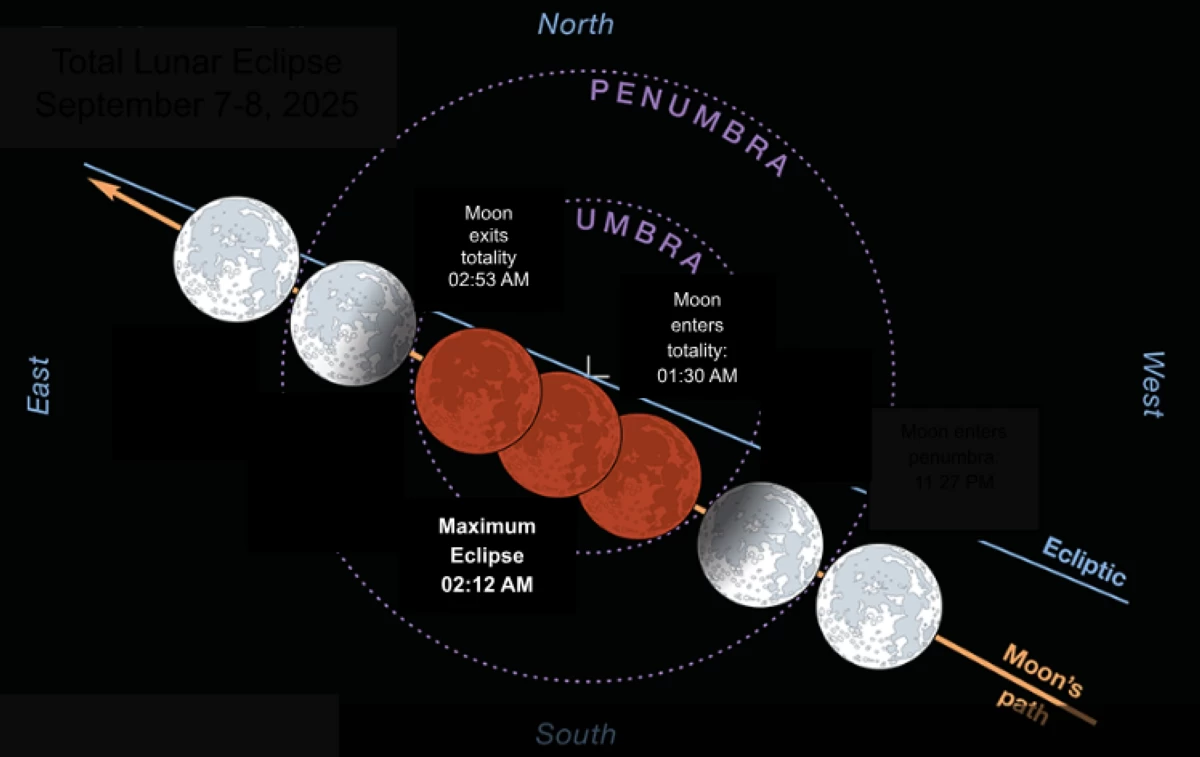
A total lunar eclipse will be visible across the Philippines tonight, Sept. 7 to 8, with the Moon expected to glow a deep red for one hour, 22 minutes, and 54 seconds, said the Philippine Atmospheric, Geophysical and Astronomical Services Administration (PAGASA).
The eclipse will begin at 11:27 p.m. on Sept. 7 with the penumbral phase, followed by the partial eclipse phase starting at 12:27 a.m. on Sept. 8.
Totality, when the Moon is fully covered by Earth’s shadow and takes on a reddish hue, will last from 1:30 a.m. to 2:53 a.m., with the maximum eclipse occurring at 2:12 a.m. This is the best time to view the eclipse, as the Moon is completely immersed in Earth’s umbral shadow.
The penumbral phase ends at 3:57 a.m., and the Moon will exit the penumbral shadow entirely at 4:57 a.m.
PAGASA forecasts partly cloudy to cloudy skies over much of the country during the event, but viewing conditions remain favorable.
“Weather permitting, the public is encouraged to observe the eclipse directly,” PAGASA said.
PAGASA’s Astronomical Observation and Time Service Unit chief Mario Raymundo explained that the reddish tint is caused by sunlight passing through Earth’s atmosphere, which casts a red glow on the Moon’s surface during the eclipse.
He added that the longest total lunar eclipse visible from the Philippines lasted one hour and 40 minutes, recorded in 1953.
The reddish color of the Moon during the total lunar eclipse, commonly called a “blood moon,” is caused by sunlight filtering through Earth’s atmosphere and casting a red glow on the Moon’s surface.
Unlike solar eclipses, total lunar eclipses are safe to watch with the naked eye, and no special equipment is needed.
Binoculars or small telescopes can enhance the view but are not required.
This event will be visible across East Africa, Asia, and Australia.
The next total lunar eclipse visible from the Philippines is expected on March 3, 2026.

Related Tags

PAGASA TOTAL LUNAR ECLIPSE BLOOD MOON PHILIPPINES
ADVERTISEMENT
.most-popular .layout-ratio{ padding-bottom: 79.13%; } @media (min-width: 768px) and (max-width: 1024px) { .widget-title { font-size: 15px !important; } }

{{ articles_filter_1561_widget.title }}

.most-popular .layout-ratio{ padding-bottom: 79.13%; } @media (min-width: 768px) and (max-width: 1024px) { .widget-title { font-size: 15px !important; } }

{{ articles_filter_1562_widget.title }}

.most-popular .layout-ratio{ padding-bottom: 79.13%; } @media (min-width: 768px) and (max-width: 1024px) { .widget-title { font-size: 15px !important; } }

{{ articles_filter_1563_widget.title }}

{{ articles_filter_1564_widget.title }}

.mb-article-details { position: relative; } .mb-article-details .article-body-preview, .mb-article-details .article-body-summary{ font-size: 17px; line-height: 30px; font-family: "Libre Caslon Text", serif; color: #000; } .mb-article-details .article-body-preview iframe , .mb-article-details .article-body-summary iframe{ width: 100%; margin: auto; } .read-more-background { background: linear-gradient(180deg, color(display-p3 1.000 1.000 1.000 / 0) 13.75%, color(display-p3 1.000 1.000 1.000 / 0.8) 30.79%, color(display-p3 1.000 1.000 1.000) 72.5%); position: absolute; height: 200px; width: 100%; bottom: 0; display: flex; justify-content: center; align-items: center; padding: 0; } .read-more-background a{ color: #000; } .read-more-btn { padding: 17px 45px; font-family: Inter; font-weight: 700; font-size: 18px; line-height: 16px; text-align: center; vertical-align: middle; border: 1px solid black; background-color: white; } .hidden { display: none; }
function initializeAllSwipers() { // Get all hidden inputs with cms_article_id document.querySelectorAll('[id^="cms_article_id_"]').forEach(function (input) { const cmsArticleId = input.value; const articleSelector = '#article-' + cmsArticleId + ' .body_images'; const swiperElement = document.querySelector(articleSelector); if (swiperElement && !swiperElement.classList.contains('swiper-initialized')) { new Swiper(articleSelector, { loop: true, pagination: false, navigation: { nextEl: '#article-' + cmsArticleId + ' .swiper-button-next', prevEl: '#article-' + cmsArticleId + ' .swiper-button-prev', }, }); } }); } setTimeout(initializeAllSwipers, 3000); const intersectionObserver = new IntersectionObserver( (entries) => { entries.forEach((entry) => { if (entry.isIntersecting) { const newUrl = entry.target.getAttribute("data-url"); if (newUrl) { history.pushState(null, null, newUrl); let article = entry.target; // Extract metadata const author = article.querySelector('.author-section').textContent.replace('By', '').trim(); const section = article.querySelector('.section-info ').textContent.replace(' ', ' '); const title = article.querySelector('.article-title h1').textContent; // Parse URL for Chartbeat path format const parsedUrl = new URL(newUrl, window.location.origin); const cleanUrl = parsedUrl.host + parsedUrl.pathname; // Update Chartbeat configuration if (typeof window._sf_async_config !== 'undefined') { window._sf_async_config.path = cleanUrl; window._sf_async_config.sections = section; window._sf_async_config.authors = author; } // Track virtual page view with Chartbeat if (typeof pSUPERFLY !== 'undefined' && typeof pSUPERFLY.virtualPage === 'function') { try { pSUPERFLY.virtualPage({ path: cleanUrl, title: title, sections: section, authors: author }); } catch (error) { console.error('ping error', error); } } // Optional: Update document title if (title && title !== document.title) { document.title = title; } } } }); }, { threshold: 0.1 } ); function showArticleBody(button) { const article = button.closest("article"); const summary = article.querySelector(".article-body-summary"); const body = article.querySelector(".article-body-preview"); const readMoreSection = article.querySelector(".read-more-background"); // Hide summary and read-more section summary.style.display = "none"; readMoreSection.style.display = "none"; // Show the full article body body.classList.remove("hidden"); } document.addEventListener("DOMContentLoaded", () => { let loadCount = 0; // Track how many times articles are loaded const offset = [1, 2, 3, 4, 5, 6, 7, 8, 9, 10]; // Offset values const currentUrl = window.location.pathname.substring(1); let isLoading = false; // Prevent multiple calls if (!currentUrl) { console.log("Current URL is invalid."); return; } const sentinel = document.getElementById("load-more-sentinel"); if (!sentinel) { console.log("Sentinel element not found."); return; } function isSentinelVisible() { const rect = sentinel.getBoundingClientRect(); return ( rect.top < window.innerHeight && rect.bottom >= 0 ); } function onScroll() { if (isLoading) return; if (isSentinelVisible()) { if (loadCount >= offset.length) { console.log("Maximum load attempts reached."); window.removeEventListener("scroll", onScroll); return; } isLoading = true; const currentOffset = offset[loadCount]; window.loadMoreItems().then(() => { let article = document.querySelector('#widget_1690 > div:nth-last-of-type(2) article'); intersectionObserver.observe(article) loadCount++; }).catch(error => { console.error("Error loading more items:", error); }).finally(() => { isLoading = false; }); } } window.addEventListener("scroll", onScroll); });

Sign up by email to receive news.