

ADVERTISEMENT

Philippines Could Unlock ₱1.8 Trillion in Growth Through AI

Published Sep 5, 2025 06:01 am  |  Updated Sep 4, 2025 04:30 pm
The Philippines, now recognized as Southeast Asia’s fastest-growing digital economy, is poised for a massive economic transformation fueled by artificial intelligence (AI). A new report by London-based research agency Public First projects that AI could add as much as ₱1.8 trillion (US$31 billion) to the nation’s economy—equivalent to a 7% boost in gross value added (GVA).
The study titled “Turbocharging Growth: The Philippines’ AI Opportunity” highlights AI’s potential to sustain the country’s growth momentum while reshaping industries, jobs, and everyday life.
AI’s Impact on Filipinos and the Workforce
According to the report, half of Filipinos already use AI tools weekly, and optimism runs high: 46% believe AI will benefit the nation, while 50% expect personal gains from the technology.
AI is expected to significantly raise workforce productivity, with 37% of jobs benefiting directly. By automating routine administrative work, the average Filipino worker could save up to three hours per week, leading to wage increases of more than 6% and boosting annual productivity by around ₱110,000.
Key industries set to gain the most from AI-driven efficiency include: wholesale and retail: ₱410 billion increase (+9% GVA); finance and insurance: ₱300 billion increase (+12% GVA); and public administration and defense: ₱109 billion increase (+9% GVA).
Beyond numbers, AI can help tackle national challenges. For instance, it could cut cybersecurity costs in half (₱180 billion) and enhance food security by adding ₱120 billion in agricultural productivity by 2035 through innovations like precision farming and early pest detection.
While AI boosts efficiency, it will also create new roles—particularly in managing AI systems and performing higher-value tasks. To prepare, 90% of Filipino workers expressed interest in AI training, underscoring the importance of upskilling.
Google and Accenture’s Commitment
Google reaffirmed its long-term commitment to building an AI-ready workforce. Through partnerships with government agencies such as the DTI, DICT, and industry groups like IBPAP, Google has rolled out Google Career Certificates, including an AI Essentials course, to equip Filipinos with future-ready skills.
"AI is more than just a buzzword; it's a powerful tool that can help every Filipino—from students to parents to business owners—thrive in a rapidly changing world," said Gabby Roxas, Country Marketing Manager, Google Philippines and Vietnam. "This report gives us a clear picture of what's possible, and it’s up to all of us to ensure we have the skills needed to seize this incredible opportunity.”
Accenture is also expanding its collaboration with Google to provide access to training programs, including support for Accenture-supported communities and employees’ families.
"At Accenture, we're committed to upskilling communities for AI, empowering individuals to drive innovation and economic growth. We believe that our investments in AI education and training can bridge the skills gap and promote digital inclusion, creating a more equitable future, and this commitment is a cornerstone of our corporate social responsibility efforts in the Philippines and beyond. We are proud to expand our collaboration with Google in the Philippines to help our communities thrive with AI,” said Rudy Guiao, managing director and corporate citizenship lead of Accenture in the Philippines.
Both Google and Accenture emphasize that upskilling is central to ensuring that the Philippines fully captures AI’s promise—unlocking economic growth, creating new opportunities, and empowering citizens to thrive in the digital age.
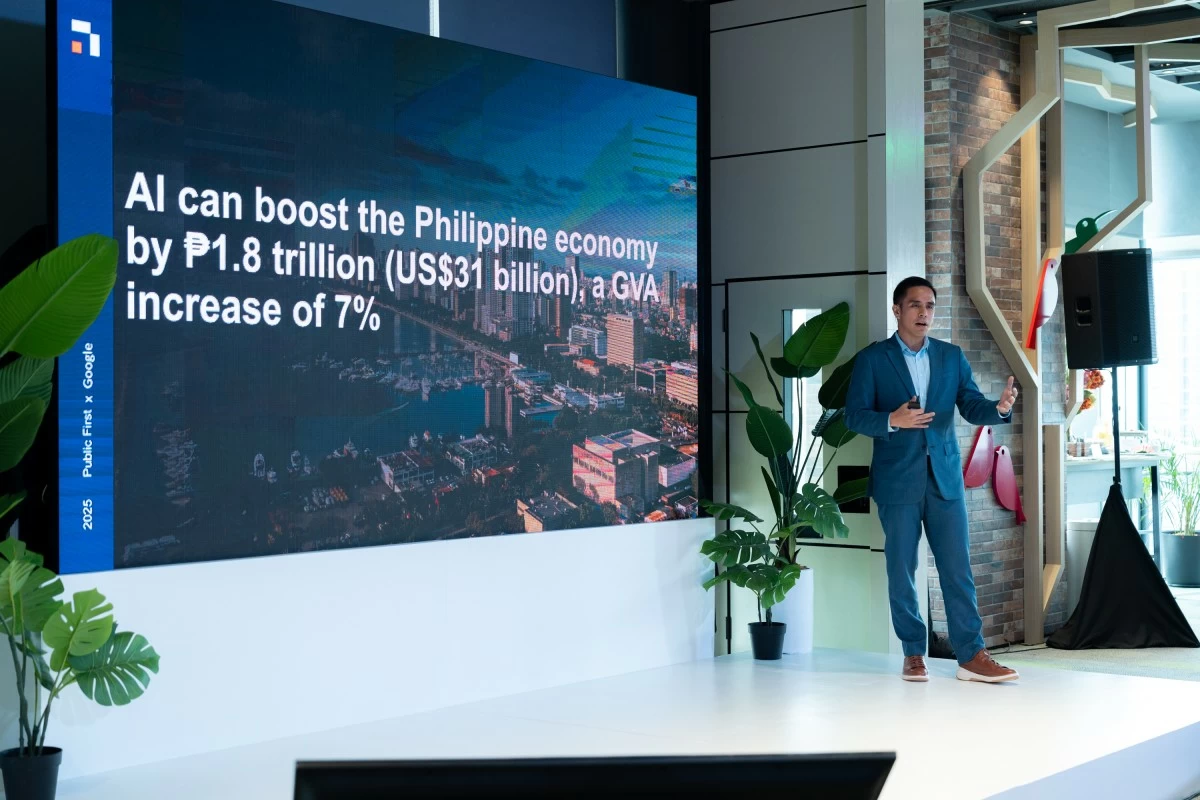
Google Country Marketing Manager for Vietnam and the Philippines Gabby Roxas explains the latest projections for the country’s economic growth once it invests in AI in the workforce, predicting a possible boost of up to ₱1.8 trillion in gross value added.
Gabby Roxas, Country Marketing Manager (Google Vietnam & Philippines), Pat Choa, Site Director (Google Philippines), and Rudy Guiao, CIO Lead, Managing Director for IT in the Philippines, China, and SEA, and Managing Director sponsor for Corporate Citizenship & Disability Inclusion (Accenture).
ADVERTISEMENT
.most-popular .layout-ratio{ padding-bottom: 79.13%; } @media (min-width: 768px) and (max-width: 1024px) { .widget-title { font-size: 15px !important; } }

{{ articles_filter_1561_widget.title }}

.most-popular .layout-ratio{ padding-bottom: 79.13%; } @media (min-width: 768px) and (max-width: 1024px) { .widget-title { font-size: 15px !important; } }

{{ articles_filter_1562_widget.title }}

.most-popular .layout-ratio{ padding-bottom: 79.13%; } @media (min-width: 768px) and (max-width: 1024px) { .widget-title { font-size: 15px !important; } }

{{ articles_filter_1563_widget.title }}

{{ articles_filter_1564_widget.title }}

.mb-article-details { position: relative; } .mb-article-details .article-body-preview, .mb-article-details .article-body-summary{ font-size: 17px; line-height: 30px; font-family: "Libre Caslon Text", serif; color: #000; } .mb-article-details .article-body-preview iframe , .mb-article-details .article-body-summary iframe{ width: 100%; margin: auto; } .read-more-background { background: linear-gradient(180deg, color(display-p3 1.000 1.000 1.000 / 0) 13.75%, color(display-p3 1.000 1.000 1.000 / 0.8) 30.79%, color(display-p3 1.000 1.000 1.000) 72.5%); position: absolute; height: 200px; width: 100%; bottom: 0; display: flex; justify-content: center; align-items: center; padding: 0; } .read-more-background a{ color: #000; } .read-more-btn { padding: 17px 45px; font-family: Inter; font-weight: 700; font-size: 18px; line-height: 16px; text-align: center; vertical-align: middle; border: 1px solid black; background-color: white; } .hidden { display: none; }
function initializeAllSwipers() { // Get all hidden inputs with cms_article_id document.querySelectorAll('[id^="cms_article_id_"]').forEach(function (input) { const cmsArticleId = input.value; const articleSelector = '#article-' + cmsArticleId + ' .body_images'; const swiperElement = document.querySelector(articleSelector); if (swiperElement && !swiperElement.classList.contains('swiper-initialized')) { new Swiper(articleSelector, { loop: true, pagination: false, navigation: { nextEl: '#article-' + cmsArticleId + ' .swiper-button-next', prevEl: '#article-' + cmsArticleId + ' .swiper-button-prev', }, }); } }); } setTimeout(initializeAllSwipers, 3000); const intersectionObserver = new IntersectionObserver( (entries) => { entries.forEach((entry) => { if (entry.isIntersecting) { const newUrl = entry.target.getAttribute("data-url"); if (newUrl) { history.pushState(null, null, newUrl); let article = entry.target; // Extract metadata const author = article.querySelector('.author-section').textContent.replace('By', '').trim(); const section = article.querySelector('.section-info ').textContent.replace(' ', ' '); const title = article.querySelector('.article-title h1').textContent; // Parse URL for Chartbeat path format const parsedUrl = new URL(newUrl, window.location.origin); const cleanUrl = parsedUrl.host + parsedUrl.pathname; // Update Chartbeat configuration if (typeof window._sf_async_config !== 'undefined') { window._sf_async_config.path = cleanUrl; window._sf_async_config.sections = section; window._sf_async_config.authors = author; } // Track virtual page view with Chartbeat if (typeof pSUPERFLY !== 'undefined' && typeof pSUPERFLY.virtualPage === 'function') { try { pSUPERFLY.virtualPage({ path: cleanUrl, title: title, sections: section, authors: author }); } catch (error) { console.error('ping error', error); } } // Optional: Update document title if (title && title !== document.title) { document.title = title; } } } }); }, { threshold: 0.1 } ); function showArticleBody(button) { const article = button.closest("article"); const summary = article.querySelector(".article-body-summary"); const body = article.querySelector(".article-body-preview"); const readMoreSection = article.querySelector(".read-more-background"); // Hide summary and read-more section summary.style.display = "none"; readMoreSection.style.display = "none"; // Show the full article body body.classList.remove("hidden"); } document.addEventListener("DOMContentLoaded", () => { let loadCount = 0; // Track how many times articles are loaded const offset = [1, 2, 3, 4, 5, 6, 7, 8, 9, 10]; // Offset values const currentUrl = window.location.pathname.substring(1); let isLoading = false; // Prevent multiple calls if (!currentUrl) { console.log("Current URL is invalid."); return; } const sentinel = document.getElementById("load-more-sentinel"); if (!sentinel) { console.log("Sentinel element not found."); return; } function isSentinelVisible() { const rect = sentinel.getBoundingClientRect(); return ( rect.top < window.innerHeight && rect.bottom >= 0 ); } function onScroll() { if (isLoading) return; if (isSentinelVisible()) { if (loadCount >= offset.length) { console.log("Maximum load attempts reached."); window.removeEventListener("scroll", onScroll); return; } isLoading = true; const currentOffset = offset[loadCount]; window.loadMoreItems().then(() => { let article = document.querySelector('#widget_1690 > div:nth-last-of-type(2) article'); intersectionObserver.observe(article) loadCount++; }).catch(error => { console.error("Error loading more items:", error); }).finally(() => { isLoading = false; }); } } window.addEventListener("scroll", onScroll); });

Sign up by email to receive news.