






Manila Bulletin
 Philippines
National
Marcos signs law liberalizing long-term land leases for foreign investors
Philippines
National
Marcos signs law liberalizing long-term land leases for foreign investors
Philippines
National
Marcos signs law liberalizing long-term land leases for foreign investors
Marcos signs law liberalizing long-term land leases for foreign investors
Published Sep 5, 2025 06:55 am


At A Glance
- The new measure, approved on Sept. 3, aims to encourage foreign investments while ensuring a stable environment for foreign investors by making lease contracts more reliable.
President Marcos has signed into law Republic Act No. 12252, amending the Investors’ Lease Act to allow foreign investors to lease private lands in the Philippines for up to 99 years, under stricter safeguards and accountability measures.
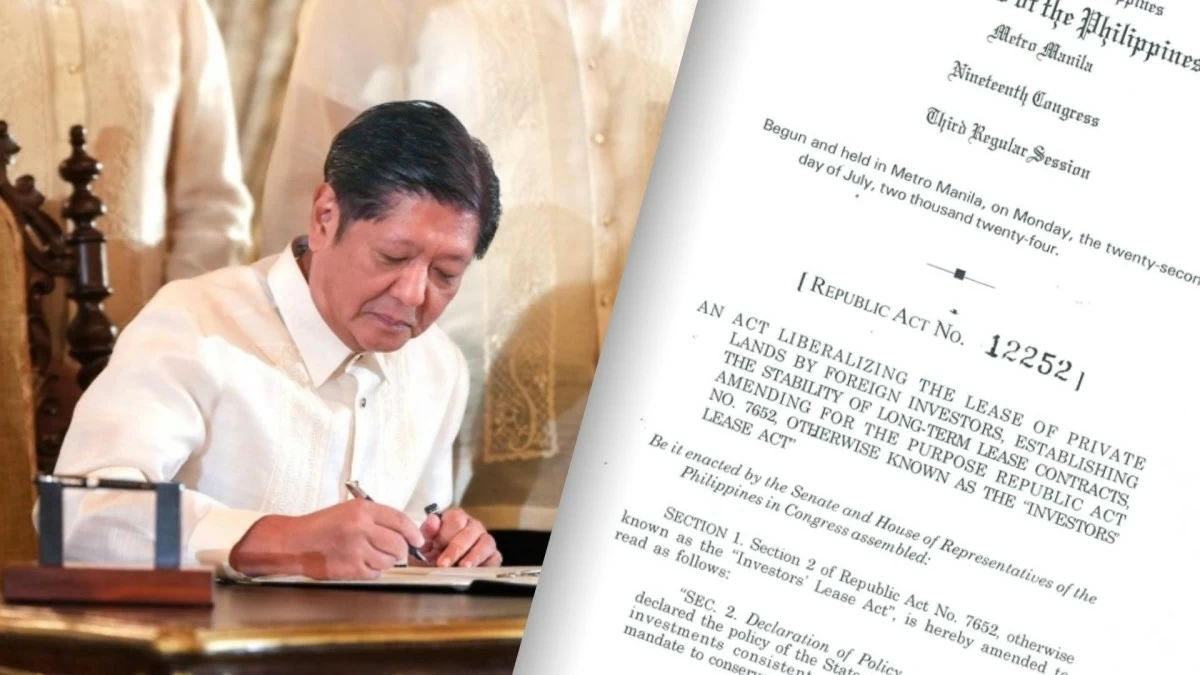
File photos
The new measure, approved on Sept. 3, aims to encourage foreign investments while ensuring a stable environment for foreign investors by making lease contracts more reliable.
It also adopts a "flexible and dynamic policy" on the granting of long-term leases on private lands to foreign investors for the establishment of industrial estates, factories, assembly or processing plants, agro-industrial enterprises, land development for commercial use, tourism, agriculture, agro-forestry, ecological conservation, and other similar priority productive endeavors.
Long-term leases for investments
Under the amended law, foreign investors with duly registered projects may now enter into lease agreements for private lands for a maximum of 99 years. The lease period may be shortened if deemed necessary by the President, particularly for investments in vital services or critical infrastructure.
The leased land must be used exclusively for the approved investment project and be proportionate to the project’s requirements. Contracts must be registered with the Registry of Deeds and annotated on the land’s title to be binding against third parties.
Registered contracts cannot be altered or canceled except through direct legal proceedings, a provision meant to strengthen investor confidence and ensure predictability.
Safeguards and penalties
The law emphasizes that lease agreements will be terminated if the investment is withdrawn or the land is used for purposes other than what was approved.
For tourism projects, only ventures with a minimum investment of $5 million, with at least 70 percent infused within three years, will qualify.
Renewals of leases are subject to mutual agreement but will require proof of tangible social and economic contributions to the country.
Violations—including contracts exceeding the 99-year limit, illegal land use, or unauthorized expansion of leased areas—will render agreements null and void.
Offenders face fines ranging from P1 million to P10 million and imprisonment of six months to six years, or both.
Subleases and oversight
Foreign lessees may sublease the property only with the consent of the lessor, unless expressly prohibited by the main lease contract. All sublease contracts are also required to be registered with the Registry of Deeds and annotated on the title.
To prevent abuses, the Board of Investments (BOI), the Fiscal Incentives Review Board (FIRB), and other investment promotion agencies may require lessees to explain delays if projects fail to start within three years. Continued non-compliance could result in the revocation of entitlements under the law.
Implementing rules
The Department of Trade and Industry, through the BOI and the Land Registration Authority, has been tasked to issue the implementing rules and regulations within 90 days of the law’s effectivity.
RA 12252 takes effect 15 days after its publication in the Official Gazette or a newspaper of general circulation.