ADVERTISEMENT

EY GDS Philippines eyes AI-native future as it targets 10,000 workforce

Published Sep 4, 2025 04:44 pm
EY GDS Philippines announces plans to expand its employee base to 10,000 by 2030.
A decade since its entry into the country, professional services firm EY Global Delivery Services (GDS) Philippines is eyeing to expand its employee base by up to 10,000 by 2030.
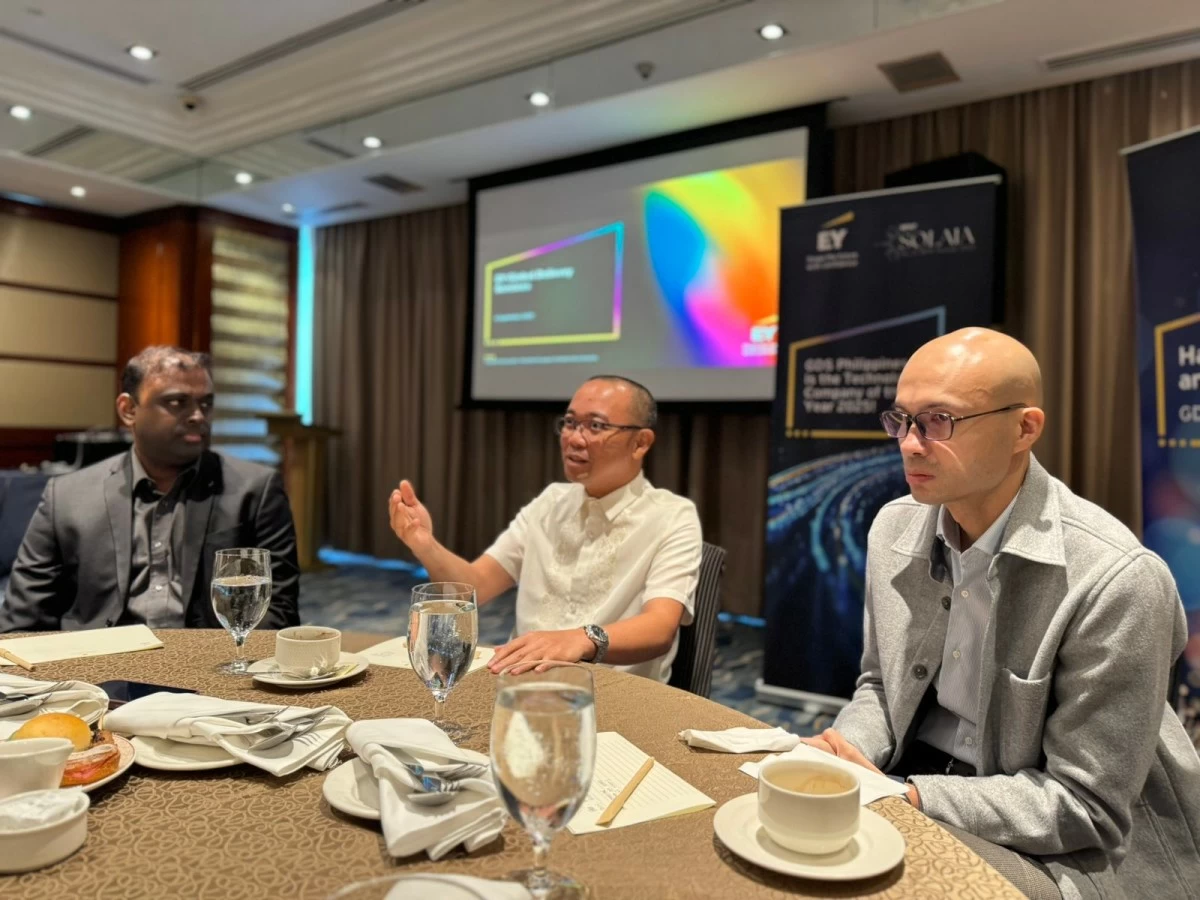
In a media roundtable discussion on Thursday, Sept. 4, Denchu Jose Decino, President of Ernst & Young Global Services (Philippines), Inc., and EY GDS (CS) Philippines, Inc., announced that the company plans to accelerate its talent headcount through office expansion.
“We’re also looking forward to our future growth from where we are to about 10,000 in three to five years, because in that world where there’s a lot of disruption, we want to be there to advise our clients,” he told reporters.
Decino, who is also EY GDS Philippines Location Leader, said that the company is expanding beyond Metro Manila due to global demand for more service workers.
“We will continue to grow [in] Manila, but we will also be growing [in] Cebu, and we are looking forward to inaugurating our new office this May 1st next year. It’s part of this multi-month celebration of our 10th anniversary,” he said.
Apart from increasing the employee count, Decino said that EY GDS is looking to improve its service lines, which include providing tax, assurance, and consulting services, as well as EY-Parthenon services, to its partner firms.
“The growth that we’re envisioning is that we’re really trying to double our impact across all of our service lines. That could mean a headcount growth, say in a particular service line,” the executive elaborated.
“It could also be in the use of AI agents that will complement and supplement our human workforce. The overall push is really double our impact, utilize technology [by] being a technology powerhouse within the EY network, leverage technology and AI.”
Raymond Garret Go, Consulting Leader of EY GDS, explained that its talent base, track record, and plans to raise the overall revenue drove the company to increase its headcount further.
“Over the years, we’ve proven that we can take on really complex type of work. In the past 10 years, that has been our journey, and we’re able to really deliver world-class talents to our best customers. So that’s confidence that our member firms across the world have in us,” Go said.
According to Go, the company’s global goal is to raise its revenues twice as high as the current $50 billion.
“As a firm, globally, we look at the opportunity to grow double… to $100 billion,” he said.
Ten years since it began operations in the Philippines, the Information Technology and Business Process Management (IT-BPM) industry has rapidly grown. Once considered less complex, the sector now handles higher-value and more specialized work.
Karthik Bhaskaran, Assurance Leader of EY GDS, said that “10 years back, a lot of our clients and any other member firms across used to use a lot of paper-related work, right? And the more you have things on paper in an office, the [more] difficult it is to collaborate… But today it is all electronic, right? So that is another key differentiator where things can be done in real time.”
He noted that a decade ago, when the Philippine branch had only 25 professionals, tasks were more basic, such as scanning documents, whereas today technological advancements and continuous employee upskilling have allowed the workforce to take on more complex, higher-value activities.
As EY GDS continues to operate as a global delivery network across nine locations and 19 cities, it plans to expand its use of artificial intelligence (AI) by enabling its workforce to become ‘AI native’ in the future.
ADVERTISEMENT
.most-popular .layout-ratio{ padding-bottom: 79.13%; } @media (min-width: 768px) and (max-width: 1024px) { .widget-title { font-size: 15px !important; } }

{{ articles_filter_1561_widget.title }}

.most-popular .layout-ratio{ padding-bottom: 79.13%; } @media (min-width: 768px) and (max-width: 1024px) { .widget-title { font-size: 15px !important; } }

{{ articles_filter_1562_widget.title }}

.most-popular .layout-ratio{ padding-bottom: 79.13%; } @media (min-width: 768px) and (max-width: 1024px) { .widget-title { font-size: 15px !important; } }

{{ articles_filter_1563_widget.title }}

{{ articles_filter_1564_widget.title }}

.mb-article-details { position: relative; } .mb-article-details .article-body-preview, .mb-article-details .article-body-summary{ font-size: 17px; line-height: 30px; font-family: "Libre Caslon Text", serif; color: #000; } .mb-article-details .article-body-preview iframe , .mb-article-details .article-body-summary iframe{ width: 100%; margin: auto; } .read-more-background { background: linear-gradient(180deg, color(display-p3 1.000 1.000 1.000 / 0) 13.75%, color(display-p3 1.000 1.000 1.000 / 0.8) 30.79%, color(display-p3 1.000 1.000 1.000) 72.5%); position: absolute; height: 200px; width: 100%; bottom: 0; display: flex; justify-content: center; align-items: center; padding: 0; } .read-more-background a{ color: #000; } .read-more-btn { padding: 17px 45px; font-family: Inter; font-weight: 700; font-size: 18px; line-height: 16px; text-align: center; vertical-align: middle; border: 1px solid black; background-color: white; } .hidden { display: none; }
function initializeAllSwipers() { // Get all hidden inputs with cms_article_id document.querySelectorAll('[id^="cms_article_id_"]').forEach(function (input) { const cmsArticleId = input.value; const articleSelector = '#article-' + cmsArticleId + ' .body_images'; const swiperElement = document.querySelector(articleSelector); if (swiperElement && !swiperElement.classList.contains('swiper-initialized')) { new Swiper(articleSelector, { loop: true, pagination: false, navigation: { nextEl: '#article-' + cmsArticleId + ' .swiper-button-next', prevEl: '#article-' + cmsArticleId + ' .swiper-button-prev', }, }); } }); } setTimeout(initializeAllSwipers, 3000); const intersectionObserver = new IntersectionObserver( (entries) => { entries.forEach((entry) => { if (entry.isIntersecting) { const newUrl = entry.target.getAttribute("data-url"); if (newUrl) { history.pushState(null, null, newUrl); let article = entry.target; // Extract metadata const author = article.querySelector('.author-section').textContent.replace('By', '').trim(); const section = article.querySelector('.section-info ').textContent.replace(' ', ' '); const title = article.querySelector('.article-title h1').textContent; // Parse URL for Chartbeat path format const parsedUrl = new URL(newUrl, window.location.origin); const cleanUrl = parsedUrl.host + parsedUrl.pathname; // Update Chartbeat configuration if (typeof window._sf_async_config !== 'undefined') { window._sf_async_config.path = cleanUrl; window._sf_async_config.sections = section; window._sf_async_config.authors = author; } // Track virtual page view with Chartbeat if (typeof pSUPERFLY !== 'undefined' && typeof pSUPERFLY.virtualPage === 'function') { try { pSUPERFLY.virtualPage({ path: cleanUrl, title: title, sections: section, authors: author }); } catch (error) { console.error('ping error', error); } } // Optional: Update document title if (title && title !== document.title) { document.title = title; } } } }); }, { threshold: 0.1 } ); function showArticleBody(button) { const article = button.closest("article"); const summary = article.querySelector(".article-body-summary"); const body = article.querySelector(".article-body-preview"); const readMoreSection = article.querySelector(".read-more-background"); // Hide summary and read-more section summary.style.display = "none"; readMoreSection.style.display = "none"; // Show the full article body body.classList.remove("hidden"); } document.addEventListener("DOMContentLoaded", () => { let loadCount = 0; // Track how many times articles are loaded const offset = [1, 2, 3, 4, 5, 6, 7, 8, 9, 10]; // Offset values const currentUrl = window.location.pathname.substring(1); let isLoading = false; // Prevent multiple calls if (!currentUrl) { console.log("Current URL is invalid."); return; } const sentinel = document.getElementById("load-more-sentinel"); if (!sentinel) { console.log("Sentinel element not found."); return; } function isSentinelVisible() { const rect = sentinel.getBoundingClientRect(); return ( rect.top < window.innerHeight && rect.bottom >= 0 ); } function onScroll() { if (isLoading) return; if (isSentinelVisible()) { if (loadCount >= offset.length) { console.log("Maximum load attempts reached."); window.removeEventListener("scroll", onScroll); return; } isLoading = true; const currentOffset = offset[loadCount]; window.loadMoreItems().then(() => { let article = document.querySelector('#widget_1690 > div:nth-last-of-type(2) article'); intersectionObserver.observe(article) loadCount++; }).catch(error => { console.error("Error loading more items:", error); }).finally(() => { isLoading = false; }); } } window.addEventListener("scroll", onScroll); });

Sign up by email to receive news.