






Manila Bulletin
 Philippines
National
From 'hopeless case' to hope: 2025 Ramon Magsaysay Awardee Fr. Flavie Villanueva inspires Filipino youth
Philippines
National
From 'hopeless case' to hope: 2025 Ramon Magsaysay Awardee Fr. Flavie Villanueva inspires Filipino youth
Philippines
National
From 'hopeless case' to hope: 2025 Ramon Magsaysay Awardee Fr. Flavie Villanueva inspires Filipino youth
From 'hopeless case' to hope: 2025 Ramon Magsaysay Awardee Fr. Flavie Villanueva inspires Filipino youth
Published Sep 3, 2025 12:18 pm
|
Updated Sep 3, 2025 02:13 pm


At A Glance
- 2025 Ramon Magsaysay Awardee Fr. Flavie Villanueva's personal journey of addiction, recovery, and transformation laid the foundation for his mission to serve the marginalized
- He advocates for addressing homelessness and addiction with care, mental health support, and community-driven rehabilitation instead of punitive measures
- Villanueva urges young Filipinos not to lose hope, reminding them that they are not just seekers of healing but also bearers of the nation's future

From rock bottom to priesthood—2025 Ramon Magsaysay Awardee Fr. Flaviano “Flavie” Villanueva, speaking at the Ramon Magsaysay Awardees Press Day on September 3, 2025, shared how his journey of recovery became a mission to serve the most vulnerable.
For many young Filipinos, life today feels like an uphill climb—where poverty, limited opportunities, and the burden of violence or fractured families leave countless disheartened and searching for direction.
To this generation, Fr. Flaviano Antonio L. Villanueva, recipient of the 2025 Ramon Magsaysay Award, offers his most urgent message: “Be not afraid. Don’t lose hope.”
From rock bottom to priesthood
Villanueva, fondly called “Father Flavie,” shared during a press conference via Zoom on Wednesday, Sept. 3, that he knew all too well what it means to feel lost.
At 14, right after graduating from grade school, he began smoking and soon spiraled into substance use.
“Right after graduating from Grade 6,” Villanueva recalled. “I started getting involved in vices. That’s how it is—it begins with one puff, one likes it, and then it becomes part of the group,” he added.
By 1995, Villanueva said he hit “rock bottom.”
“I secluded myself and went cold turkey,” he recalled. “That’s when I realized there must be something higher or more valuable to life than what I was doing,” he added.
That realization led Villanueva to the priesthood, where his own journey of recovery became the foundation of his mission: to serve those society has abandoned.
Through the Kalinga Center and the Dambana ng Paghilom, he has built communities of care—feeding the hungry, rehabilitating the homeless, and walking with widows and orphans scarred by the drug war.
The Ramon Magsaysay Award—the region’s most prestigious honor—recognizes not just his service but also his courage to speak truth to power and insist that the most vulnerable deserve dignity, healing, and hope.
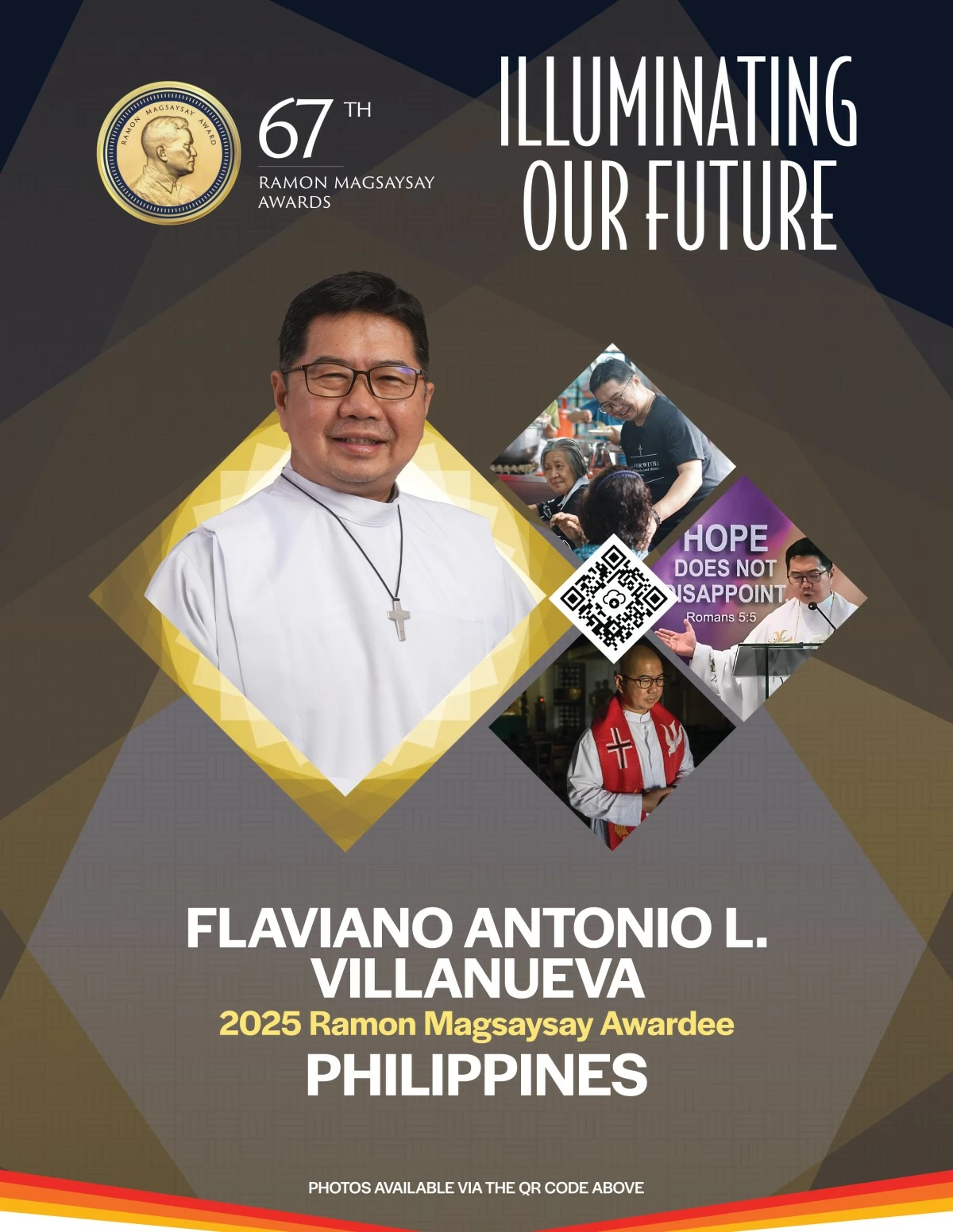
The 2025 Ramon Magsaysay Award honors Fr. Flaviano Antonio L. Villanueva for his lifelong mission of upholding the dignity of the poor and oppressed—living proof that in serving the least, all are restored. (Photo courtesy of RMAF)
“This award is not about me,” Villanueva said. “It speaks about the mission. It calls us to bring back decency in our lives.”
Caring, not killing
Villanueva has been vocal about addressing homelessness and addiction with compassion, not condemnation.
“Drug addicts are people in need of mental and health care,” he said. “They should not be pushed aside. They should never be killed.”
But he also pointed to a deeper issue afflicting society: apathy.
“People just stopped caring,” he lamented. “Unless we start caring, we will sadly find ourselves in a cycle of poverty.”
Diagnosing the real problem
Asked how institutions like the Church and government can guide young Filipinos, Villanueva insisted that their struggles must be “diagnosed correctly.”
Drug addiction, he stressed, is not just an issue of law and order—it is also a mental health issue. “We need to understand that they are human beings in need of mental and basic care,” he said.
For him, community-driven initiatives such as community-based rehabilitation programs are far more effective than punitive ones.
These programs give young people struggling with trauma or addiction the chance to be embraced with compassion rather than condemned.
Healing through collaboration
Healing, Villanueva stressed, is not the task of one sector alone.
“Only when we work hand in hand—Church, government, and society—can we address their real needs,” he said.
Despite sedition charges, threats, and doubts from even his own family in the past, Villanueva has persisted in his mission. He says he draws strength from “angels of hope” who remind him why he cannot stop.
A message to the youth
At the heart of Villanueva’s mission is a deeply personal appeal to young Filipinos who feel overwhelmed by life’s burdens.
“To the youth: Be not afraid. You are not alone on the journey of finding life too difficult or stressful. There are people who care—you only need to look behind you, beside you,” he said.

‘Be not afraid. Don’t lose hope.’ Fr. Villanueva urges Filipino youth to hold on and become bearers of hope amid poverty, violence, and disillusionment.
He encouraged them to break their silence and share their struggles, insisting that this act of openness is already a victory. “If you start opening up, the problem is half-solved. And when that happens, there’s hope.”
Villanueva reminded the youth in particular that they are not just seekers of hope but its bearers. “Don’t lose hope. You, the youth, are our hope.”
The hope of a nation
In a time when disillusionment weighs heavily on the young, Villanueva’s voice rings clear: hope is not naïve optimism, but a conscious choice to keep going, to care for one another, and to rebuild broken communities.
“I had friends and family who believed that I was a hopeless case,” Villanueva said. “They all doubted—I even doubted myself. I thought I was not worthy of this kind of life.”
However, his Ramon Magsaysay Award affirmed what many who know him already believe—that his life is a testament to how healing begins not with grand policies but with compassion, courage, and the unwavering belief that no one should ever walk alone.
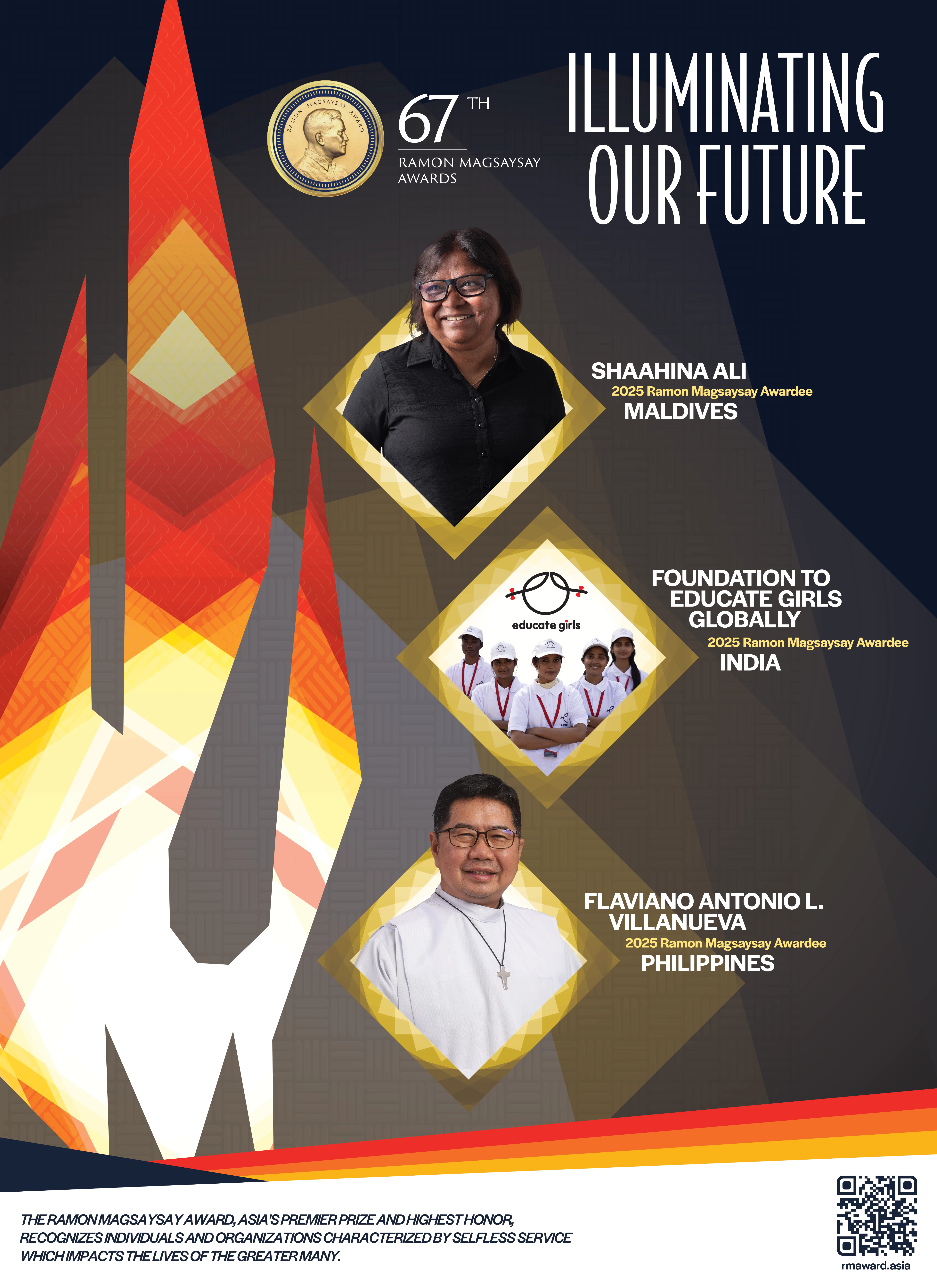
Completing the 2025 Ramon Magsaysay Awardees are Shaahina Ali of the Maldives and India’s Educate Girls, who will be honored at the 67th Awards Ceremony on November 7, 2025 at the Metropolitan Theatre, Manila (Courtesy of RMFA)
“What I have learned in this life is that there will be people who condemn you, but there will also always be people who encourage and care. They become ‘angels of hope’—inspirations who propel me forward,” he added.