







Rethinking Digital Infrastructure
By Carl Javier
Published Sep 2, 2025 09:00 am
|
Updated Sep 1, 2025 09:24 am


Appreciate the phone in your pocket. I’m not just talking about all the apps and capabilities and camera lenses and things you consciously use it for. Consider how powerful this machine is. The processing power of today’s simplest smartphones today would be equivalent to an 80s supercomputer. Its ubiquity makes us take it for granted.
Now consider that despite all of us having supercomputers in our pockets, so much computing happens in the cloud. Invisible to us, largely unnoticed, seamlessly integrated into the things we do.
This is part of the conversation I had with Vertiv’s Senior Director for Enterprise Sales in Emerging Markets for Asia, Jordan Koh. Vertiv is a global provider of critical digital infrastructure and continuity solutions. They recently held their 2025 Asia Channel Summit that showcased future-ready solutions. These included AI-ready systems, high-density power designs, advanced liquid cooling technologies, and more.
Paths to Data and AI Sovereignty
We might not think about it, but every time we throw a query into a chatbot, data is traveling to wherever the chatbot’s data centers are, probably crossing borders. If you are merely doing silly things with AI, no worries right?. But anyone operating at the enterprise and government level knows that these cross-border data flows are vulnerabilities that could be exploited.
And if nothing else, our reliance on cloud, AI, and digital services from providers in different parts of the world render us vulnerable to price changes and other instabilities created by the geopolitical and economic landscape. Koh says, "national sovereignty is going to be reliant on the ability to store, house, (and) analyze data locally... And with that in mind, data residency will be needed because you cannot pump the data to somewhere else offshore."
As we attempt to digitalize more government and business services, we can see how much data infrastructure is needed. Add AI into the mix and that need is multiplied drastically.
In addition to questions of sovereignty, there’s also the simple fact that data traveling outside can cause problems in terms of privacy and speed. Koh gives the example of AI-powered healthcare processing. "You don't want to pop it up into the cloud, have it turned somewhere else and then come back, right? You want it local," Koh explains. "The data collected locally, it's processed, analyzed locally. The decisions are made out of those analyses made locally.”

Redesigning our approach to digital infrastructure
When power demands increase, the obvious approach is to add generators. When servers overheat, add more cooling. But Koh says that with the demands of technology like AI, we have an opportunity to rethink this approach, “...how do we relook at your existing infrastructure and how do we then redesign or reoptimize. So that is a sustainability effort, in my opinion, right? Basically, if you do that well, basically we don't need to power more." He adds to this thought, “...rather than…you need more power. I give you more power. It's too hot. I give you more cooling. That is not dealing with the problem." This creates what he describes as an "endless cycle" that becomes environmentally and economically unsustainable.“
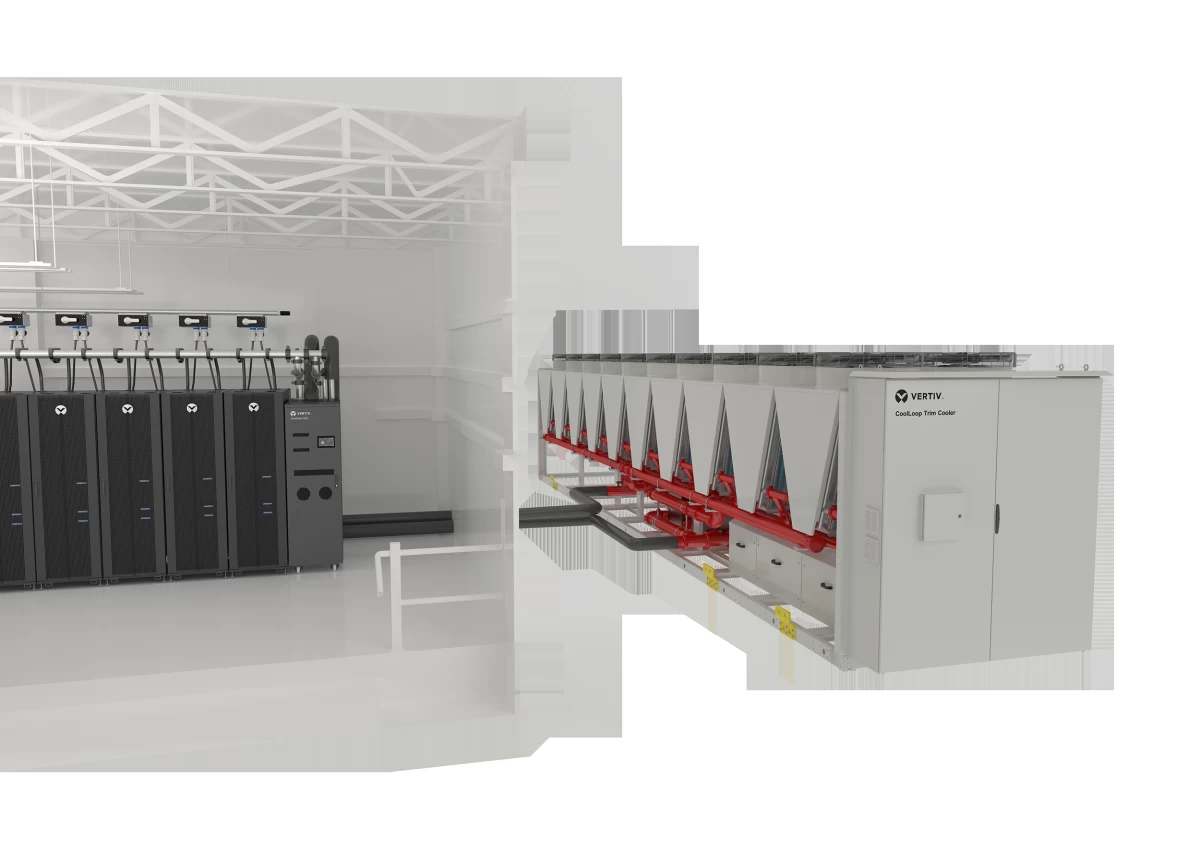
Advanced data center design integrates power management, thermal architecture, and cooling systems from the outset. "When we look at the architecture in totality, cooling could mean indirect cooling, right? So we architected it. We built it into the design so that before the hot air or the heat gets exchanged into the environment (it) is cooled down." This holistic approach addresses multiple challenges simultaneously.
This engineering philosophy extends to modular, scalable infrastructure that can grow incrementally. Rather than requiring massive upfront investment in 20MW facilities, modular approaches allow organizations to "start with 1MW" and expand based on actual demand. This reduces both financial barriers and environmental impact while providing the flexibility to adapt to changing technological requirements.
We need digital infrastructure if we want to be part of an AI-powered future. At the same time, we need to care for our environment and find a path that’s sustainable. Vertiv’s approach offers us one path we can explore that meets these demands.