






Manila Bulletin
 Philippines
National
PNP says no demoralization within ranks as Nartatez holds first command conference
Philippines
National
PNP says no demoralization within ranks as Nartatez holds first command conference
Philippines
National
PNP says no demoralization within ranks as Nartatez holds first command conference
PNP says no demoralization within ranks as Nartatez holds first command conference
Published Aug 29, 2025 12:19 pm


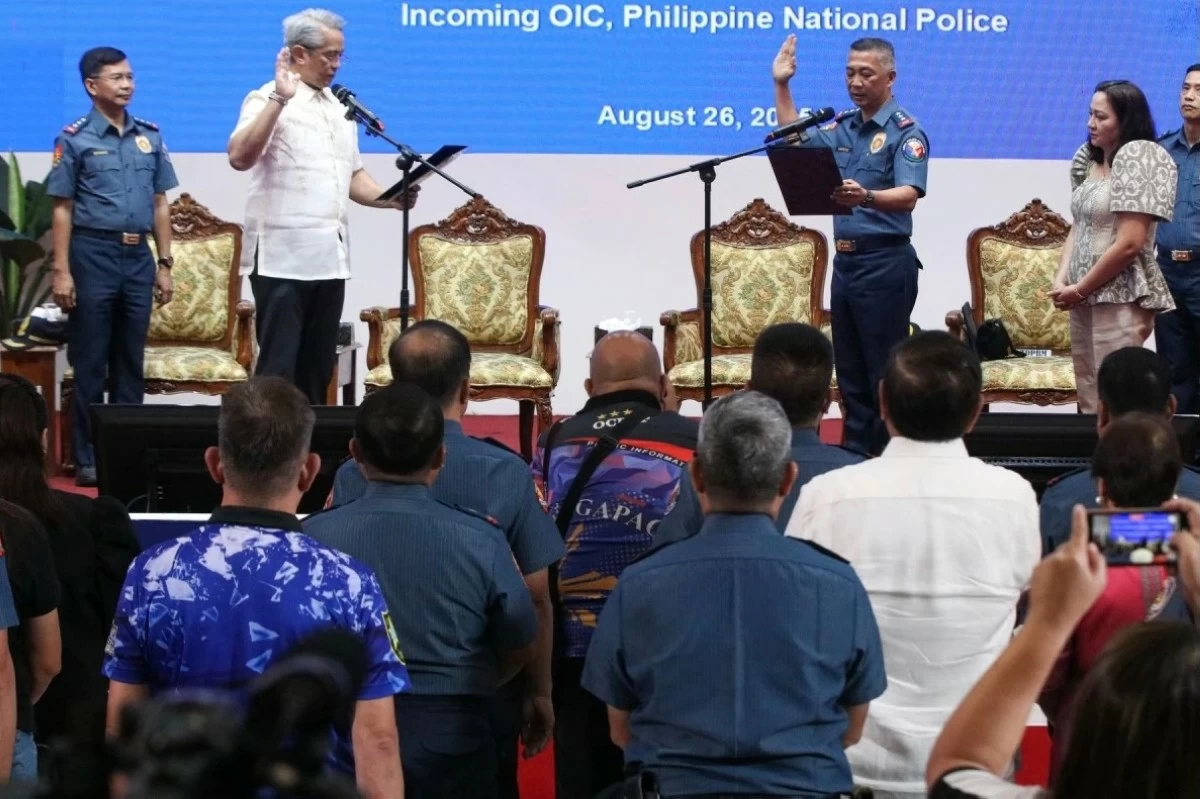
Department of the Interior and Local Government (DILG) Secretary Jonvic Remulla administers the oath-taking of Police Lt. Gen. Jose Melencio Nartatez Jr. as officer-in-charge of the Philippine National Police (PNP) in a ceremony at Camp Crame in Quezon City on Aug. 26, 2025. (Santi San Juan/MANILA BULLETIN)
Police Lt. Gen. Jose Melencio Nartatez Jr. convened his first command conference as the acting chief of the Philippine National Police (PNP) on Friday, Aug. 29, gathering senior police officials to set the tone for his leadership and outline his priorities for the organization while ensuring that there is no demoralization within the police ranks following the sacking of General Nicolas Torre III.
During the top-level meeting at the PNP National Headquarters, Camp Crame in Quezon City, Nartatez stressed his seven-point command guidance, a strategic plan which focuses on improving police operations and effectiveness.
The guidance encompasses enhanced management of police operations, combating specific crimes such as illegal drugs and cybercrime, strengthening security for vital installations, ensuring personnel morale and welfare, and managing human, material, and financial resources. The plan also includes revisiting risk management plans and focusing on public trust through a disciplined and accountable police force.
“Of course, we want the field commanders to be clarified on the details of what he wants to implement regarding his seven-thrust program,” PNP spokesperson Police Brig. Gen. Randulf Tuaño said on the details of the command conference.
“There is no demoralization within the ranks of the PNP,” he stressed, adding that the meeting brought together top commanders and directors from the national headquarters and regional offices.
According to Tuaño, Nartatez would not implement a major reshuffle, saying the new top cop “is a very, very professional officer.”
“Even if you are identified with the former chief PNP (Torre), it will not be a hindrance. What will be the basis is your performance while holding your current position. Even when he was the regional director in Region 4A (Calabarzon) and NCRPO (National Capital Region Police Office), he would never remove an official without a just cause,” the PNP spokesman noted.
Among the first moves that Nartatez made after assuming the post was to remove Police Brig. Gen. Jean as the PNP spokesperson as she is concurrently the director for comptrollership of the PNP.
But Tuaño explained that there was “incompatibility” in the two offices being held by Fajardo. He said being the PNP spokesperson involves handling media and public affairs while the position of the director for comptrollership entails managing the finances of the police organization.
“There is an incompatible office in being the spokesperson and director of comptrollership. The PNP chief is also studying whether the spokesperson of the Office of the Chief PNP should be removed since there is already a Public Information Office under the Office of the Chief PNP,” said Tuaño, who is also the head of the PNP-PIO.
5-minute response
According to Tuaño, Nartatez will also continue Torre’s brainchild, the Five-Minute Response Policy (5MRP), which mandates cops to respond to calls for police assistance within five minutes through the e-911 emergency response.
“The five-minute response time is included in the PNP’s e-911 program. In his program thrust, he [Nartatez] included intensified patrols and police presence, and these are included in the 5MRP,” Tuaño said.
Rank issues
It’s also not an issue for Nartatez if he is not immediately promoted to four-star general. Torre, whose retirement will be in March 2027, currently holds the 4-star rank.
Under the law that created the PNP, the Department of the Interior and Local Government (DILG) Act of 1990 or Republic Act 6975, only one four-star general (Police Director General and later renamed to Police General) shall hold the position of Chief PNP. The next highest positions, namely the Deputy Chief for Administration and Deputy Chief for Operations, and the Chief of the Directorial Staff, shall hold the rank of Police Lieutenant General (three stars).
“The Napolcom (National Police Commission) is studying the status of General Nartatez’s rank because his appointment order states ‘open and close parentheses Police General.’ But if retirement rules are followed, General Nartatez is two weeks younger than General Torre, which means he still has the chance to become a four-star general two weeks before his retirement,” Tuaño said.
Torre’s mandatory retirement will be on March 11, 2027 while Nartatez’ will be on March 19, 2027.
“Technically, Torre is still a police officer who holds the 4-star rank. But he will be on floating status,” Tuaño said. Torre will be placed under the Office of the Chief PNP until he retires but Tuaño said he will no longer have a hand in managing the affairs of the Office of the Chief PNP.
According to Tuaño, it is not the first time that a 3-star police general was not immediately promoted to 4-star after assuming as the Chief PNP.
He said this occurred during the time of former PNP chiefs Roberto Lastimoso and Panfilo Lacson from 1999 to 2000, who only held the 3-star rank since their predecessor, Santiago Aliño retained the 4-star rank after being relieved in 1998. In January 2001, Leandro Mendoza was also a 3-star officer when he assumed as acting Chief PNP following Lacson’s resignation, and his promotion was delayed since Lacson only retired formally two months later.