







Marcos, US senators reaffirm defense, security cooperation
Published Aug 28, 2025 04:33 pm


At A Glance
- Marcos acknowledged the challenges faced by the Philippines, noting that US assistance has been vital in helping the country strengthen its defense capabilities.
President Marcos reaffirmed the Philippines’ long-standing defense and security cooperation with Washington as he welcomed visiting US senators in Malacañan on Thursday, Aug. 28.
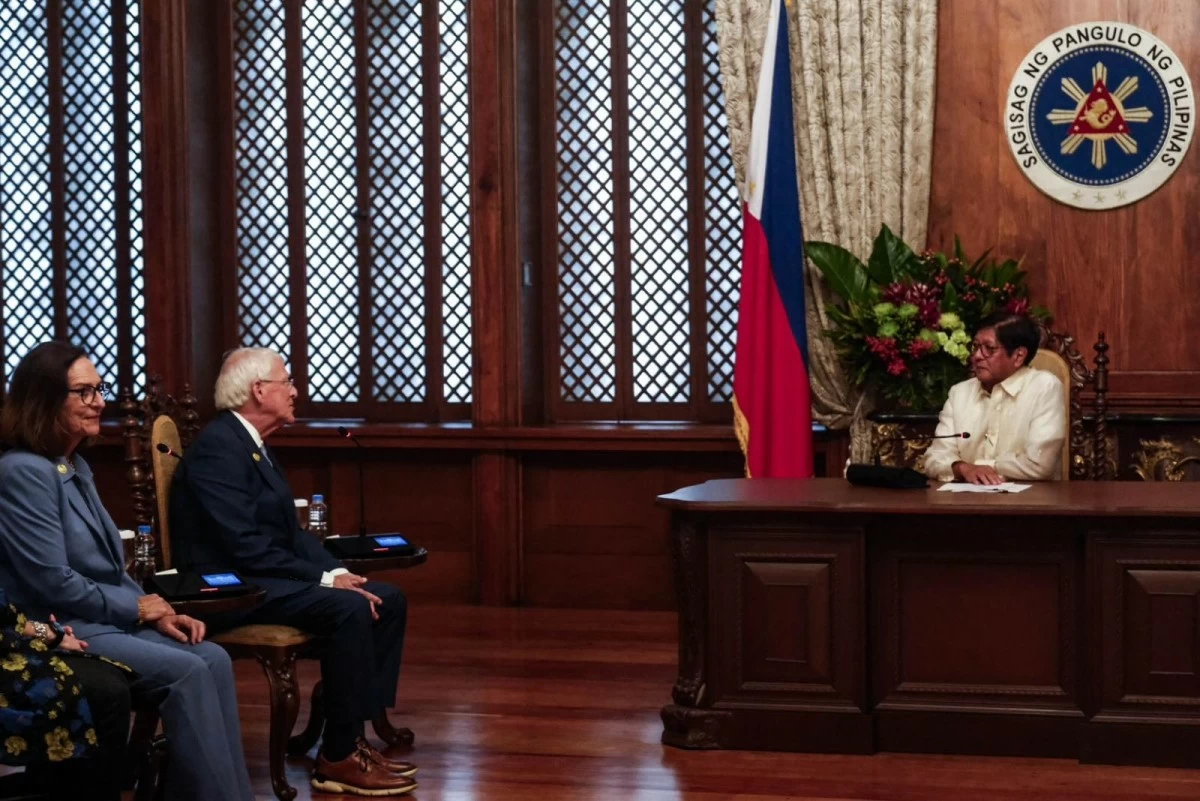
President Ferdinand 'Bongbong' Marcos Jr. receives US Senators Roger Wicker and Deb Fischer, along with the US Senate Armed Services Committee Congressional Delegation, during a courtesy call in Malacañan Palace, on Aug. 28, 2025. The meeting underscored the enduring alliance between the Philippines and the United States, its sole treaty partner. Discussions focused on strengthening mutual defense capabilities and promoting peace and stability in the Indo-Pacific region. (YUMMIE DINGDING / PPA POOL)
In his remarks during the courtesy call of members of the US Senate Armed Services Committee and other congressional delegates, the President described the relationship as one of the country’s oldest and closest partnerships, built over more than a century of shared history.
“There are many things that we have to discuss, considering the very, very close partnership that has been established between the United States and the Philippines, not only in the recent past, but in the previous hundred-plus years of our relationship between our two countries,” he said.
Marcos acknowledged the challenges faced by the Philippines, noting that US assistance has been vital in helping the country strengthen its defense capabilities.
“We are greatly appreciative of all the support that the United States has given us in the face of all the challenges that we in the Philippines are facing, and the continuing support that you have given us with regard to the modernization of our armed forces,” he said.
The Chief Executive also emphasized that Manila is open to ideas and proposals from Washington, not only on bilateral defense matters but also on wider regional cooperation.
“[We] are very willing and very open to any proposals, any suggestions, any ideas that you might have for us to improve the situation here… not only bilateral between the US and the Philippines, but also with our multilateral arrangements that we have made around the region, and even in faraway areas,” he said.
The President added that the visit came at a time of evolving developments in the region.
Senator Roger Wicker, who led the congressional delegation, expressed gratitude for the meeting, calling the US-Philippines relationship one of the strongest and most important in Washington’s engagements in Asia.
“Our relationship is one of the most important, and I would say one of the most growing in terms of closeness that we have,” Wicker said.
He explained that while the delegation originally included five members of the US House of Representatives, rules in their chamber prevented them from joining.
“So you honor us by entertaining a small but very supportive delegation of senators,” he said.
Wicker also noted that despite the short two-night visit, the delegation held substantive discussions with Philippine officials.
“We’ve had conversations with two of your ministers, who have been generous in their time, and we’ve learned so very, very much,” he said.
Meanwhile, President Marcos responded with light humor when Wicker praised the Philippine ambassador to the US, Jose Manuel Romualdez, as “well-known and somewhat of a legend.”
“Is that code for notorious?” Marcos quipped, to which the US senator clarified: “It’s a very positive way that he’s well-known.”