






Manila Bulletin
 Philippines
National
Ditch burdensome travel tax for economy class passengers--Rodriguez
Philippines
National
Ditch burdensome travel tax for economy class passengers--Rodriguez
Philippines
National
Ditch burdensome travel tax for economy class passengers--Rodriguez
Ditch burdensome travel tax for economy class passengers--Rodriguez
Published Aug 27, 2025 09:34 am


At A Glance
- Calling it an undue and outdated burden on Filipinos, Cagayan de Oro City 2nd district Rep. Rufus Rodriguez made a compelling pitch in plenary Tuesday night, Aug. 27 for Congress to do away with the travel tax, particularly for economy class airplane passengers.
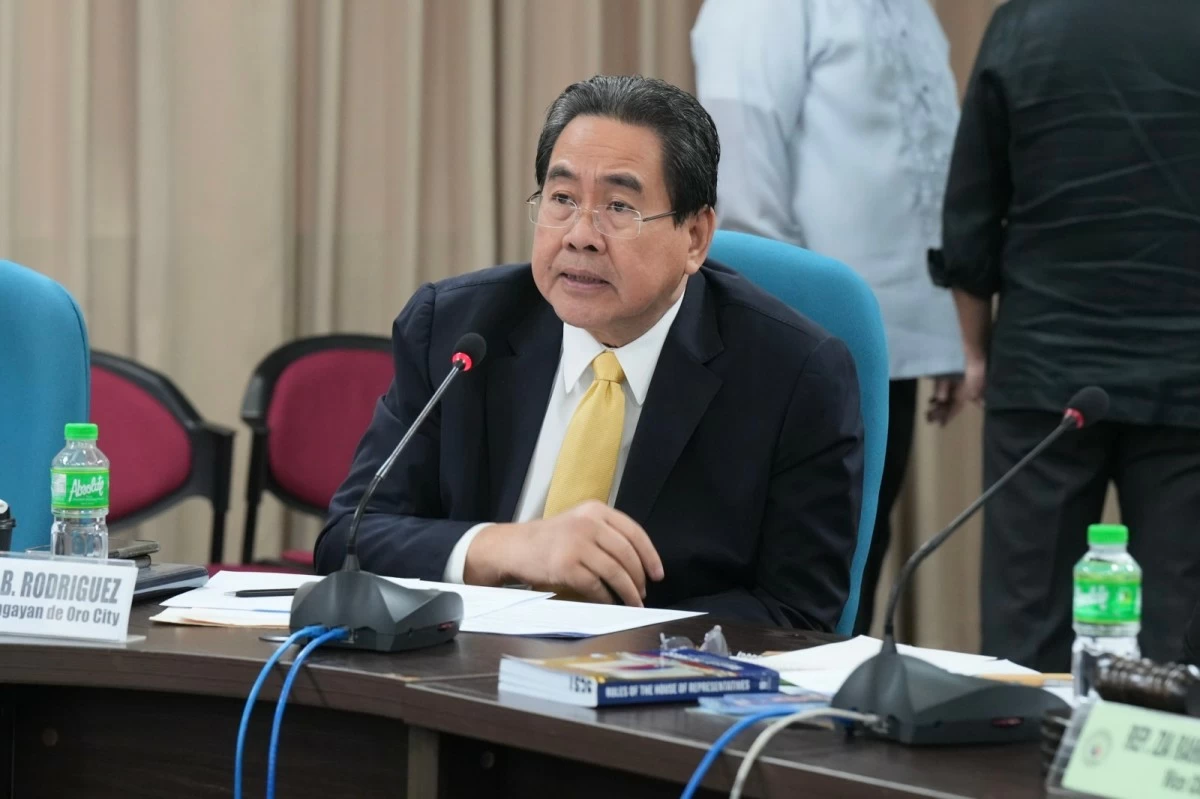
Cagayan de Oro City 2nd district Rep. Rufus Rodriguez (PPAB)
Calling it an undue and outdated burden on Filipinos, Cagayan de Oro City 2nd district Rep. Rufus Rodriguez made a compelling pitch in plenary Tuesday night, Aug. 27 for Congress to do away with the travel tax, particularly for economy class airplane passengers.
In a privilege speech, Rodriguez argued that its the common Filipino--the ones who need to save their money just to afford a plane ticket--who truly bears the brunt of the travel tax.
"Mr. Speaker, I urge this chamber to pass a bill that will abolish the travel tax for all [economy] class passengers retaining it only for business class [passengers] with a higher rate of P3,000, first class travelers with a higher rate of P5,000," he said.
"This is a strong signal that Congress stands for fairness, accessibility and the constitutional right of every Filipino to travel. Let us be the Congress that removes this outdated burden and replace it with a policy more suited to our times," added Rodriguez.
Rodriguez says that save for very few exemptions like overseas Filipino workers (OFW), every Filipino departing or country by air is required to pay this tax regardless of circumstance.
"For families traveling abroad, Mr. Speaker, it becomes an even heavier financial burden. While traveling should uplift the spirit and broaden our horizons, it has become an unnecessary burden for ordinary Filipinos: working men and women in the Philippines, students, retirees who barely save enough to purchase a plane ticket," he said in his speech.
The veteran solon noted that the travel tax was provided for by Presidential Decree (PD) No.1183, signed by the late president Ferdinand Marcos Sr. in 1977. He said it was imposed during a time when the Philippines sought to conserve foreign exchange reserves and fund tourism infrastructure.
"But times have changed," Rodriguez noted.
"The Philippines is no longer under the same economic conditions of the 1970s. Our tourism sector has expanded, our foreign reserves have grown, and ASEAN (Association of Southeast Asian Nations) neighbors have since abandoned similar outdated policies.
"The Philippines and Cambodia remain as the only ASEAN member nations imposing this outdated tax. In Indonesia, Thailand and Singapore, Cambodia, Laos, and Brunei, they pay airport tax or airport fee completely different from a travel tax," said the Committee on Constitutional Amendments chairman.
"What is more concerning is that this tax does not discriminate between rich and poor. Mr. Speaker, let us ask ourselves, who truly bears the brunt of this tax? Is it not the wealthy who can easily afford business or first class tickets? It is the ordinary Filipino, the workers working in the Philippines, the student joining an exchange program. Retirees, micro and small entrepreneurs, employees both in the government and in the private sector," Rodriguez said.
"The families creeping together their savings for a once in a lifetime vacation. For them, the travel tax is a barrier. It is an added expense," he added.
He said Filipinos shouldn't be penalized for exercising their constitutionally-recognized right to travel.
"The message is clear. It is time to modernize our policies. This travel tax was created for a different era. Today, it only acts as a barrier to mobility, a burden on our workers and their families and a contradiction to our commitment to promote tourism and financial inclusion," Rodriguez further said.