ADVERTISEMENT

Researchers uncover Stone Age settlement submerged by rising sea levels in Denmark

Published Aug 26, 2025 11:02 pm
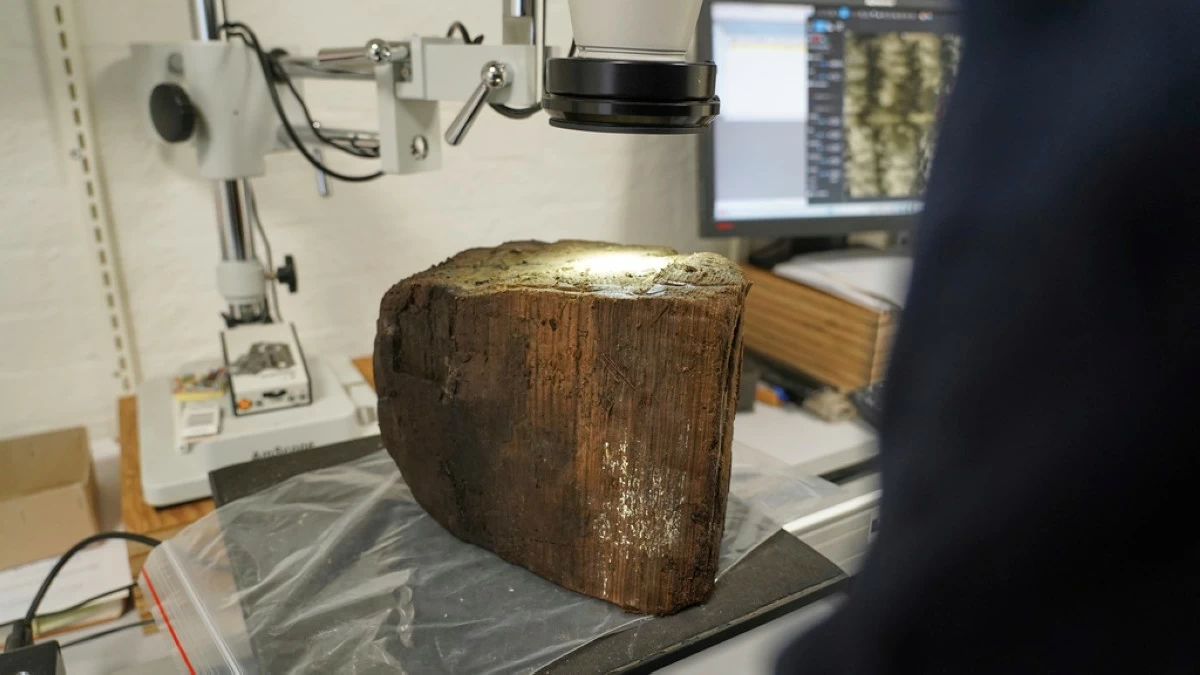
A suspected Stone Age tree trunk, unearthed at an 8,500-year-old coastal settlement submerged by sea level rise in the Bay of Aarhus Aarhus Denmark. Aug.18, 2025. (AP Photo/James Brooks)
BAY OF AARHUS, Denmark (AP) — Below the dark blue waters of the Bay of Aarhus in northern Denmark, archaeologists search for coastal settlements swallowed by rising sea levels more than 8,500 years ago.
This summer, divers descended about 8 meters (26 feet) below the waves close to Aarhus, Denmark's second-biggest city, and collected evidence of a Stone Age settlement from the seabed.
It's part of a 13.2 million euro ($15.5 million) six-year international project to map parts of the seabed in the Baltic and North Seas, funded by the European Union, that includes researchers in Aarhus as well as from the U.K.'s University of Bradford and the Lower Saxony Institute for Historical Coastal Research in Germany.
The goal is to explore sunken Northern European landscapes and uncover lost Mesolithic settlements as offshore wind farms and other sea infrastructure expand.
Global sea levels rose after the last ice age
Most evidence of such settlements so far has been found at locations inland from the Stone Age coast, said underwater archaeologist Peter Moe Astrup, who’s leading underwater excavations in Denmark.
“Here, we actually have an old coastline. We have a settlement that was positioned directly at the coastline,” he said. “What we actually try to find out here is how was life at a coastal settlement.”
After the last ice age, huge ice sheets melted and global sea levels rose, submerging Stone Age settlements and forcing the hunter-gatherer human population inland.
About 8,500 years ago, sea levels rose by about 2 meters (6.5 feet) per century, Moe Astrup said.
Moe Astrup and colleagues at the Moesgaard Museum in Højbjerg, just outside Aarhus, have excavated an area of about 40 square meters (430 square feet) at the small settlement they discovered just off today's coast.
Rising sea levels preserved history “like a time capsule”
Early dives uncovered animal bones, stones tools, arrowheads, a seal tooth, and a small piece of worked wood, likely a simple tool. The researchers are combing the site meter by meter using a kind of underwater vacuum cleaner to collect material for future analysis.
They hope further excavations will find harpoons, fish hooks or traces of fishing structures.
“It’s like a time capsule,” Moe Astrup said. “When sea level rose, everything was preserved in an oxygen-free environment … time just stops.”
“We find completely well-preserved wood,” he added. “We find hazelnut. ... Everything is well preserved.”
Excavations in the relatively calm and shallow Bay of Aarhus and dives off the coast of Germany will be followed by later work at two locations in the more inhospitable North Sea.
The sea level rise thousands of years ago submerged, among other things, a vast area known as Doggerland that connected Britain with continental Europe and now lies underneath the southern North Sea.
To build a picture of the rapid rise of the waters, Danish researchers are using dendrochronology, the study of tree rings.
Submerged tree stumps preserved in mud and sediment can be dated precisely, revealing when rising tides drowned coastal forests.
“We can say very precisely when these trees died at the coastlines,” Moesgaard Museum dendrochronologist Jonas Ogdal Jensen said as he peered at a section of Stone Age tree trunk through a microscope.
“That tells us something about how the sea level changed through time.”
As today's world faces rising sea levels driven by climate change, the researchers hope to shed light on how Stone Age societies adapted to shifting coastlines more than eight millennia ago.
“It’s hard to answer exactly what it meant to people,” Moe Astrup said. “But it clearly had a huge impact in the long run because it completely changed the landscape.”
Sea levels rose by a global average of around 4.3 centimeters (1.7 inches) in the decade up to 2023.

Related Tags

WORLDNEWS
ADVERTISEMENT
.most-popular .layout-ratio{ padding-bottom: 79.13%; } @media (min-width: 768px) and (max-width: 1024px) { .widget-title { font-size: 15px !important; } }

{{ articles_filter_1561_widget.title }}

.most-popular .layout-ratio{ padding-bottom: 79.13%; } @media (min-width: 768px) and (max-width: 1024px) { .widget-title { font-size: 15px !important; } }

{{ articles_filter_1562_widget.title }}

.most-popular .layout-ratio{ padding-bottom: 79.13%; } @media (min-width: 768px) and (max-width: 1024px) { .widget-title { font-size: 15px !important; } }

{{ articles_filter_1563_widget.title }}

{{ articles_filter_1564_widget.title }}

.mb-article-details { position: relative; } .mb-article-details .article-body-preview, .mb-article-details .article-body-summary{ font-size: 17px; line-height: 30px; font-family: "Libre Caslon Text", serif; color: #000; } .mb-article-details .article-body-preview iframe , .mb-article-details .article-body-summary iframe{ width: 100%; margin: auto; } .read-more-background { background: linear-gradient(180deg, color(display-p3 1.000 1.000 1.000 / 0) 13.75%, color(display-p3 1.000 1.000 1.000 / 0.8) 30.79%, color(display-p3 1.000 1.000 1.000) 72.5%); position: absolute; height: 200px; width: 100%; bottom: 0; display: flex; justify-content: center; align-items: center; padding: 0; } .read-more-background a{ color: #000; } .read-more-btn { padding: 17px 45px; font-family: Inter; font-weight: 700; font-size: 18px; line-height: 16px; text-align: center; vertical-align: middle; border: 1px solid black; background-color: white; } .hidden { display: none; }
function initializeAllSwipers() { // Get all hidden inputs with cms_article_id document.querySelectorAll('[id^="cms_article_id_"]').forEach(function (input) { const cmsArticleId = input.value; const articleSelector = '#article-' + cmsArticleId + ' .body_images'; const swiperElement = document.querySelector(articleSelector); if (swiperElement && !swiperElement.classList.contains('swiper-initialized')) { new Swiper(articleSelector, { loop: true, pagination: false, navigation: { nextEl: '#article-' + cmsArticleId + ' .swiper-button-next', prevEl: '#article-' + cmsArticleId + ' .swiper-button-prev', }, }); } }); } setTimeout(initializeAllSwipers, 3000); const intersectionObserver = new IntersectionObserver( (entries) => { entries.forEach((entry) => { if (entry.isIntersecting) { const newUrl = entry.target.getAttribute("data-url"); if (newUrl) { history.pushState(null, null, newUrl); let article = entry.target; // Extract metadata const author = article.querySelector('.author-section').textContent.replace('By', '').trim(); const section = article.querySelector('.section-info ').textContent.replace(' ', ' '); const title = article.querySelector('.article-title h1').textContent; // Parse URL for Chartbeat path format const parsedUrl = new URL(newUrl, window.location.origin); const cleanUrl = parsedUrl.host + parsedUrl.pathname; // Update Chartbeat configuration if (typeof window._sf_async_config !== 'undefined') { window._sf_async_config.path = cleanUrl; window._sf_async_config.sections = section; window._sf_async_config.authors = author; } // Track virtual page view with Chartbeat if (typeof pSUPERFLY !== 'undefined' && typeof pSUPERFLY.virtualPage === 'function') { try { pSUPERFLY.virtualPage({ path: cleanUrl, title: title, sections: section, authors: author }); } catch (error) { console.error('ping error', error); } } // Optional: Update document title if (title && title !== document.title) { document.title = title; } } } }); }, { threshold: 0.1 } ); function showArticleBody(button) { const article = button.closest("article"); const summary = article.querySelector(".article-body-summary"); const body = article.querySelector(".article-body-preview"); const readMoreSection = article.querySelector(".read-more-background"); // Hide summary and read-more section summary.style.display = "none"; readMoreSection.style.display = "none"; // Show the full article body body.classList.remove("hidden"); } document.addEventListener("DOMContentLoaded", () => { let loadCount = 0; // Track how many times articles are loaded const offset = [1, 2, 3, 4, 5, 6, 7, 8, 9, 10]; // Offset values const currentUrl = window.location.pathname.substring(1); let isLoading = false; // Prevent multiple calls if (!currentUrl) { console.log("Current URL is invalid."); return; } const sentinel = document.getElementById("load-more-sentinel"); if (!sentinel) { console.log("Sentinel element not found."); return; } function isSentinelVisible() { const rect = sentinel.getBoundingClientRect(); return ( rect.top < window.innerHeight && rect.bottom >= 0 ); } function onScroll() { if (isLoading) return; if (isSentinelVisible()) { if (loadCount >= offset.length) { console.log("Maximum load attempts reached."); window.removeEventListener("scroll", onScroll); return; } isLoading = true; const currentOffset = offset[loadCount]; window.loadMoreItems().then(() => { let article = document.querySelector('#widget_1690 > div:nth-last-of-type(2) article'); intersectionObserver.observe(article) loadCount++; }).catch(error => { console.error("Error loading more items:", error); }).finally(() => { isLoading = false; }); } } window.addEventListener("scroll", onScroll); });

Sign up by email to receive news.