






Manila Bulletin
 Business
Trade & Industry
Hong Kong eyes stronger trade with Philippines amid US tariff tensions
Business
Trade & Industry
Hong Kong eyes stronger trade with Philippines amid US tariff tensions
Business
Trade & Industry
Hong Kong eyes stronger trade with Philippines amid US tariff tensions
Hong Kong eyes stronger trade with Philippines amid US tariff tensions
Published Aug 26, 2025 04:46 pm


Hong Kong is ramping up its incentive programs and investment facilitation schemes to further boost trade with the Philippines, committing to low trade barriers, in contrast with the protectionist policies of the United States (US).
Invest Hong Kong (InvestHK), the agency responsible for facilitating investments into Hong Kong, expressed optimism over the prospect after the Philippine economy posted growth in the first half.
The Philippines’ gross domestic product (GDP) grew by 5.5 percent in the second quarter, slightly faster than the 5.4 percent posted in the first three months of the year, according to the Philippine Statistics Authority (PSA).
InvestHK Director-General Alpha Lau said this steady economic growth, combined with the Philippines’ growing population, are among the key components for boosting trade.
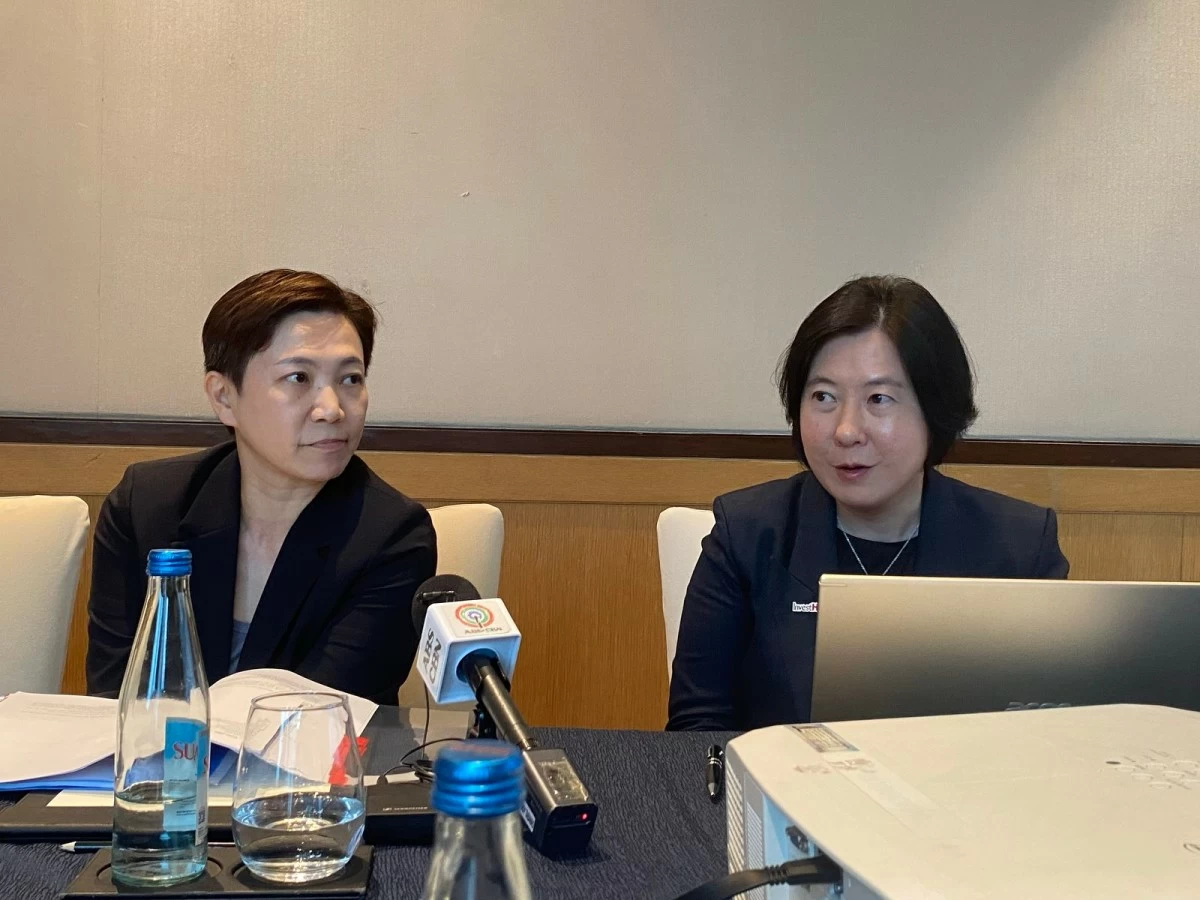
(Left) Hong Kong Economic and Trade Office in Jakarta Director-General Libera Cheng and Invest Hong Kong (InvestHK) Director-General Alpha Lau (Dexter Barro II/MANILA BULLETIN)
“Collaboration with Hong Kong, I’m very positive about this. Despite the strange things going on in the world about tariffs and all that, it actually has made Asia gel together closer,” said Lau in a media roundtable on Tuesday, Aug. 26.
This is “because we are determined to maintain a good relationship. We follow WTO [the World Trade Organization]. We want to focus on collaborative, as low trade barrier as possible,” she continued.
Like the Philippines, which faces a 19-percent reciprocal tariff from the US, Hong Kong is also subject to a similar tax on its exports to America—albeit higher at 34 percent—along with an additional levy on certain goods.
With US President Donald Trump’s protectionist policies in place, Hong Kong sees the need to promote a more seamless flow of trade, particularly with one of its top partners, the Philippines.
Hong Kong was the Philippines’ fifth-largest trading partner last year, with bilateral trade amounting to $13.9 billion.
PSA data showed that Hong Kong is the second-most-valuable export trading partner of the country with $1.07 billion as of June, second only to the US’ $1.21 billion.
Lau did not quantify their target, although she emphasized that trade growth should be “as much as possible.”
While she expressed optimism of increasing trade with the country, she noted that it “takes two to tango.”
“We need more Philippine companies to do business with Hong Kong or in Hong Kong,” explained Lau.
To entice Philippine firms to expand in the special administrative region (SAR), the official said the governments of Hong Kong and the Philippines are negotiating the comprehensive agreement for the avoidance of double taxation and the prevention of fiscal evasion with respect to taxes on income (CDTA).
The Department of Finance (DOF) said earlier that this CDTA with Hong Kong would pave the way for stronger economic ties and increased investments between the two trading partners.
“I understand that for some countries that do not have a double taxation agreement (DTA) with Hong Kong, they may need to file tax here and also file tax in the area that they make profit. But with this agreement, there will be a cap to both sides, and they will not be paying excess,” said Libera Cheng, director-general of Hong Kong Economic and Trade Office in Jakarta, Indonesia.
Cheng noted that Hong Kong has been pushing the Philippines to have a similar agreement for some time, with substantial progress only being seen this year.
After the first round of DTA negotiations last May, both governments are expected to hold the second round of talks in October.
“We want to complete it, of course, ASAP [as soon as possible] because it would be beneficial to the businessmen of both sides. But it would depend on a lot of things, of course—some legal considerations and also local considerations. But Hong Kong is quite ready to enter into that agreement anytime,” explained Cheng.
Lau added that during their trade mission to the country this month, InvestHK will be meeting with various business groups, companies, as well as some wealthy individuals and families.
She explained that Hong Kong is a growing hub for the wealthy populace since it offers a tax system that she described as “simple and low.”
Since Hong Kong is also becoming a major driver for start-up companies, Lau said InvestHK will be pushing emerging Filipino technology companies to take advantage of the SAR to expand their global operations.
Additionally, Lau said highly skilled Filipinos can also benefit from admission schemes that would let them work and live in Hong Kong, another major step in opening up their economy.