






Manila Bulletin
 Philippines
National
What's happening in Ayungin? AFP monitors armed Chinese boats, coast guard ships in disputed shoal
Philippines
National
What's happening in Ayungin? AFP monitors armed Chinese boats, coast guard ships in disputed shoal
Philippines
National
What's happening in Ayungin? AFP monitors armed Chinese boats, coast guard ships in disputed shoal
What's happening in Ayungin? AFP monitors armed Chinese boats, coast guard ships in disputed shoal
Published Aug 22, 2025 11:36 am


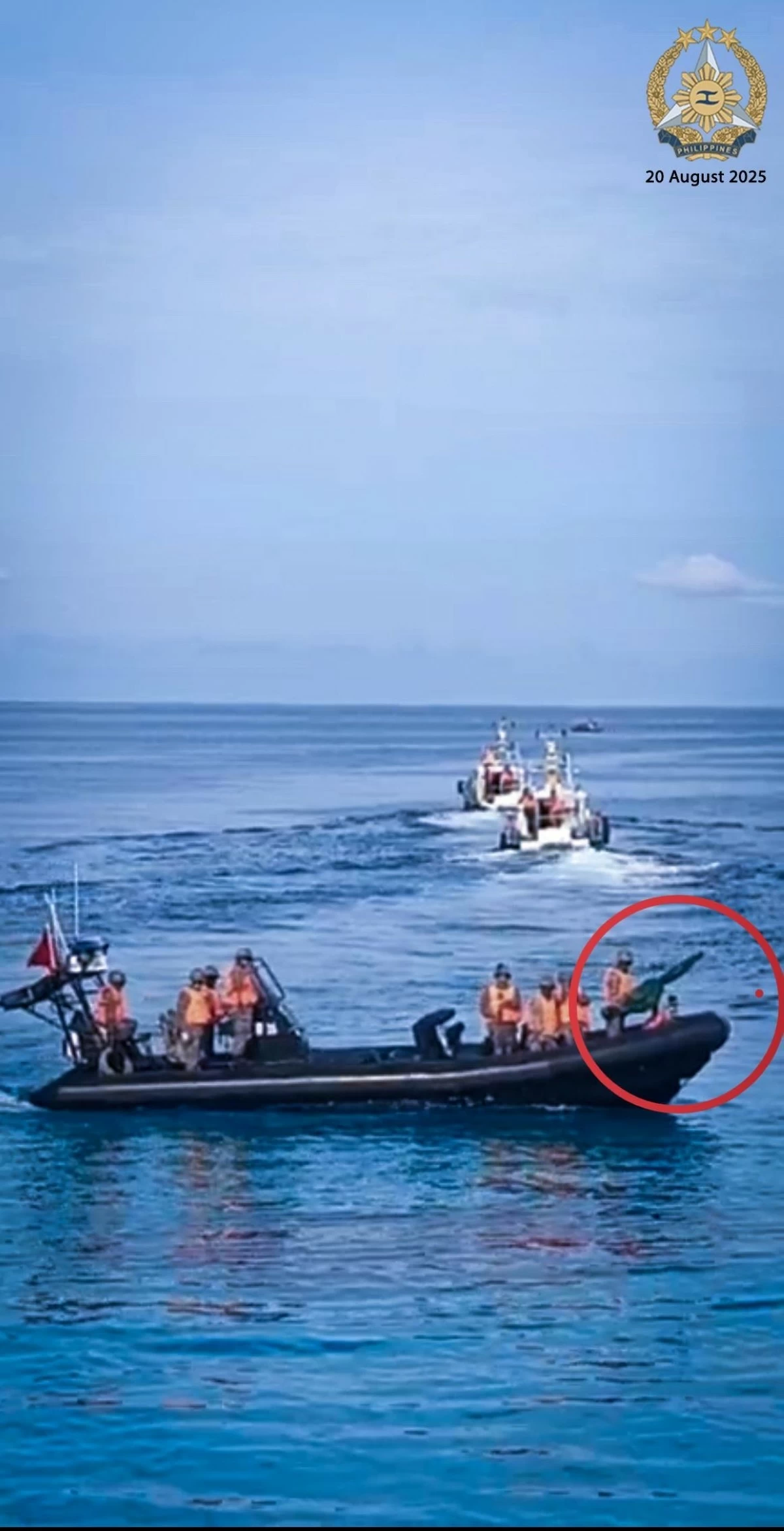
Chinese fast boats and a rigid-hull inflatable boat (RHIB) mounted with a heavy crew-served weapon are seen maneuvering in the vicinity of Ayungin Shoal on Aug. 20, 2025. (Photo: Armed Forces of the Philippines)
Tension gripped soldiers and marines onboard BRP Sierra Madre (LS57) as China deployed coast guard ships with water cannons and small boats armed with mounted weapons in the vicinity of Ayungin Shoal (Second Thomas Shoal) in the West Philippine Sea (WPS), the Armed Forces of the Philippines (AFP) revealed on Thursday night, Aug. 21.
The AFP said it first observed an “increased” presence of Chinese vessels in Ayungin Shoal on Aug. 20, nine days after the collision of two Chinese vessels in Bajo de Masinloc.
During a maritime domain awareness (MDA) monitoring, the AFP saw a total of five China Coast Guard (CCG) ships and these were supported by 11 rigid hull inflatable boats (RHIBs) and fast boats, as well as nine Chinese maritime militia vessels.
“China Coast Guard vessels have been seen conducting maneuvers and drills involving the use of water cannons at sea, while a number of smaller craft, such as rigid-hulled inflatable boats and fast boats, were also deployed inside the shoal,” the military reported.
And what was more disturbing was that some of the CCG’s fast boats were armed with mounted weapons, including heavy crew-served weapons.
On top of the sea vessels, the AFP added that China also sent a Chinese aircraft and an unmanned aerial vehicle (UAV) to the shoal.
What were the Chinese forces doing?
According to the AFP, one of the Chinese vessels deployed fishing nets along the southeast approach of Ayungin Shoal while coast guard ships trained their hoses on an imaginary target and rehearsed water cannon maneuvers.
Three black RHIBs mounted with armaments, three fast boats, and five white RHIBs also performed a blockade position, staying side-by-side in the vicinity of the shoal. Other boats with weapons circled Ayungin.
At one point, a small Chinese boat tried to come close to BRP Sierra Madre, a Philippine Navy (PN) vessel grounded on Ayungin Shoal which also serves as a military outpost, but it was blocked by two rubber boats deployed by the Filipino crew.
AFP public affairs office chief Colonel Xerxes Trinidad said there was no resupply mission to Ayungin Shoal when the Chinese maritime forces appeared. Often, Chinese forces would appear near Ayungin Shoal to block civilian resupply boats delivering food and other provisions for the soldiers and marines onboard BRP Sierra Madre.
But Manila and Beijing’s foreign affairs departments have since agreed to a provisional arrangement, enabling the peaceful conduct of resupply missions to Ayungin.
'Changing the narrative after the ‘embarrassing’ collision?'
For a maritime security analyst, the swarming of Chinese vessels in Ayungin Shoal could be an attempt by China to redeem itself and reestablish its position as a major force in the South China Sea after the “embarrassing” collision of its vessels in Bajo de Masinloc nearly two weeks ago.
To recall, a CCG vessel and a Chinese navy warship collided while chasing a Philippine Coast Guard (PCG) ship in Bajo de Masinloc. The AFP and PCG both suspected casualties on the part of the CCG, but there was no confirmation on the part of the Chinese government.
“China's swarming of the Philippines' outpost at Second Thomas Shoal began on 12 August, just one day after [the collision] happened near Scarborough Shoal. Could it be that someone's trying to change the subject?” said Ray Powell, director of SeaLight project at Stanford University's Gordian Knot Center for National Security Innovation.
“China suffered a major embarrassment last week, when its much larger navy and coast guard ships collided while chasing a Philippine patrol vessel. However, this was ultimately caused by its sharp turn toward heightened aggression in the West Philippine Sea over these past two years, and there's no indication that it is rethinking its belligerence,” he added.
Powell said Beijing was pursuing a policy of what can only be interpreted as “an imperial maritime occupation”. He elaborated that previously contested features are now being converted into Chinese exclusion zones through which the Philippines’ freedom of navigation is suspended. Meanwhile, he said previously quiet regions quite near to the Philippine archipelago are “now menacingly patrolled by Chinese ships.”
“As Beijing redraws its map of effective control ever more expansively and just off its shores, the Philippines will be forced to find new ways to assert its position lest it be seen as accepting its western entitlements’ fate as a permanently occupied maritime region,” he noted.
Asked if the AFP would deploy augmentation forces from the PN, Trinidad said the military is prepared to respond if China further escalates its activities near Ayungin Shoal.
“Our continuous monitoring activity in the WPS provides us with a clear picture of the operational environment and awareness of the situation. The AFP has contingencies in place for any eventualities. We affirm our commitment in performing our mandate to protect our sovereignty and sovereign rights in the WPS,” he said.