







PH, Australia seeks enhanced defense cooperation
Published Aug 22, 2025 05:18 pm


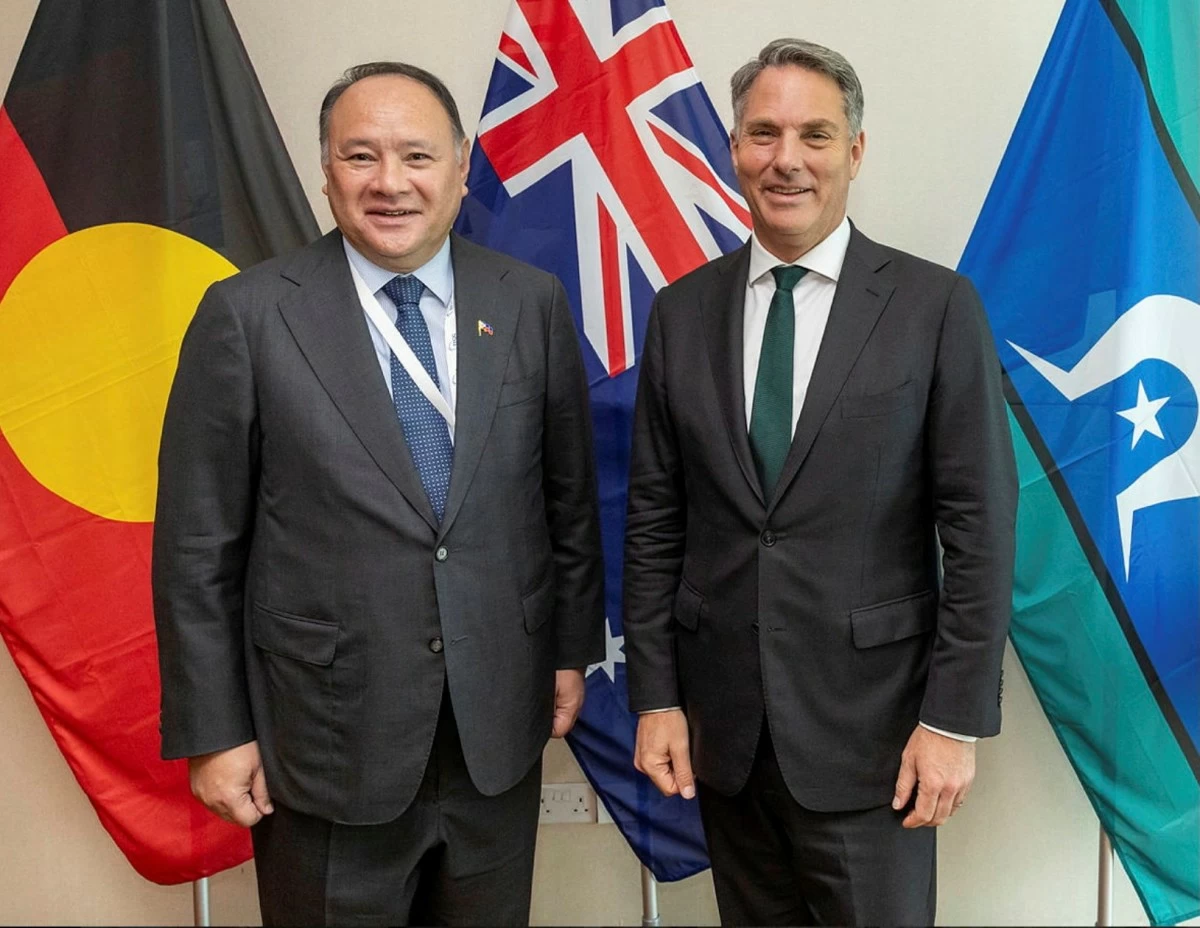
(L-R) Department of National Defense (DND) Secretary Gilberto Teodoro Jr. and Australian Deputy Prime Minister and Minister for Defence Richard Marles (File photo: DND)
The Department of National Defense (DND) is eyeing to enhance its cooperation with Australia to bolster deterrence capabilities amid China’s escalating aggression in the West Philippine Sea (WPS).
DND Secretary Gilberto Teodoro Jr. and Australia Australian Deputy Prime Minister and Minister for Defence Richard Marles signed a statement of intent to pursue a defense cooperation agreement during the second Philippines-Defense Ministers’ Meeting in Makati City on Friday, Aug. 22.
The planned defense cooperation agreement based on the newly signed statement of intent is targeted to be sealed in 2026.
Marles described the defense and security relationship between Manila and Canberra as “fundamentally important” as both nations work together to preserve peace and security in an “increasingly complex and volatile world.”
“Australia and the Philippines are both countries which have shared values and a shared commitment to the rules-based order, an order which is under pressure in our region. And what we have seen over the last few years is a growing body of activity between our two defense forces to assert the rules-based order within the Indo-Pacific,” Marles said.
The planned defense agreement places in concrete form the way that the two countries want their defense partnership to grow and progress. It builds on the 1995 Memorandum of Understanding (MOU) on defense cooperation between the two countries.
Through the defense cooperation agreement, both the Philippines and Australia agreed to build a defense infrastructure plan that will “guide the way in which our infrastructure investment is pursued over the coming years.”
“It will encapsulate the totality of our engagement in defence but it will include for example a commitment to see us having annual Defence Ministers’ Meetings. It will look at how we can do more in terms of coordinating our exercise and operational tempo between our two countries. It will look to do more in terms of pursuing infrastructure development here in the Philippines for the benefit of the Armed Forces of the Philippines,” Marles noted.
At present, Australia is planning to establish eight military infrastructure projects across five different locations in the Philippines, according to Marles.
Marles was visiting Manila as the Armed Forces of the Philippines (AFP) is conducting a military exercise with the Australian Defence Forces (ADF) dubbed as Exercise ALON (Amphibious and Land Operations). More than 3,600 Filipino and Australian troops, as well as American and Canadian forces, are participating in the war games being held at training locations around the islands of Palawan and Luzon facing WPS from Aug. 15 to 29.
Marles and Teodoro will witness some of the training exercises this weekend featuring ADF’s HMAS Brisbane, an air warfare destroyer; advanced aircraft such as F18 fighter jets, Boeing EA-18G Growler electronic warfare aircraft, and Boeing P-8 patrol and reconnaissance aircraft, and infantry components.
In Ayungin Shoal (Second Thomas Shoal), WPS, Chinese coast guard deployed vessels armed with water cannons and small but agile boats with mounted weapons to perform maritime exercises in front of the troops guarding BRP Sierra Madre, a Philippine Navy warship that serves as Manila’s outpost in the disputed shoal.
“The activities of China in any area, whether in the Sierra Madre or any area under their nebulous claims, are a matter not only of concern but of condemnation because these are in gross violation of international law. And actually it is a product of a false narrative. I've even seen some social media posts saying that they are the progenitors of certain areas in the Philippines. So this information is as disgusting as their activities. And we need to stand up to this,” Teodoro said.
The DND chief said the Philippines cannot control the “illegal, coercive, aggressive, and deceptive” (ICAD) activities of China, hence, the need to deter them. One way to do it, according to him, is through strong partnerships with other “like-minded” countries, such as Australia.
“we are countries invested in the rules-based order. And we really need international law to have some parity so that might does not mean right. And we are also used to negotiating in good faith and not with insincerity,” Teodoro stated.
“And as I've said, much as China professes to want dialogue and negotiation, there is a deficit of trust that they need to overcome. And with these activities that have been happening, that deficit has widened more than lessened,” he concluded.