

ADVERTISEMENT

Sinner, Alcaraz, aka Sincaraz, rule men's tennis as 2025 US Open arrives

Published Aug 21, 2025 10:27 pm

At A Glance

  • NEW YORK (AP) — OK, sure, maybe it wouldn't be rational to say there's no point in actually holding the full U.S. Open and instead just fast-forwarding to the inevitable matchup for the men's championship between Jannik Sinner — assuming he's healthy — and Carlos Alcaraz on Sept. 7.
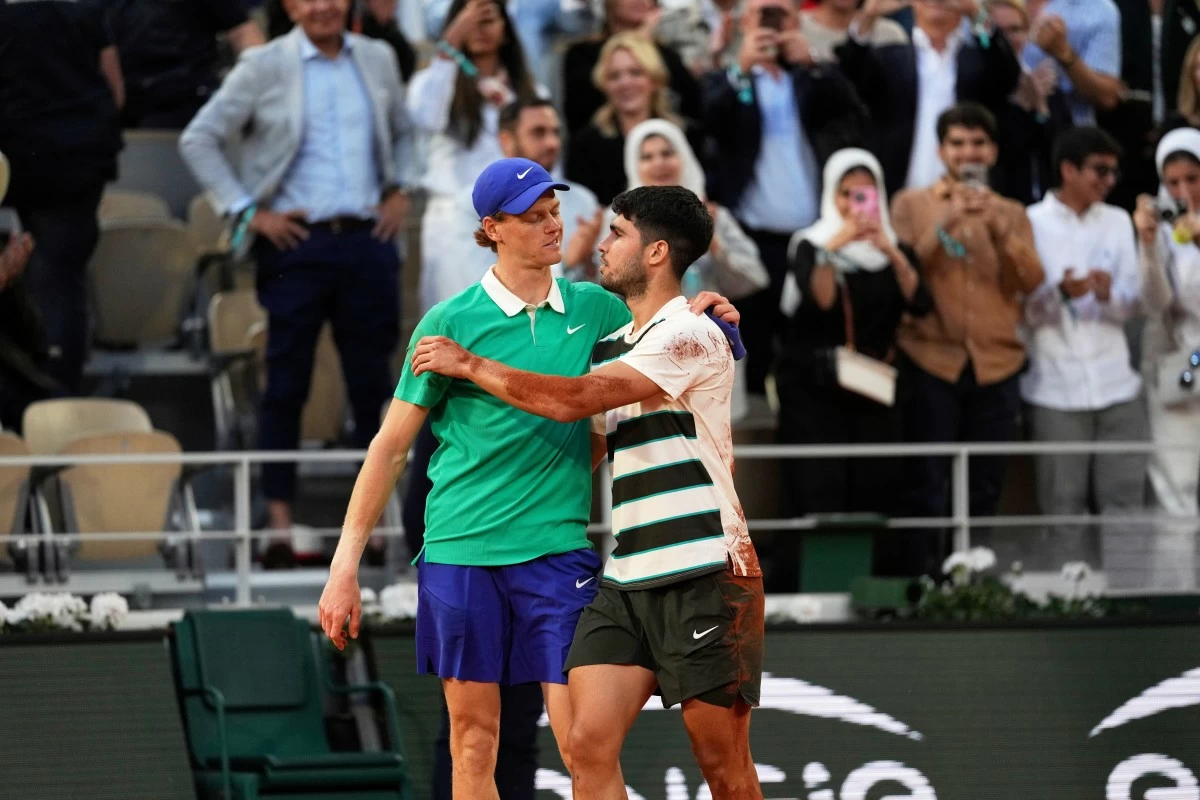
FILE - Winner Spain's Carlos Alcaraz, right, and Italy's Jannik Sinner hug after the final match of the French Tennis Open at the Roland-Garros stadium in Paris,  June 8, 2025. (AP Photo/Thibault Camus, File)
FILE - Winner Spain's Carlos Alcaraz, right, and Italy's Jannik Sinner hug after the final match of the French Tennis Open at the Roland-Garros stadium in Paris, June 8, 2025. (AP Photo/Thibault Camus, File)
NEW YORK (AP) — OK, sure, maybe it wouldn't be rational to say there's no point in actually holding the full U.S. Open and instead just fast-forwarding to the inevitable matchup for the men's championship between Jannik Sinner — assuming he's healthy — and Carlos Alcaraz on Sept. 7.
Seems reasonable, though.
“We know,” Novak Djokovic acknowledged, “they’re the dominant force right now.”
When singles action begins Sunday at Flushing Meadows, a change from the usual Monday start, there are cases to be made for various players to make their way to the women's final. The top three in the rankings — No. 1 Aryna Sabalenka, No. 2 Iga Swiatek and No. 3 Coco Gauff — have won the past three U.S. Open titles, for example. Other past major champions such as Naomi Osaka or Elena Rybakina have performed well lately; maybe a new face will emerge.
Jannik Sinner and Carlos Alcaraz have won the last 7 Grand Slam titles
When it comes to the men, there really is just one name that matters in this post-Big Three era, and that name is “Sincaraz,” the silly, made-up, “Fedal”-style mashup of the guys who are ranked No. 1 (Sinner) and No. 2 (Alcaraz) and have claimed seven Grand Slam trophies in a row and nine of the last 12.
Djokovic took the other three in that span.
There is nothing quite like it in the women’s game at the moment. The past five Slams were won by five players: Swiatek (Wimbledon in July), Gauff (French Open in June), Madison Keys (Australian Open in January), Sabalenka (last year’s U.S. Open) and Barbora Krejcikova (last year’s Wimbledon).
‘Sincaraz’ is a cut above as the US Open starts
“Sinner and Alcaraz,” said Marcos Giron, an American who has been ranked 37th and faced both, "are bringing a ridiculous level, week in and week out."
Look at the ATP rankings, which either could lead after the U.S. Open. Look at the titles. Look at the past two Grand Slam finals, with Alcaraz erasing a two-set deficit and saving three championship points to win the French Open in June, before Sinner won in four sets at Wimbledon in July. Look at the most recent Masters 1000 tournament, the Cincinnati Open, where Sinner didn't drop a set en route to Monday's final but quit because he was feeling ill, ceding the trophy to Alcaraz.
That ended Sinner's 26-match winning streak on hard courts; Alcaraz was responsible for the previous defeat, too. Alcaraz collected his tour-leading sixth trophy this season and has won 39 of his most recent 41 contests.
Since Sinner returned in May from a three-month doping ban, Cincinnati was the fourth event both entered — and they met to decide the title in all four.
What makes No. 1 Sinner and No. 2 Alcaraz so good?
They hit the ball as hard as anyone. Sinner's returns rival Djokovic's for best in the game. Alcaraz's drop shots are unrivaled. The athleticism displayed by both is remarkable. Alcaraz might be the fastest guy around. Sinner's long limbs reach everything.
What sets them apart from others?
“Their confidence. Their ball-striking. Their movement is basically perfect,” said Sam Querrey, a former player who made it to Wimbledon's semifinals and the U.S. Open's quarterfinals. “It seems like they hit the ball with just a little extra force when they need to.”
It leaves other elite players such as Ben Shelton, the 22-year-old American who is ranked No. 6, so-close-yet-so-far at majors.
Shelton's 2025 Grand Slam resume includes losses to Sinner at the Australian Open, to Alcaraz at the French Open and to Sinner at Wimbledon.
“Frustrating,” Shelton said. “Two very different players and challenges.”
How big a deal is the Alcaraz vs. Sinner rivalry heading to the US Open?
The sample size is, admittedly, small, but these two are producing the sort of riveting points and thrill-a-minute matches that Roger Federer vs. Rafael Nadal, or Nadal vs. Djokovic, used to.
“The rivalry is real. It’s there,” said Darren Cahill, one of Sinner’s two coaches. “And hopefully it’s going to be there and real for the next 10 or 12 years.”
Not sure? Head to YouTube and check out Alcaraz vs. Sinner, whether at Roland-Garros this year or at the U.S. Open in 2022 or pretty much any of their 14 showdowns ( Alcaraz leads 9-5 ).
“You have to earn every point, every game. He makes you suffer (from) the first point of the match until the last ball,” said Alcaraz, a 22-year-old from Spain. “It's really tough to find holes in his game.”
Sinner's take?
“We try,” the 24-year-old from Italy said of their matchups, “to push ourselves to the limits."
ADVERTISEMENT
.most-popular .layout-ratio{ padding-bottom: 79.13%; } @media (min-width: 768px) and (max-width: 1024px) { .widget-title { font-size: 15px !important; } }

{{ articles_filter_1561_widget.title }}

.most-popular .layout-ratio{ padding-bottom: 79.13%; } @media (min-width: 768px) and (max-width: 1024px) { .widget-title { font-size: 15px !important; } }

{{ articles_filter_1562_widget.title }}

.most-popular .layout-ratio{ padding-bottom: 79.13%; } @media (min-width: 768px) and (max-width: 1024px) { .widget-title { font-size: 15px !important; } }

{{ articles_filter_1563_widget.title }}

{{ articles_filter_1564_widget.title }}

.mb-article-details { position: relative; } .mb-article-details .article-body-preview, .mb-article-details .article-body-summary{ font-size: 17px; line-height: 30px; font-family: "Libre Caslon Text", serif; color: #000; } .mb-article-details .article-body-preview iframe , .mb-article-details .article-body-summary iframe{ width: 100%; margin: auto; } .read-more-background { background: linear-gradient(180deg, color(display-p3 1.000 1.000 1.000 / 0) 13.75%, color(display-p3 1.000 1.000 1.000 / 0.8) 30.79%, color(display-p3 1.000 1.000 1.000) 72.5%); position: absolute; height: 200px; width: 100%; bottom: 0; display: flex; justify-content: center; align-items: center; padding: 0; } .read-more-background a{ color: #000; } .read-more-btn { padding: 17px 45px; font-family: Inter; font-weight: 700; font-size: 18px; line-height: 16px; text-align: center; vertical-align: middle; border: 1px solid black; background-color: white; } .hidden { display: none; }
function initializeAllSwipers() { // Get all hidden inputs with cms_article_id document.querySelectorAll('[id^="cms_article_id_"]').forEach(function (input) { const cmsArticleId = input.value; const articleSelector = '#article-' + cmsArticleId + ' .body_images'; const swiperElement = document.querySelector(articleSelector); if (swiperElement && !swiperElement.classList.contains('swiper-initialized')) { new Swiper(articleSelector, { loop: true, pagination: false, navigation: { nextEl: '#article-' + cmsArticleId + ' .swiper-button-next', prevEl: '#article-' + cmsArticleId + ' .swiper-button-prev', }, }); } }); } setTimeout(initializeAllSwipers, 3000); const intersectionObserver = new IntersectionObserver( (entries) => { entries.forEach((entry) => { if (entry.isIntersecting) { const newUrl = entry.target.getAttribute("data-url"); if (newUrl) { history.pushState(null, null, newUrl); let article = entry.target; // Extract metadata const author = article.querySelector('.author-section').textContent.replace('By', '').trim(); const section = article.querySelector('.section-info ').textContent.replace(' ', ' '); const title = article.querySelector('.article-title h1').textContent; // Parse URL for Chartbeat path format const parsedUrl = new URL(newUrl, window.location.origin); const cleanUrl = parsedUrl.host + parsedUrl.pathname; // Update Chartbeat configuration if (typeof window._sf_async_config !== 'undefined') { window._sf_async_config.path = cleanUrl; window._sf_async_config.sections = section; window._sf_async_config.authors = author; } // Track virtual page view with Chartbeat if (typeof pSUPERFLY !== 'undefined' && typeof pSUPERFLY.virtualPage === 'function') { try { pSUPERFLY.virtualPage({ path: cleanUrl, title: title, sections: section, authors: author }); } catch (error) { console.error('ping error', error); } } // Optional: Update document title if (title && title !== document.title) { document.title = title; } } } }); }, { threshold: 0.1 } ); function showArticleBody(button) { const article = button.closest("article"); const summary = article.querySelector(".article-body-summary"); const body = article.querySelector(".article-body-preview"); const readMoreSection = article.querySelector(".read-more-background"); // Hide summary and read-more section summary.style.display = "none"; readMoreSection.style.display = "none"; // Show the full article body body.classList.remove("hidden"); } document.addEventListener("DOMContentLoaded", () => { let loadCount = 0; // Track how many times articles are loaded const offset = [1, 2, 3, 4, 5, 6, 7, 8, 9, 10]; // Offset values const currentUrl = window.location.pathname.substring(1); let isLoading = false; // Prevent multiple calls if (!currentUrl) { console.log("Current URL is invalid."); return; } const sentinel = document.getElementById("load-more-sentinel"); if (!sentinel) { console.log("Sentinel element not found."); return; } function isSentinelVisible() { const rect = sentinel.getBoundingClientRect(); return ( rect.top < window.innerHeight && rect.bottom >= 0 ); } function onScroll() { if (isLoading) return; if (isSentinelVisible()) { if (loadCount >= offset.length) { console.log("Maximum load attempts reached."); window.removeEventListener("scroll", onScroll); return; } isLoading = true; const currentOffset = offset[loadCount]; window.loadMoreItems().then(() => { let article = document.querySelector('#widget_1690 > div:nth-last-of-type(2) article'); intersectionObserver.observe(article) loadCount++; }).catch(error => { console.error("Error loading more items:", error); }).finally(() => { isLoading = false; }); } } window.addEventListener("scroll", onScroll); });

Sign up by email to receive news.