








Romeo Antipuesto Jr. proudly stands beside an 18-year-old bonsai tree—a Silver Awardee at the prestigious ASPAC Asia Pacific Bonsai and Suiseki Exhibition and Conference.
With only ₱500 for fertilizers and a budding curiosity, Romeo Antipuesto Jr. embarked on a bonsai journey that would eventually define his career. At 38, the Davao City native credits his friend and mentor, Oliver Pavo, for helping him find his footing. Starting with lower-grade materials, the duo trained for three years in Manila, honing their skills and experimenting with different plant species.
During their three-year training, Oliver and Romeo gained hands-on experience in identifying the best plant species for bonsai cultivation. One prized example is Bantigue or Pemphis acidula, a coastal shrub highly valued in the bonsai community for its gnarled beauty and high market value when fully developed.
They also participated in various bonsai competitions and exhibits, where they showcased their artistic skills—painstakingly shaping and nurturing bonsai trees over the years to achieve perfect form.
The duo eventually brought their knowledge back to Davao. In 2009, Romeo established his own bonsai business, turning his passion into a full-time career. Oliver, meanwhile, relocated to Leyte, where he continues to practice bonsai while focusing more on farming.
At first, Romeo cultivated bonsai for fun and for fellow hobbyists, but it wasn’t long before his work gained traction in the bonsai community.
Romeo worked as a nurse, but in 2014, he realized that his bonsai sideline was generating more income than his full-time job, so he decided to devote his time to bonsai cultivation. Today, Romeo earns anywhere from ₱500 to as much as ₱280,000 per bonsai tree, depending on its age, structure, and refinement.

At the 1st Tinalak Festival in Koronadal City, Romeo Antipuesto Jr. with Margie Huan, after winning another ‘Best in Show’ award.
“The price depends on the shape of your plant. If I sell a small, unfinished plant, it will cost around ₱1,500. But if it’s finished and has reached its ideal form, it can sell for ₱5,000 up to ₱30,000,” he explained.
He added, “I have a bougainvillea bonsai that I sell for ₱160,000. I started growing it in 2015. The older and more refined the tree is, the more valuable it becomes.”
Where wild trees become art
Romeo begins the process by sourcing wild materials, particularly yamadori—a Japanese term meaning "mountain dug"—referring to trees collected from natural landscapes. These materials are then planted in a mix of 60 percent river sand and 40 percent garden soil, with a large plastic covering used to lock in moisture and help the plant adapt to its new environment.
After two months, the shaping process begins. “To form a bonsai, we guide the branches using wires. After three years of training, it becomes a full-grown, finished bonsai,” Romeo said.
Depending on the plant, Romeo’s bonsai trees can take as little as eight months or as long as 10 years to mature. Still, he believes it’s a worthwhile investment. “You can create a bonsai in just one year and earn from it. It’s really an investment of time more than money.”
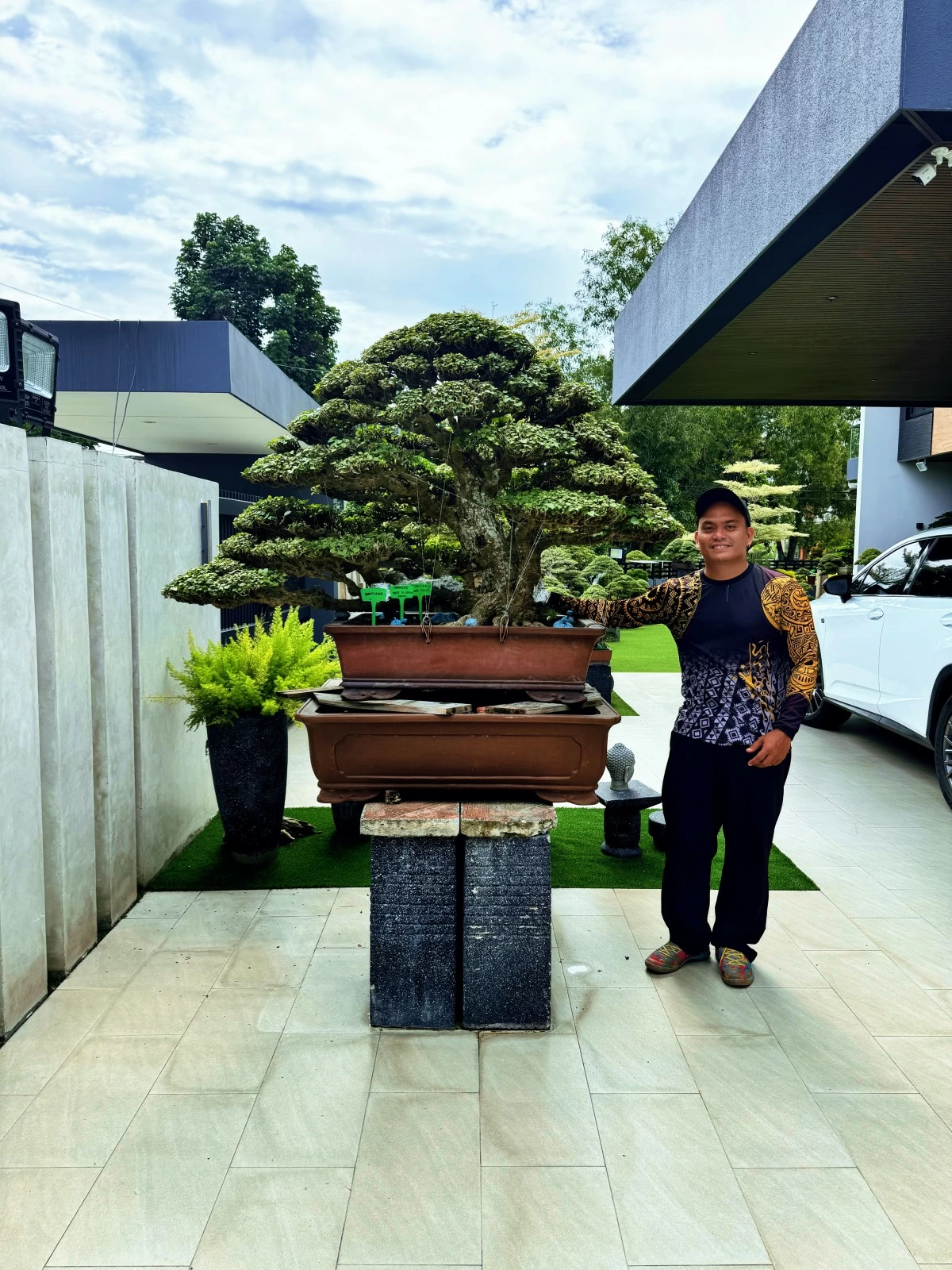
A 65-year-old Hibiscus Taiwan bonsai tree, part of Margie Huan’s collection and a multiple-awarded piece, including ‘Best in Show’ at the 2023 ASPAC Exhibition.
Romeo tends most of the bonsai trees in a client’s 300-400 meter lot, while smaller bonsai trees remain in his own home. He also creates video content to share tips and behind-the-scenes work with his 167,000 followers.
Bonsai triumphs
A member of the Davao Bonsai Society, Romeo takes pride in the awards he has received from various competitions. “The maintenance for competition bonsai is different from the ones we sell as decorations. We do everything manually and delicately because they’re competition pieces,” he explained.
Romeo joins around three bonsai competitions a year, both in Davao and other areas. “Our plants are undefeated. We have a bonsai from Taiwan that’s 65 years old. It’s huge and has already won two championships,” he said proudly.
Today, Romeo has six regular clients and regularly shares educational content and updates on his personal Facebook page. “I also made videos on how to rescue plants. Even if they grow anywhere, on roofs or walls, they still have potential for bonsai,” he said. “Wherever it grows, it still has value.”
‘Don’t fear mistakes’
Romeo reminds beginners that patience and persistence are key. “Branches can break during the training process, especially in the early months. It can be frustrating, but that’s okay. You need to experience these things to learn.”
For aspiring bonsai artists, Romeo’s top advice is to join communities and workshops. “Everyone starts somewhere, just like I did with a simple plant. Join groups and attend workshops. That’s where you’ll learn and improve.”
With demand for bonsai trees increasing, Romeo says more artists are needed in the field. While he is enjoying his success in the Philippines, he is open to working abroad if the opportunity arises. “The international market demands more artists. If the chance comes, I’m ready.”
Photos courtesy of Romeo Antipuesto, Jr.