

ADVERTISEMENT

Italy's Ventina glacier has melted so much geologists now can only monitor it remotely

Published Aug 19, 2025 01:20 pm

At A Glance

  • The melting has accelerated in recent years, with the glacier losing 431 meters (471 yards) in the last 10 years, nearly half of that since 2021, the service said. It's another example of how accelerating global warming is melting and shrinking Europe's glaciers, causing a host of environmental and other impacts.
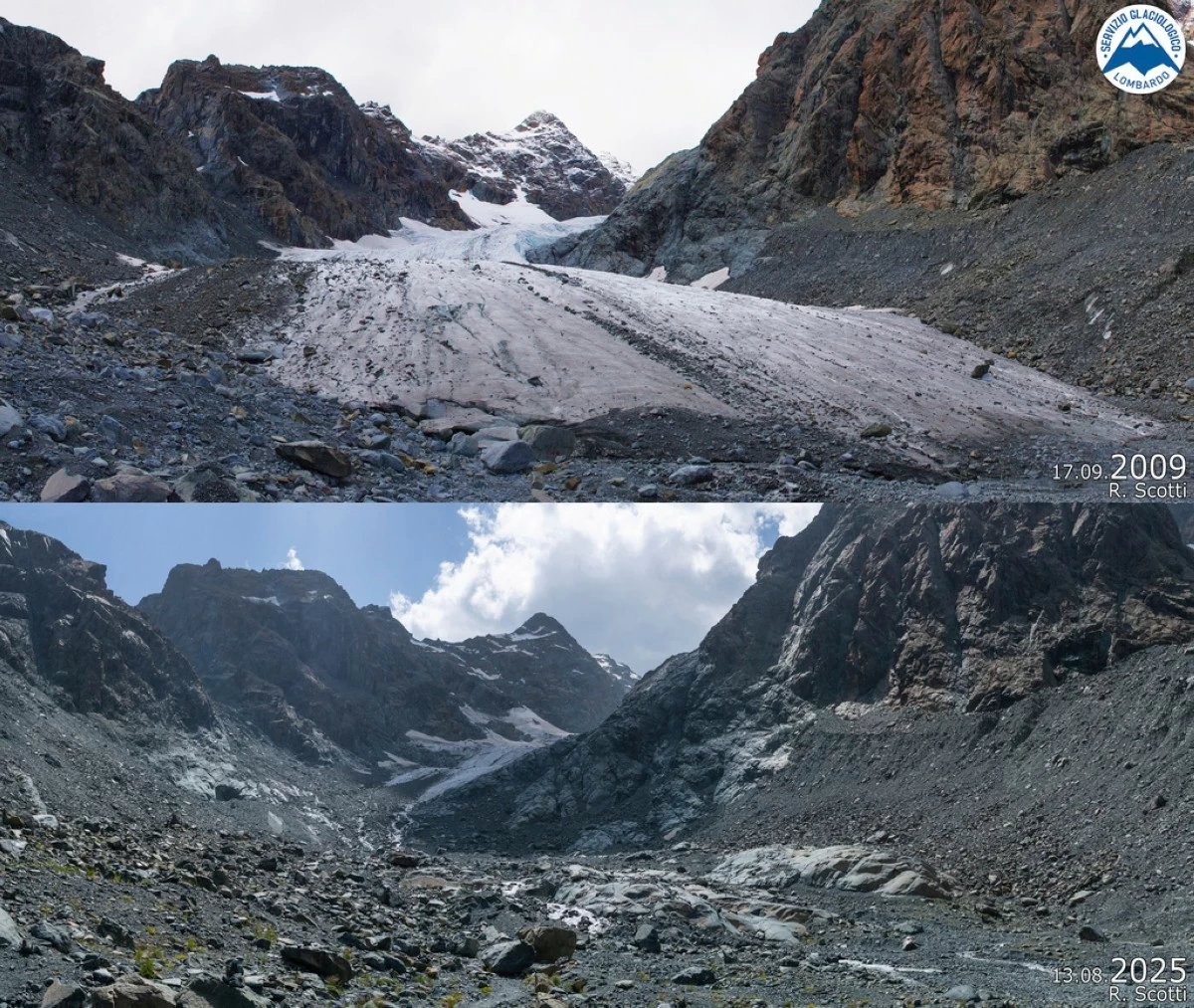
A combo image of an overview of the Ventina glacier, near Sondrio, northern Italy, in 2009, above, and same view on Wednesday, Aug. 13, 2025. (Lombardy Glaciology Service via AP)
ROME (AP) — Italy’s Ventina glacier, one of the biggest in northern Lombardy, has melted so much due to climate change that geologists can no longer measure it the way they have for the past 130 years.
After this year’s hot summer, geologists discovered that the simple stakes used as benchmarks to measure the glacier’s retraction each year are now buried under rockslides and debris that have made the terrain too unsteady for future in-person visits.
The Lombardy Glaciological Service said Monday that it will now use drone imagery and remote sensing to keep track of the ongoing shrinkage.
Geologists say that the Ventina glacier has already lost 1.7 kilometers (1 mile) in length since the first measuring benchmarks were positioned at the front of the glacier in 1895.
The melting has accelerated in recent years, with the glacier losing 431 meters (471 yards) in the last 10 years, nearly half of that since 2021, the service said. It's another example of how accelerating global warming is melting and shrinking Europe’s glaciers, causing a host of environmental and other impacts.
“While we could still hope until the 1980s that there would be normal cycles (of retraction) or at least a contained retraction, in the last 40 years something truly striking has occurred,” said Andrea Toffaletti, a member of the Lombardy Glaciological Service.
Italy’s mountain glaciers, which are found throughout the Alps and Dolomites in the north and along the central Apennines, have been receding for years, thanks to inadequate snowfall in the winter and record-setting hot summers. Glaciers always melt some in summer, with the runoff fueling mountain streams and rivers.
But the hot summers are “no longer able to guarantee the survival of the winter snowpack,” that keeps the glacier intact, Toffaletti said.
“In order to regenerate and remain in balance, a certain amount of residual snow from the winter must remain on the glacier's surface at the end of the summer. And this is happening less and less frequently,” said Toffaletti.
According to the Lombardy service, the Alps represent a climate hotspot, recording double the global average of temperature increases since pre-industrial times, resulting in the loss of over 64% of the volume of Alpine glaciers.
In February, the journal Nature reported on a study showing the world’s glaciers lost ice at the rate of about 255 billion tons (231 billion metric tons) annually from 2000 to 2011, but that quickened to about 346 billion tons (314 billion metric tons) annually over about the next decade.

Related Tags

WORLDNEWS melting glaciers
ADVERTISEMENT
.most-popular .layout-ratio{ padding-bottom: 79.13%; } @media (min-width: 768px) and (max-width: 1024px) { .widget-title { font-size: 15px !important; } }

{{ articles_filter_1561_widget.title }}

.most-popular .layout-ratio{ padding-bottom: 79.13%; } @media (min-width: 768px) and (max-width: 1024px) { .widget-title { font-size: 15px !important; } }

{{ articles_filter_1562_widget.title }}

.most-popular .layout-ratio{ padding-bottom: 79.13%; } @media (min-width: 768px) and (max-width: 1024px) { .widget-title { font-size: 15px !important; } }

{{ articles_filter_1563_widget.title }}

{{ articles_filter_1564_widget.title }}

.mb-article-details { position: relative; } .mb-article-details .article-body-preview, .mb-article-details .article-body-summary{ font-size: 17px; line-height: 30px; font-family: "Libre Caslon Text", serif; color: #000; } .mb-article-details .article-body-preview iframe , .mb-article-details .article-body-summary iframe{ width: 100%; margin: auto; } .read-more-background { background: linear-gradient(180deg, color(display-p3 1.000 1.000 1.000 / 0) 13.75%, color(display-p3 1.000 1.000 1.000 / 0.8) 30.79%, color(display-p3 1.000 1.000 1.000) 72.5%); position: absolute; height: 200px; width: 100%; bottom: 0; display: flex; justify-content: center; align-items: center; padding: 0; } .read-more-background a{ color: #000; } .read-more-btn { padding: 17px 45px; font-family: Inter; font-weight: 700; font-size: 18px; line-height: 16px; text-align: center; vertical-align: middle; border: 1px solid black; background-color: white; } .hidden { display: none; }
function initializeAllSwipers() { // Get all hidden inputs with cms_article_id document.querySelectorAll('[id^="cms_article_id_"]').forEach(function (input) { const cmsArticleId = input.value; const articleSelector = '#article-' + cmsArticleId + ' .body_images'; const swiperElement = document.querySelector(articleSelector); if (swiperElement && !swiperElement.classList.contains('swiper-initialized')) { new Swiper(articleSelector, { loop: true, pagination: false, navigation: { nextEl: '#article-' + cmsArticleId + ' .swiper-button-next', prevEl: '#article-' + cmsArticleId + ' .swiper-button-prev', }, }); } }); } setTimeout(initializeAllSwipers, 3000); const intersectionObserver = new IntersectionObserver( (entries) => { entries.forEach((entry) => { if (entry.isIntersecting) { const newUrl = entry.target.getAttribute("data-url"); if (newUrl) { history.pushState(null, null, newUrl); let article = entry.target; // Extract metadata const author = article.querySelector('.author-section').textContent.replace('By', '').trim(); const section = article.querySelector('.section-info ').textContent.replace(' ', ' '); const title = article.querySelector('.article-title h1').textContent; // Parse URL for Chartbeat path format const parsedUrl = new URL(newUrl, window.location.origin); const cleanUrl = parsedUrl.host + parsedUrl.pathname; // Update Chartbeat configuration if (typeof window._sf_async_config !== 'undefined') { window._sf_async_config.path = cleanUrl; window._sf_async_config.sections = section; window._sf_async_config.authors = author; } // Track virtual page view with Chartbeat if (typeof pSUPERFLY !== 'undefined' && typeof pSUPERFLY.virtualPage === 'function') { try { pSUPERFLY.virtualPage({ path: cleanUrl, title: title, sections: section, authors: author }); } catch (error) { console.error('ping error', error); } } // Optional: Update document title if (title && title !== document.title) { document.title = title; } } } }); }, { threshold: 0.1 } ); function showArticleBody(button) { const article = button.closest("article"); const summary = article.querySelector(".article-body-summary"); const body = article.querySelector(".article-body-preview"); const readMoreSection = article.querySelector(".read-more-background"); // Hide summary and read-more section summary.style.display = "none"; readMoreSection.style.display = "none"; // Show the full article body body.classList.remove("hidden"); } document.addEventListener("DOMContentLoaded", () => { let loadCount = 0; // Track how many times articles are loaded const offset = [1, 2, 3, 4, 5, 6, 7, 8, 9, 10]; // Offset values const currentUrl = window.location.pathname.substring(1); let isLoading = false; // Prevent multiple calls if (!currentUrl) { console.log("Current URL is invalid."); return; } const sentinel = document.getElementById("load-more-sentinel"); if (!sentinel) { console.log("Sentinel element not found."); return; } function isSentinelVisible() { const rect = sentinel.getBoundingClientRect(); return ( rect.top < window.innerHeight && rect.bottom >= 0 ); } function onScroll() { if (isLoading) return; if (isSentinelVisible()) { if (loadCount >= offset.length) { console.log("Maximum load attempts reached."); window.removeEventListener("scroll", onScroll); return; } isLoading = true; const currentOffset = offset[loadCount]; window.loadMoreItems().then(() => { let article = document.querySelector('#widget_1690 > div:nth-last-of-type(2) article'); intersectionObserver.observe(article) loadCount++; }).catch(error => { console.error("Error loading more items:", error); }).finally(() => { isLoading = false; }); } } window.addEventListener("scroll", onScroll); });

Sign up by email to receive news.