






Manila Bulletin
 Business
The Economy
Ineffective flood control worsens damage to agri sector, says DA
Business
The Economy
Ineffective flood control worsens damage to agri sector, says DA
Business
The Economy
Ineffective flood control worsens damage to agri sector, says DA
Ineffective flood control worsens damage to agri sector, says DA
Published Aug 18, 2025 08:06 pm


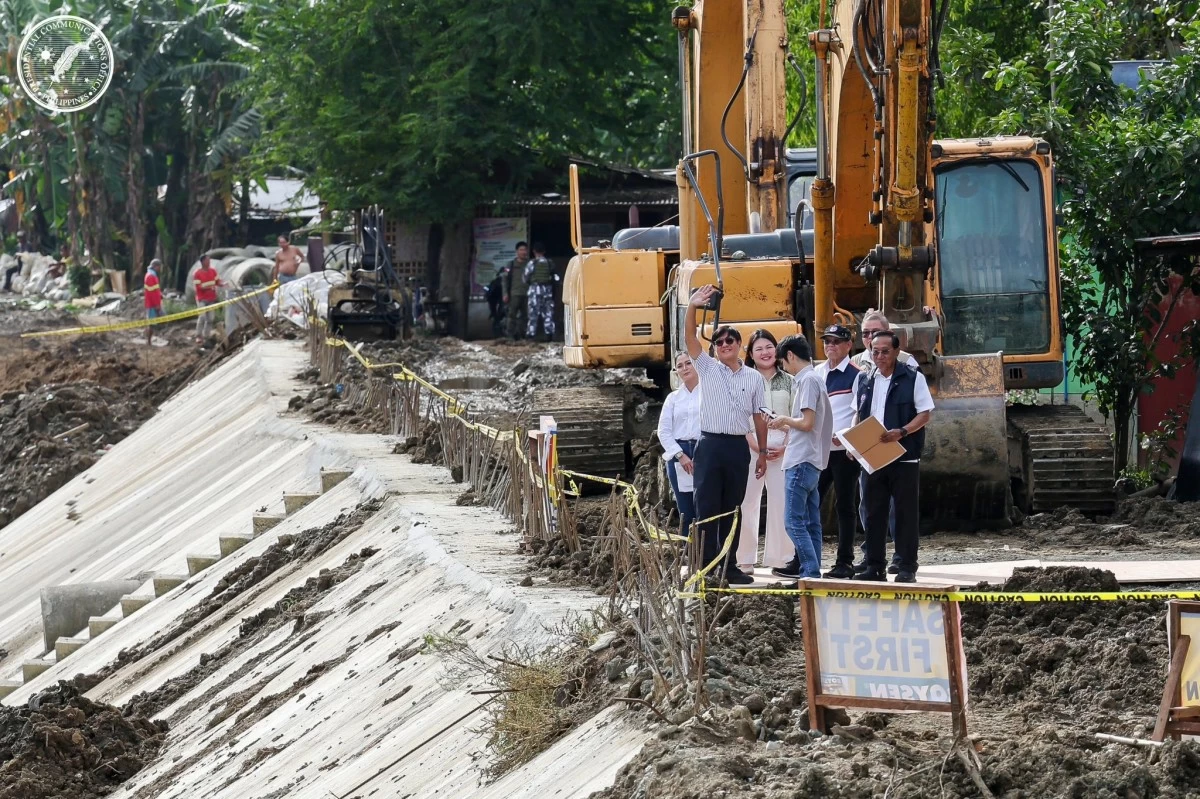
President Ferdinand R. Marcos Jr. leads the inspection of the Flood Mitigation Project in in Barangay San Isidro, Jaro, Iloilo City on Aug. 13, 2025. (Photo courtesy of PCO)
The Department of Agriculture (DA) said the ineffectiveness of certain flood control projects, particularly in rice-producing areas, worsens the agricultural damage the country suffers annually due to tropical storms.
In a press briefing on Monday, Aug. 18, DA Assistant Secretary Arnel de Mesa said that if only the country’s flood control projects are actually effective, there would be less damage to the agricultural sector.
He said the sector incurs 500,000 to 600,000 metric tons (MT) of agricultural damage every year due to heavy flooding, the majority of which is palay or unmilled rice.
“Habang mas tumatagal ang pagbabad ng baha—kasi kung mabilis lang ‘yan, mabilis lang ang pag-recover ng palay kasi naturally flooded naman ang condition niyan—pero ‘pag mas matagal na lubog, parang tayo lang, hindi ‘yan makahinga,” said De Mesa, also the DA’s spokesman.
(The longer the floodwaters linger—because if it’s just brief, palay recovers quickly since it naturally grows in flooded conditions—but if it stays submerged for too long, it’s like us, it can’t breathe.)
Aside from affecting rice and crops, he said flooding also leads to livestock deaths and damage to irrigation facilities and agricultural infrastructure.
“Every report that there is a storm, there are floods, we are the first ones to have damage,” he said.
The DA reported earlier this month that the combined damage from tropical storms “Crising,” “Dante,” and “Emong,” as well as habagat or the southwest monsoon on the agriculture sector reached ₱3.53 billion.
The agency said 14 regions of the country saw severe impact on rice, corn, cassava, high-value crops, fisheries, livestock and poultry, and even agricultural infrastructure.
The severe weather damaged 102,451 hectares (ha) of agricultural land, affecting nearly 110,000 farmers and fisherfolk.
The rice sector accounted for the bulk of the damage, with impact on 95,152 ha of rice crops, amounting to losses of 60,589 MT of rice valued at ₱1.81 billion.
Instead of funding flood control projects that are proven ineffective, De Mesa said redirecting these funds to irrigation facilities could benefit farmers and the country’s agricultural output.
For instance, he said even a portion of a ₱100-billion funding for a flood control project could have irrigated many hectares of farmland.
De Mesa said the country still has about one million ha of potentially irrigable areas.
He said additional funding for irrigation projects would enable the DA and the National Irrigation Administration (NIA) to build more drainage and water impounding projects such as dams.
In particular, these dams would store floodwaters, enabling the government to release them for irrigation purposes, he said.
“Hindi kagaya ng iba, ‘pag binigay mo na, mawawala na. Ito long-term investment,” said De Mesa.
(Unlike other projects, once you give it, it’s gone. This one is a long-term investment.)
President Ferdinand R. Marcos Jr. is spearheading a sweeping crackdown on flood control infrastructure, driven by concerns that substandard projects—many tainted by corruption—are only aggravating flooding.
Last week, Marcos said 20 percent of all flood control projects in the past three years, valued at ₱100 billion, were only undertaken by 15 contractors.