ADVERTISEMENT

Remembering 1976 Moro Gulf earthquake and tsunami: Deadliest tsunami in Philippine history

Published Aug 17, 2025 12:42 pm
PHIVOLCS
PHIVOLCS
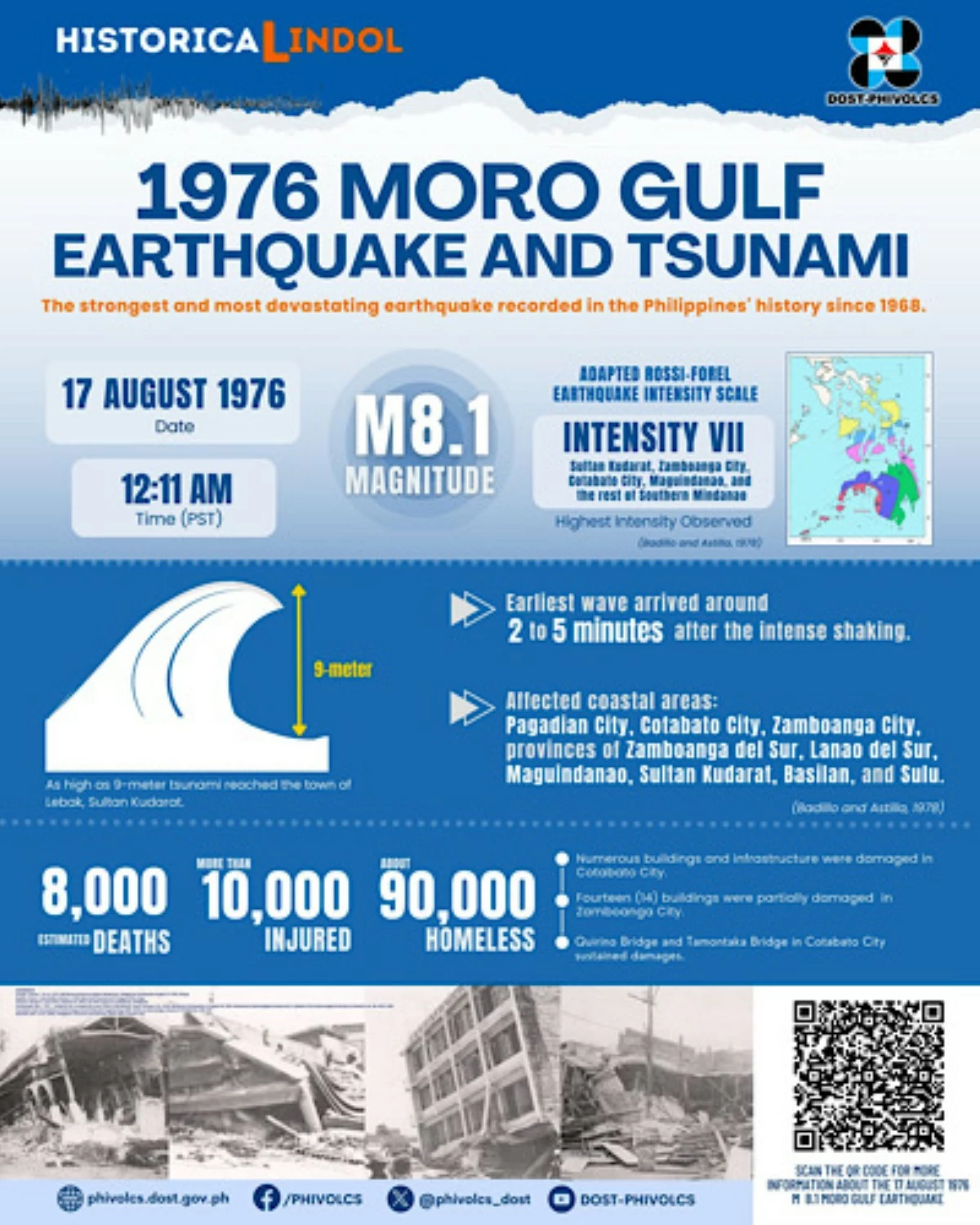
At 12:11 a.m. on Aug. 17, 1976, a powerful earthquake triggered the Philippines’ deadliest tsunami, causing widespread devastation across Southern Mindanao.
According to the Philippine Institute of Volcanology and Seismology (Phivolcs), the magnitude 8.1 earthquake, known as the strongest in the country since 1968, originated from the Cotabato Trench beneath the Moro Gulf.
The tremor reached its highest intensity of VII (destructive) in Sultan Kudarat, Cotabato City, Zamboanga City, Maguindanao, and other parts of Southern Mindanao.
Within just two to five minutes after the initial shaking, a massive tsunami surged ashore, with waves as high as nine meters devastating coastal towns such as Lebak in Sultan Kudarat.
The major cause of the high number of casualties could be attributed to the fact that the tremor occurred just after midnight, when most people were sleeping, and the tsunami struck from multiple directions, catching residents unaware.
Phivolcs said the tsunami affected over 700 kilometers of coastline along the Moro Gulf and the North Celebes Sea.
The disaster claimed an estimated 8,000 lives, injured more than 10,000 people, and left nearly 90,000 homeless, making it one of the most catastrophic natural disasters in Philippine history.
In Cotabato City, the earthquake and tsunami caused widespread damage.
Key infrastructure, including the Quirino Bridge and Tamontaka Bridge, sustained structural damages, while 14 buildings were partially damaged in Zamboanga City.
As Mindanao marks the 49th anniversary of the Moro Gulf earthquake and tsunami, the event and its impact continue to be remembered.
To help reduce risks from similar events in the future, Phivolcs advises the public to watch for three natural warning signs of a possible local tsunami:
* Shake — a strong or prolonged earthquake felt near the coast
* Drop — a sudden and unusual receding or rise of sea water
* Roar — an abnormal loud sound coming from the ocean
When these signs occur, people in coastal areas should evacuate immediately to higher ground, even before official warnings are issued, as tsunami waves can arrive within minutes.
Phivolcs said the Philippines is vulnerable to tsunami due to the presence of offshore faults and trenches such as Manila Trench, Negros Trench, Sulu Trench, Cotabato Trench, Philippine Trench, and East Luzon Trough.
Tsunamis in the country are rare but could be devastating.

Related Tags

PHIVOLCS 1976 MORO GULF EARTHQUAKE AND TSUNAMI TSUNAMI EARTHQUAKE
ADVERTISEMENT
.most-popular .layout-ratio{ padding-bottom: 79.13%; } @media (min-width: 768px) and (max-width: 1024px) { .widget-title { font-size: 15px !important; } }

{{ articles_filter_1561_widget.title }}

.most-popular .layout-ratio{ padding-bottom: 79.13%; } @media (min-width: 768px) and (max-width: 1024px) { .widget-title { font-size: 15px !important; } }

{{ articles_filter_1562_widget.title }}

.most-popular .layout-ratio{ padding-bottom: 79.13%; } @media (min-width: 768px) and (max-width: 1024px) { .widget-title { font-size: 15px !important; } }

{{ articles_filter_1563_widget.title }}

{{ articles_filter_1564_widget.title }}

.mb-article-details { position: relative; } .mb-article-details .article-body-preview, .mb-article-details .article-body-summary{ font-size: 17px; line-height: 30px; font-family: "Libre Caslon Text", serif; color: #000; } .mb-article-details .article-body-preview iframe , .mb-article-details .article-body-summary iframe{ width: 100%; margin: auto; } .read-more-background { background: linear-gradient(180deg, color(display-p3 1.000 1.000 1.000 / 0) 13.75%, color(display-p3 1.000 1.000 1.000 / 0.8) 30.79%, color(display-p3 1.000 1.000 1.000) 72.5%); position: absolute; height: 200px; width: 100%; bottom: 0; display: flex; justify-content: center; align-items: center; padding: 0; } .read-more-background a{ color: #000; } .read-more-btn { padding: 17px 45px; font-family: Inter; font-weight: 700; font-size: 18px; line-height: 16px; text-align: center; vertical-align: middle; border: 1px solid black; background-color: white; } .hidden { display: none; }
function initializeAllSwipers() { // Get all hidden inputs with cms_article_id document.querySelectorAll('[id^="cms_article_id_"]').forEach(function (input) { const cmsArticleId = input.value; const articleSelector = '#article-' + cmsArticleId + ' .body_images'; const swiperElement = document.querySelector(articleSelector); if (swiperElement && !swiperElement.classList.contains('swiper-initialized')) { new Swiper(articleSelector, { loop: true, pagination: false, navigation: { nextEl: '#article-' + cmsArticleId + ' .swiper-button-next', prevEl: '#article-' + cmsArticleId + ' .swiper-button-prev', }, }); } }); } setTimeout(initializeAllSwipers, 3000); const intersectionObserver = new IntersectionObserver( (entries) => { entries.forEach((entry) => { if (entry.isIntersecting) { const newUrl = entry.target.getAttribute("data-url"); if (newUrl) { history.pushState(null, null, newUrl); let article = entry.target; // Extract metadata const author = article.querySelector('.author-section').textContent.replace('By', '').trim(); const section = article.querySelector('.section-info ').textContent.replace(' ', ' '); const title = article.querySelector('.article-title h1').textContent; // Parse URL for Chartbeat path format const parsedUrl = new URL(newUrl, window.location.origin); const cleanUrl = parsedUrl.host + parsedUrl.pathname; // Update Chartbeat configuration if (typeof window._sf_async_config !== 'undefined') { window._sf_async_config.path = cleanUrl; window._sf_async_config.sections = section; window._sf_async_config.authors = author; } // Track virtual page view with Chartbeat if (typeof pSUPERFLY !== 'undefined' && typeof pSUPERFLY.virtualPage === 'function') { try { pSUPERFLY.virtualPage({ path: cleanUrl, title: title, sections: section, authors: author }); } catch (error) { console.error('ping error', error); } } // Optional: Update document title if (title && title !== document.title) { document.title = title; } } } }); }, { threshold: 0.1 } ); function showArticleBody(button) { const article = button.closest("article"); const summary = article.querySelector(".article-body-summary"); const body = article.querySelector(".article-body-preview"); const readMoreSection = article.querySelector(".read-more-background"); // Hide summary and read-more section summary.style.display = "none"; readMoreSection.style.display = "none"; // Show the full article body body.classList.remove("hidden"); } document.addEventListener("DOMContentLoaded", () => { let loadCount = 0; // Track how many times articles are loaded const offset = [1, 2, 3, 4, 5, 6, 7, 8, 9, 10]; // Offset values const currentUrl = window.location.pathname.substring(1); let isLoading = false; // Prevent multiple calls if (!currentUrl) { console.log("Current URL is invalid."); return; } const sentinel = document.getElementById("load-more-sentinel"); if (!sentinel) { console.log("Sentinel element not found."); return; } function isSentinelVisible() { const rect = sentinel.getBoundingClientRect(); return ( rect.top < window.innerHeight && rect.bottom >= 0 ); } function onScroll() { if (isLoading) return; if (isSentinelVisible()) { if (loadCount >= offset.length) { console.log("Maximum load attempts reached."); window.removeEventListener("scroll", onScroll); return; } isLoading = true; const currentOffset = offset[loadCount]; window.loadMoreItems().then(() => { let article = document.querySelector('#widget_1690 > div:nth-last-of-type(2) article'); intersectionObserver.observe(article) loadCount++; }).catch(error => { console.error("Error loading more items:", error); }).finally(() => { isLoading = false; }); } } window.addEventListener("scroll", onScroll); });

Sign up by email to receive news.