ADVERTISEMENT

PCG: China's lack of seamanship skills caused WPS collision

Published Aug 16, 2025 03:09 pm
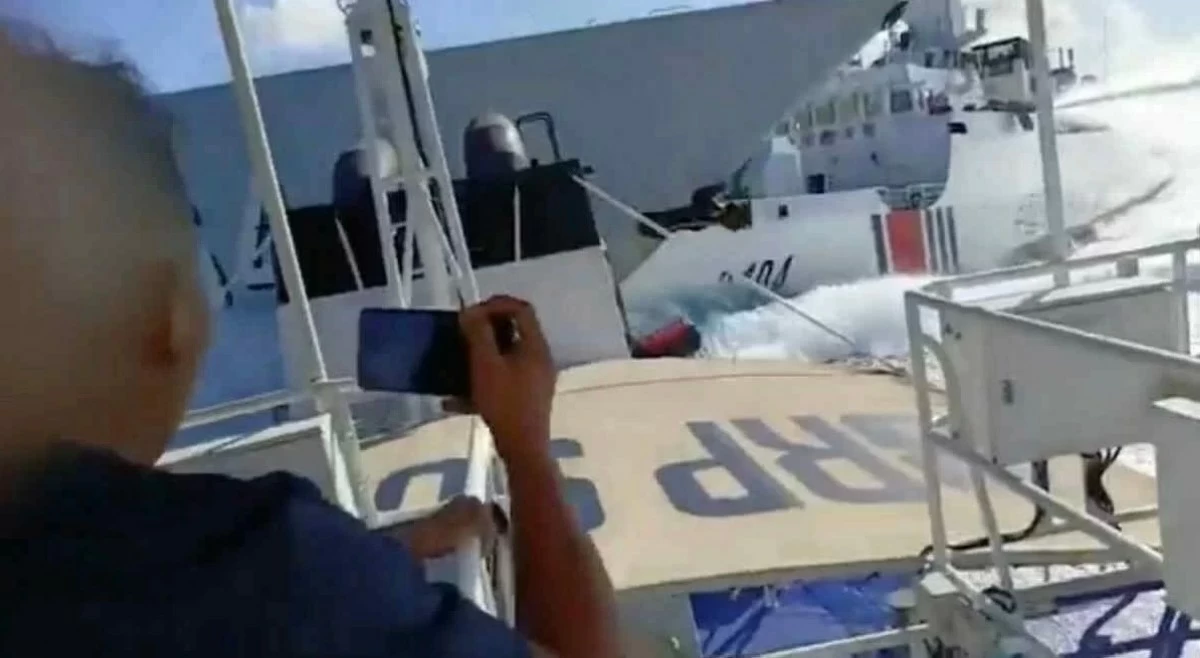
This image shows the exact moment when China Coast Guard (CCG) ship
This image shows the exact moment when China Coast Guard (CCG) ship "3104" collided with a Chinese People's Liberation Army-Navy (PLA-N) warship "164" while chasing BRP Suluan in Bajo de Masinloc, West Philippine Sea on Aug. 11, 2025. (Photo from Philippine Coast Guard)
The Philippine Coast Guard (PCG) on Saturday, Aug. 16, dismissed Beijing’s claim that Manila was responsible for the recent collision of two Chinese vessels near Bajo de Masinloc (Scarborough or Panatag Shoal) in the West Philippine Sea (WPS).
PCG spokesperson for WPS, Commodore Jay Tarriela stressed that the incident was a result of the poor seamanship skills of Chinese maritime officials.
“No matter how modern or big their warships or coast guard vessels are, if they lack seamanship skills, a collision like what happened last Monday will always be possible,” he said at a news forum in Quezon City.
A China Coast Guard (CCG) vessel and a People’s Liberation Army–Navy (PLA-N) warship collided near Bajo de Masinloc on Aug. 11 while chasing a PCG ship.
BRP Suluan was being pursued by CCG-3104 and PLA-N-164 when the Chinese navy warship suddenly cut the PCG vessel’s stern.
BRP Suluan managed to evade the dangerous maneuver but the pursuing CCG vessel slammed into the Chinese navy warship as a result of the maneuver.
China’s Ministry of National Defense blamed the Philippines for the collision.
“Philippine Coast Guard vessels repeatedly engaged in dangerous maneuvers, including high-speed incursions and sharp turns across the bow of Chinese vessels, creating a complex and tense situation at sea,” China’s Ministry of National Defense spokesperson Jiang Bin was quoted as saying by Chinese state media Global Times on Friday, Aug. 15.
In response, Tarriela said it is not the Philippines but Beijing’s illegal presence and actions that are heightening tensions in the region.
“It’s not the Philippine Coast Guard nor the Philippine government that escalates tension in the West Philippine Sea. The reason why tension is rising is because of the dangerous actions and [China’s] illegal presence within our own exclusive economic zone,” the official noted.
“If there is one country that escalates the tension in the entire South China Sea, not just in the West Philippine Sea, that is the People's Republic of China because they are deploying their China Coast Guard vessels and even PLA-Navy warships. This is the source of the tension,” he added.

Related Tags

PCG China Bajo de Masinloc WPS collision
ADVERTISEMENT
.most-popular .layout-ratio{ padding-bottom: 79.13%; } @media (min-width: 768px) and (max-width: 1024px) { .widget-title { font-size: 15px !important; } }

{{ articles_filter_1561_widget.title }}

.most-popular .layout-ratio{ padding-bottom: 79.13%; } @media (min-width: 768px) and (max-width: 1024px) { .widget-title { font-size: 15px !important; } }

{{ articles_filter_1562_widget.title }}

.most-popular .layout-ratio{ padding-bottom: 79.13%; } @media (min-width: 768px) and (max-width: 1024px) { .widget-title { font-size: 15px !important; } }

{{ articles_filter_1563_widget.title }}

{{ articles_filter_1564_widget.title }}

.mb-article-details { position: relative; } .mb-article-details .article-body-preview, .mb-article-details .article-body-summary{ font-size: 17px; line-height: 30px; font-family: "Libre Caslon Text", serif; color: #000; } .mb-article-details .article-body-preview iframe , .mb-article-details .article-body-summary iframe{ width: 100%; margin: auto; } .read-more-background { background: linear-gradient(180deg, color(display-p3 1.000 1.000 1.000 / 0) 13.75%, color(display-p3 1.000 1.000 1.000 / 0.8) 30.79%, color(display-p3 1.000 1.000 1.000) 72.5%); position: absolute; height: 200px; width: 100%; bottom: 0; display: flex; justify-content: center; align-items: center; padding: 0; } .read-more-background a{ color: #000; } .read-more-btn { padding: 17px 45px; font-family: Inter; font-weight: 700; font-size: 18px; line-height: 16px; text-align: center; vertical-align: middle; border: 1px solid black; background-color: white; } .hidden { display: none; }
function initializeAllSwipers() { // Get all hidden inputs with cms_article_id document.querySelectorAll('[id^="cms_article_id_"]').forEach(function (input) { const cmsArticleId = input.value; const articleSelector = '#article-' + cmsArticleId + ' .body_images'; const swiperElement = document.querySelector(articleSelector); if (swiperElement && !swiperElement.classList.contains('swiper-initialized')) { new Swiper(articleSelector, { loop: true, pagination: false, navigation: { nextEl: '#article-' + cmsArticleId + ' .swiper-button-next', prevEl: '#article-' + cmsArticleId + ' .swiper-button-prev', }, }); } }); } setTimeout(initializeAllSwipers, 3000); const intersectionObserver = new IntersectionObserver( (entries) => { entries.forEach((entry) => { if (entry.isIntersecting) { const newUrl = entry.target.getAttribute("data-url"); if (newUrl) { history.pushState(null, null, newUrl); let article = entry.target; // Extract metadata const author = article.querySelector('.author-section').textContent.replace('By', '').trim(); const section = article.querySelector('.section-info ').textContent.replace(' ', ' '); const title = article.querySelector('.article-title h1').textContent; // Parse URL for Chartbeat path format const parsedUrl = new URL(newUrl, window.location.origin); const cleanUrl = parsedUrl.host + parsedUrl.pathname; // Update Chartbeat configuration if (typeof window._sf_async_config !== 'undefined') { window._sf_async_config.path = cleanUrl; window._sf_async_config.sections = section; window._sf_async_config.authors = author; } // Track virtual page view with Chartbeat if (typeof pSUPERFLY !== 'undefined' && typeof pSUPERFLY.virtualPage === 'function') { try { pSUPERFLY.virtualPage({ path: cleanUrl, title: title, sections: section, authors: author }); } catch (error) { console.error('ping error', error); } } // Optional: Update document title if (title && title !== document.title) { document.title = title; } } } }); }, { threshold: 0.1 } ); function showArticleBody(button) { const article = button.closest("article"); const summary = article.querySelector(".article-body-summary"); const body = article.querySelector(".article-body-preview"); const readMoreSection = article.querySelector(".read-more-background"); // Hide summary and read-more section summary.style.display = "none"; readMoreSection.style.display = "none"; // Show the full article body body.classList.remove("hidden"); } document.addEventListener("DOMContentLoaded", () => { let loadCount = 0; // Track how many times articles are loaded const offset = [1, 2, 3, 4, 5, 6, 7, 8, 9, 10]; // Offset values const currentUrl = window.location.pathname.substring(1); let isLoading = false; // Prevent multiple calls if (!currentUrl) { console.log("Current URL is invalid."); return; } const sentinel = document.getElementById("load-more-sentinel"); if (!sentinel) { console.log("Sentinel element not found."); return; } function isSentinelVisible() { const rect = sentinel.getBoundingClientRect(); return ( rect.top < window.innerHeight && rect.bottom >= 0 ); } function onScroll() { if (isLoading) return; if (isSentinelVisible()) { if (loadCount >= offset.length) { console.log("Maximum load attempts reached."); window.removeEventListener("scroll", onScroll); return; } isLoading = true; const currentOffset = offset[loadCount]; window.loadMoreItems().then(() => { let article = document.querySelector('#widget_1690 > div:nth-last-of-type(2) article'); intersectionObserver.observe(article) loadCount++; }).catch(error => { console.error("Error loading more items:", error); }).finally(() => { isLoading = false; }); } } window.addEventListener("scroll", onScroll); });

Sign up by email to receive news.