






Manila Bulletin
 Lifestyle
Arts and Culture
Word-play humor, zombie compassion, and detecting with history
Lifestyle
Arts and Culture
Word-play humor, zombie compassion, and detecting with history
Lifestyle
Arts and Culture
Word-play humor, zombie compassion, and detecting with history
Word-play humor, zombie compassion, and detecting with history
Published Aug 14, 2025 11:05 pm


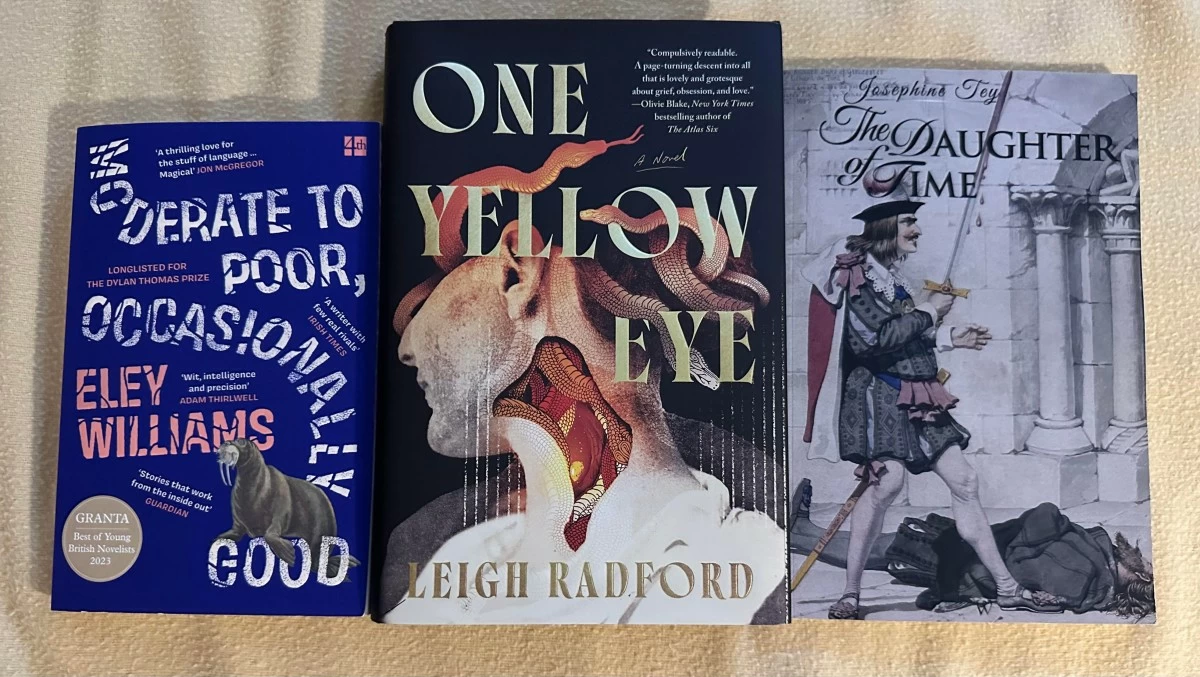
The novels today are led by Leigh Radford’s, with a narrative that uses a zombie outbreak to deliver a richly textured story about grief, obsession, and love. Then there’s the latest from wordsmith Eley Williams, a collection of short stories, and a reissue of Josephine Tey’s historical crime fiction.
"Moderate to Poor, Occasionally Good" by Eley Williams
Longlisted for the Dylan Thomas Prize, this new collection of short stories comes from Eley Williams, who wrote "The Liar’s Dictionary," a Guardian Book of the Year and Betty Trask Award winner in 2021. Eley is known for her affinity for dictionaries, language, and words, and the titles of this collection manifest that wonderfully. From Scrimshaw and Squared Circle to Sonant and Wilgefortis, there’s an intent that’s whimsical, and challenges us to pick up our own dictionary (or head to Google Search). Poignant while being playful, the stories here study relationships from an oblique angle or a skewed perspective, seeking surprise and even bafflement, as everyday experiences. Then some of the stories will have a darker, more complex foundation that Eley sifts through and offers for our consideration.
A courtroom artist reflecting on a date and her many "sketchy" qualities, the different ways one can yawn and their meanings, how a visit to a museum in Italy of terracotta whistles can lead to an obsession with visiting Burlington Arcade in London, or how being asked to look after a laptop in a café turns into anger over a husband hiding his pornography viewing at home under the guise of researching for a military history book—all of these illustrate the range of Eley's stories. It is about form—about turning one story into the instruction manual of a card game, and about never being far from new words. Words that Eley purposely leaves undefined, which we can try to guess from context, but ultimately must look up ourselves to be certain. I first read Eley through her novel "Liar’s Dictionary," and if you love words, I would highly recommend starting with that novel.
"One Yellow Eye" by Leigh Radford
The premise for this could have come out of "28 Days Later," as it has to do with a zombie outbreak in modern London. Our protagonist is Kesta, a biomedical scientist, whose specialization is Oncology. Her husband, Tim, was one of the last to have caught the virus, and while all the zombies were rounded up and exterminated, what no one knows is that Kesta has Tim locked up in their flat and chained to the wall, while she works at the laboratory and searches for a cure. Kesta is even a member of a Zombie Apocalypse Recovery Group (ZARG), where they share about losing their loved ones to the virus, and how they cope with the guilt or loss. She attends in order to keep hidden the fact that Tim is still with her. When she’s asked to join Project Dawn, the stakes for helping find the cure get higher, and her secret staying a secret becomes all the more vital.
The discovery that others besides Tim have survived the extermination causes panic, while providing Project Dawn with a live specimen. There’s body horror, visceral, and bloody passages that will make the reader squirm with unease and disgust. And always lingering is the question of whether Kesta’s actions border on obsession, an unhealthy response to grief and loss. The novel transcends being a straight-out horror suspense story and rises above the genre to be an exploration into love, loss, and what extremes we are ready to go to hold on to the one we love. And it does not shirk from asking the hard questions of whether what we do can be just for ourselves and not truly for the one we profess to love and be doing it for. That we just recently came out of our version of a global health crisis caused by a virus gives this novel added gravitas.
"The Daughter of Time" by Josephine Tey
This last work of the late Josephine Tey was voted number one when the British Crime Writers Association selected their Top 100 Crime Novels of All Time in 1990. And five years later, it was ranked fourth when the Mystery Writers of America compiled their Top 100 Mystery Novels of All Time.
Written in 1951, the premise has to do with a modern police officer’s investigation into the alleged crimes of King Richard III of England. This reissue is my first time reading the book, and I just had to bring it to your attention because it’s that good. Grant is the police officer in question, and he’s in the hospital after a nasty fall, experienced while apprehending a suspect. It’s while he’s recuperating that friends bring books to help while the time. But it’s when a good friend brings portraits of historical characters that his curiosity is piqued as to how much one can discern about the character of a person and their predilection to crime, from said portrait.
The one Grant gets stuck on is that of Richard III, and how the common thread of knowledge is that he had his two nephews murdered, perceiving them to be obstacles to the legitimacy of his ascension to the throne. But when conflicting retellings of what transpired occur, a shadow of doubt is cast upon history, and Grant’s research proves that even the version written by Sir Thomas More was, in fact, nothing more than his copying down what someone else had written. More was writing way after the events ascribed to Richard, so his "authorized" version is in fact just hearsay, not an eyewitness account. From his hospital bed, Grant embarks on an "investigation," aided by a young American friend.
Soon, the novel becomes a study of how so much of "history" depends on intent, and not the facts per se. And how true history can often be not what is said or written about "events," but the examination of what happened during the period, information that may not seem to have a direct bearing on the history, but which has more truth in it.