ADVERTISEMENT

Five minutes that can save lives and build trust

Published Aug 14, 2025 12:01 am  |  Updated Aug 13, 2025 04:21 pm
Trust is an important factor in public safety. When people trust the authorities to always be there to keep them safe during times of natural disaster or from criminal elements, a strong partnership between government and citizens is forged.
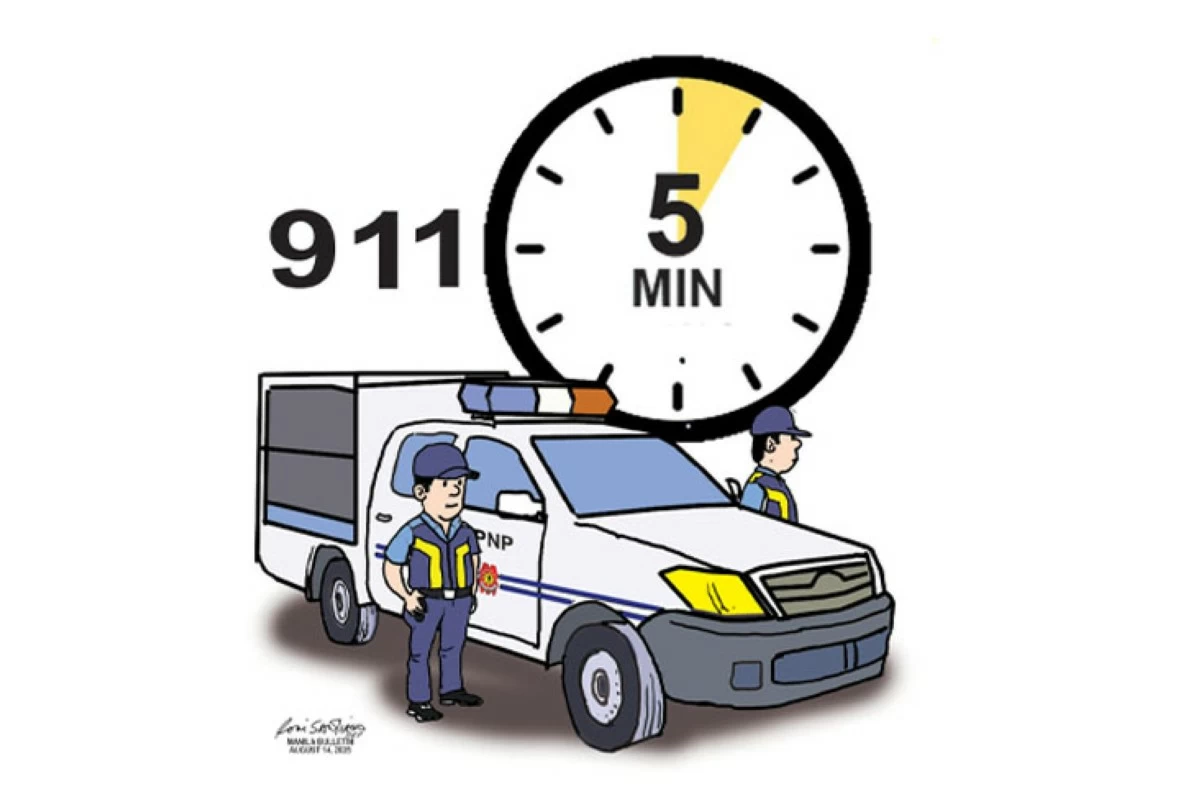
The Philippine National Police’s (PNP) new five-minute response policy—successfully demonstrated before President Ferdinand R. Marcos Jr. during the 124th Police Service Anniversary on Aug. 12 — is a decisive step toward rebuilding public confidence in the country’s law enforcement. In emergencies, five minutes can mean the difference between life and death, capture or escape, trust or skepticism.
From June 2, when PNP Chief Gen. Nicolas Torre III launched the initiative, to Aug. 10, the PNP received 3,574 calls to the 911 hotline requiring police assistance. Of these, nearly 94 percent were acted upon within five minutes. This is not a hollow statistic—it is nine out of 10 calls answered swiftly.
The demonstration to the President at Camp Crame was more than ceremonial. It reflected a police force that has begun to leverage technology and coordination in unprecedented ways. The PNP Command Center’s real-time maps, GPS-integrated tracking tools, and live monitoring systems, coupled with drone-assisted operations and 800 body-worn cameras capable of live streaming, are redefining how law enforcement responds.
The integration of all 911 hotlines nationwide into a unified Emergency 911 system— that will be fully rolled out by the end of this month —will further strengthen the trust factor. By linking local government hotlines, CCTV feeds, and dispatch operations into one coordinated network, response can be swift. Even language barri-ers are being addressed, with the system accommodating Ilocano, Kapampangan, Tagalog, Bicolano, Waray, Bisaya, and Tausug.
The relevance of this initiative cannot be overstated. For decades, one of the public’s deepest frustrations has been the slow, sometimes indifferent, arrival of help in urgent situations. The image of a police force arriv-ing “too late” has been difficult to erase. This five-minute benchmark, if sustained and institutionalized, di-rectly confronts that perception.
But speed alone will not heal the fractures in public trust. As the President reminded during the celebration, no amount of state-of-the-art equipment will matter if corruption and abuse persist within the ranks. The sight of help arriving in minutes is powerful; the assurance that this help is honest, fair, and competent is what will make it lasting.
Sustaining this five-minute policy will demand more than technology. It will require continuous training, adequate mobility resources—such as the additional motorcycles and vehicles pledged by the Department of the Interior and Local Government—and a culture of accountability. Rain or shine, midnight or midday, police pres-ence must remain a given, not a good guess.
There is also the matter of scope. Urban centers with dense networks of roads, cameras, and patrol units may meet the five-minute mark consistently,. But in the rural and far-flung areas, this presents a far greater challenge. Expanding this promise to the nation’s most remote barangays will test the PNP’s logistical inge-nuity and resource allocation.
Ultimately, the five-minute police response is not merely about clocking in faster—it is about showing up when the public needs it most. If this commitment is safeguarded from complacency and corruption, it can become a defining achievement for the PNP, a tangible assurance that in moments of fear and urgency, the people are not alone.

Related Tags

FIVE-MINUTE RESPONSE
ADVERTISEMENT
.most-popular .layout-ratio{ padding-bottom: 79.13%; } @media (min-width: 768px) and (max-width: 1024px) { .widget-title { font-size: 15px !important; } }

{{ articles_filter_1561_widget.title }}

.most-popular .layout-ratio{ padding-bottom: 79.13%; } @media (min-width: 768px) and (max-width: 1024px) { .widget-title { font-size: 15px !important; } }

{{ articles_filter_1562_widget.title }}

.most-popular .layout-ratio{ padding-bottom: 79.13%; } @media (min-width: 768px) and (max-width: 1024px) { .widget-title { font-size: 15px !important; } }

{{ articles_filter_1563_widget.title }}

{{ articles_filter_1564_widget.title }}

.mb-article-details { position: relative; } .mb-article-details .article-body-preview, .mb-article-details .article-body-summary{ font-size: 17px; line-height: 30px; font-family: "Libre Caslon Text", serif; color: #000; } .mb-article-details .article-body-preview iframe , .mb-article-details .article-body-summary iframe{ width: 100%; margin: auto; } .read-more-background { background: linear-gradient(180deg, color(display-p3 1.000 1.000 1.000 / 0) 13.75%, color(display-p3 1.000 1.000 1.000 / 0.8) 30.79%, color(display-p3 1.000 1.000 1.000) 72.5%); position: absolute; height: 200px; width: 100%; bottom: 0; display: flex; justify-content: center; align-items: center; padding: 0; } .read-more-background a{ color: #000; } .read-more-btn { padding: 17px 45px; font-family: Inter; font-weight: 700; font-size: 18px; line-height: 16px; text-align: center; vertical-align: middle; border: 1px solid black; background-color: white; } .hidden { display: none; }
function initializeAllSwipers() { // Get all hidden inputs with cms_article_id document.querySelectorAll('[id^="cms_article_id_"]').forEach(function (input) { const cmsArticleId = input.value; const articleSelector = '#article-' + cmsArticleId + ' .body_images'; const swiperElement = document.querySelector(articleSelector); if (swiperElement && !swiperElement.classList.contains('swiper-initialized')) { new Swiper(articleSelector, { loop: true, pagination: false, navigation: { nextEl: '#article-' + cmsArticleId + ' .swiper-button-next', prevEl: '#article-' + cmsArticleId + ' .swiper-button-prev', }, }); } }); } setTimeout(initializeAllSwipers, 3000); const intersectionObserver = new IntersectionObserver( (entries) => { entries.forEach((entry) => { if (entry.isIntersecting) { const newUrl = entry.target.getAttribute("data-url"); if (newUrl) { history.pushState(null, null, newUrl); let article = entry.target; // Extract metadata const author = article.querySelector('.author-section').textContent.replace('By', '').trim(); const section = article.querySelector('.section-info ').textContent.replace(' ', ' '); const title = article.querySelector('.article-title h1').textContent; // Parse URL for Chartbeat path format const parsedUrl = new URL(newUrl, window.location.origin); const cleanUrl = parsedUrl.host + parsedUrl.pathname; // Update Chartbeat configuration if (typeof window._sf_async_config !== 'undefined') { window._sf_async_config.path = cleanUrl; window._sf_async_config.sections = section; window._sf_async_config.authors = author; } // Track virtual page view with Chartbeat if (typeof pSUPERFLY !== 'undefined' && typeof pSUPERFLY.virtualPage === 'function') { try { pSUPERFLY.virtualPage({ path: cleanUrl, title: title, sections: section, authors: author }); } catch (error) { console.error('ping error', error); } } // Optional: Update document title if (title && title !== document.title) { document.title = title; } } } }); }, { threshold: 0.1 } ); function showArticleBody(button) { const article = button.closest("article"); const summary = article.querySelector(".article-body-summary"); const body = article.querySelector(".article-body-preview"); const readMoreSection = article.querySelector(".read-more-background"); // Hide summary and read-more section summary.style.display = "none"; readMoreSection.style.display = "none"; // Show the full article body body.classList.remove("hidden"); } document.addEventListener("DOMContentLoaded", () => { let loadCount = 0; // Track how many times articles are loaded const offset = [1, 2, 3, 4, 5, 6, 7, 8, 9, 10]; // Offset values const currentUrl = window.location.pathname.substring(1); let isLoading = false; // Prevent multiple calls if (!currentUrl) { console.log("Current URL is invalid."); return; } const sentinel = document.getElementById("load-more-sentinel"); if (!sentinel) { console.log("Sentinel element not found."); return; } function isSentinelVisible() { const rect = sentinel.getBoundingClientRect(); return ( rect.top < window.innerHeight && rect.bottom >= 0 ); } function onScroll() { if (isLoading) return; if (isSentinelVisible()) { if (loadCount >= offset.length) { console.log("Maximum load attempts reached."); window.removeEventListener("scroll", onScroll); return; } isLoading = true; const currentOffset = offset[loadCount]; window.loadMoreItems().then(() => { let article = document.querySelector('#widget_1690 > div:nth-last-of-type(2) article'); intersectionObserver.observe(article) loadCount++; }).catch(error => { console.error("Error loading more items:", error); }).finally(() => { isLoading = false; }); } } window.addEventListener("scroll", onScroll); });

Sign up by email to receive news.