






 Philippines
National
Marcos: 2026 budget geared toward 'biggest treasure: our people'
Philippines
National
Marcos: 2026 budget geared toward 'biggest treasure: our people'
Marcos: 2026 budget geared toward 'biggest treasure: our people'


At A Glance
- In his budget message, the President said that while the administration continues to pursue its desired economic transformation, it is now time to focus on the needs of the people.
President Marcos has submitted to Congress a proposed ₱6.793-trillion national budget for 2026, saying it marks a deliberate shift from infrastructure-heavy investments to greater funding for the country’s human capital.
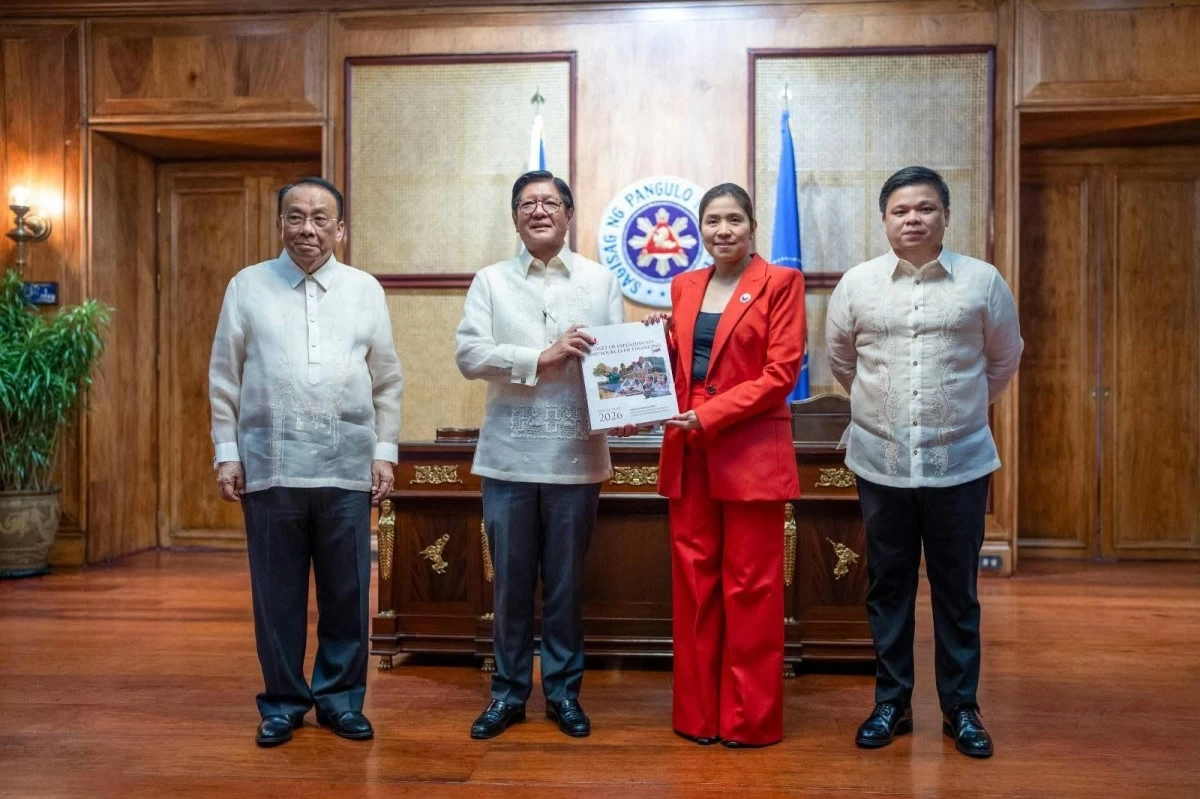
In his budget message, the President said that while the administration continues to pursue its desired economic transformation, it is now time to focus on the needs of the people.
“As we reach the halfway point of this Administration, we shall shift the focus of our strategy to invest greatly not only in infrastructure but in our biggest treasure: our people, especially the next generations,” he said in his budget message.
“By nurturing future-ready generations, we will be able to truly achieve the full potential of our nation,” he added.
The proposed National Expenditure Program (NEP) is anchored in the theme “Agenda for Prosperity: Nurturing Future-Ready Generations to Achieve the Full Potential of the Nation” and is equivalent to 22 percent of the nation's gross domestic product (GDP). It is 7.4 percent higher than this year’s P6.326-trillion NEP.
Right on track
President Marcos expressed confidence that the Philippines is on track with its Agenda for Prosperity and poised to be a leader among nations, especially in the Asia Pacific region.
However, while the country has recovered from the pandemic, he recognized that there is still much to rebuild, and there is still much that can be achieved.
“We must not lose sight of our collective responsibility to ensure a brighter future for our people, especially the next generations,” he said.
“Hence, I urge the honorable members of Congress to swiftly enact this budget. Let us work together to realize the full potential of our nation, nurture future-ready generations, and fulfill our dream of a Bagong Pilipinas,” he added.
Economic outlook and assumptions
Marcos said the Philippine economy grew by 5.4 percent in the first quarter of 2025 and is expected to meet the adjusted full-year target of 5.5 to 6.5 percent. From 2026 to 2028, the government is projecting a 6.0 to 7.0 percent GDP growth rate in the country.
The inflation rate assumption for 2025 is projected at two to three percent and is expected to remain within the two to four percent target range through 2028.
Meanwhile, the peso-dollar exchange rate assumption is pegged at P56 to P58 for 2025 to 2028.
“This is supported by lower domestic inflation, and will continue to be influenced by global financial conditions and external trade performance,” the President said.
Fiscal program
Government revenues for 2026 are projected at P4.983 trillion, up 10.2 percent from this year’s P4.520 trillion.
According to President Marcos, total disbursements in 2026 are programmed at P6.630 trillion, equivalent to 21.5 percent of GDP.
The fiscal deficit is expected to be 5.3 percent of GDP in 2026, down from 5.5 percent in 2025, and decreasing even further to 4.3 percent by 2028.
Education as highest priority
“Fulfilling our Constitutional mandate to assign the highest budgetary priority to education, the budget for the Education sector has been substantially increased to P1.224 trillion,” Marcos said, noting that this is an increase from the P1.182 trillion in 2025.
The allocation includes P928.5 billion for the Department of Education (DepEd), an 18.7 percent increase from the P782.2 billion in the 2025 General Appropriations Act; P134.9 billion for state universities and colleges; P33.9 billion for the Commission on Higher Education (CHED); and P20.2 billion for the Technical Education and Skills Development Authority (TESDA).
A total allocation of P15.4 billion is allotted for the creation of 65,184 positions, comprising 32,916 teaching positions and 32,268 non-teaching positions.
Health sector funding
To honor the promise of universal health care for every Filipino, the President said the Department of Health (DOH), including Specialty Hospitals and PhilHealth, will receive the third largest budget allocation at P320.5 billion, marking a 5.6 percent increase from the FY 2025 NEP.
The budget includes P24.2 billion for Medical Assistance to Indigent Patients (MAIP), P53.3 billion for the National Health Insurance Program (NHIP), and P1.3 billion for the Cancer Assistance Fund.
Social protection
President Marcos reaffirmed his administration’s “enduring commitment” to protect the most vulnerable sectors of society through the P227 billion budget for the Social Services sector in 2026.
This budget allocation includes P113.0 billion for the Pantawid Pamilyang Pilipino Program (4Ps), P49.8 billion for the Social Pension for Indigent Senior Citizens, and P1.9 billion for the Walang Gutom 2027: Food STAMP Program.
Agriculture and food security
A total of P256.5 billion will be used to strengthen our Agriculture sector in 2026, according to the President.
For 2026, the Executive Branch has allocated P29.9 billion for the National Rice Program, P30 billion for the Rice Competitiveness Enhancement Fund (RCEF), and P11.2 billion for the Buffer Stocking Program to procure 300,000 metric tons of palay.
Infrastructure
President Marcos said the government is fast-tracking infrastructure development to create more livable communities, modernize transportation systems, and address long-standing challenges.
To support this, the Build Better More program will receive P1.556 trillion in 2026, which is five percent of GDP, aligned with the target infrastructure spending of five to six percent of GDP.
The Department of Public Works and Highways (DPWH) and Department of Transportation (DOTr), as the main agencies that will implement infrastructure programs and projects, will receive P881.3 billion and P197.3 billion, respectively.
The Department of Information and Communications Technology (DICT), on the other hand, has been allocated P18.9 billion to bridge the digital divide and unlock the full potential of using technology to propel the economy.
In line with the PDP 2023–2028’s push to expand renewable energy systems and scale up energy efficiency and conservation, the Department of Energy (DOE) will receive P3.8 billion in the 2026 budget, a 24.4 percent increase from its P3.1 billion allocation in 2025.