ADVERTISEMENT

BDO chief warns of 'second-order' risks from US tariffs

Published Aug 13, 2025 03:19 pm
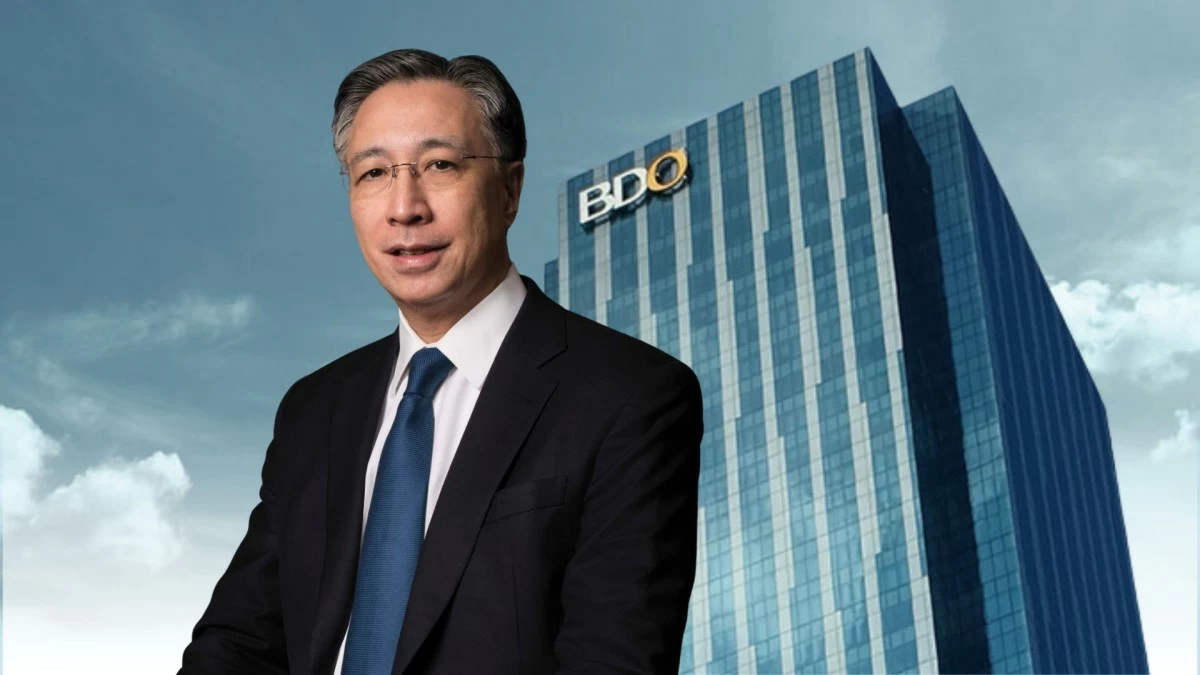
Nestor V. Tan, President and CEO of BDO Unibank, Inc.
Head of the Philippines’ largest bank believes the country’s economy will be shielded from the direct fallout of new United States (US) tariffs, but warned of a larger, global danger that could ripple back to the country through remittances.
Speaking with Channel News Asia (CNA), BDO Unibank President and CEO Nestor Tan said that the Philippines’ economy has limited direct exposure to US tariffs, since Manila’s exports account for only 16 percent of its gross domestic product (GDP).
And of that total, Tan pointed out that only two percent goes to the US. He estimated the direct impact on the Philippines’ GDP is at “a few basis points."
Data from the Philippine Statistics Authority (PSA) showed that Philippine exports to the US comprised 17.3 percent of total exports in June 2025, with overall exports around 25.77 percent of its GDP in 2024.
Tan’s assessments concur with the Asian Development Bank’s (ADB) estimates, which suggest that US tariffs have a minimal direct effect on the Philippine economy because it depends heavily on domestic demand.
Washington recently announced a 19 percent reciprocal tariff on Philippine goods, effective Aug. 1, 2025, a slight reduction from an initial 20 percent following negotiations between President Ferdinand R. Marcos Jr. and US President Donald Trump.
Despite the tariff, the Manila’s rate is comparatively lower than many Southeast Asian nations, positioning it to potentially attract supply chain shifts. Marcos, in turn, has agreed to remove tariffs on US automobile imports and increase imports of soy products, wheat, and pharmaceuticals.
However, the BDO chief’s primary concern lies with the indirect consequences. 
“What we're also worried about is the second-order impact, meaning we have exporters to other countries that will be impacted by the tariffs that we don’t know yet," he explained.
This includes potential slowdowns in global activity and inflationary pressures that could affect remittances from overseas Filipino workers (OFWs) — a crucial economic driver. While overseas remittances have historically proven resilient, recent growth has slowed, with May 2025 seeing a 2.9 percent increase.
Despite these external headwinds, Tan noted BDO’s loan portfolio has not been significantly affected, with “asset qualities having held out.” He also expressed confidence in the bank’s “adequate provisions” for any tariff-related fallout.
On the broader economic front, Tan expects a general slowdown due to higher prices impacting consumer purchasing. However, he pointed to the Philippines’ “counter-cyclical effect,” where it often secures better trade deals during global downturns.
With the US accounting for approximately 17 percent of world trade, “the 83 percent can still continue with the free trade that they’re used to,” Tan added, highlighting opportunities for trade redirection.
The Philippines is actively pursuing trade diversification, exploring agreements like the Comprehensive and Progressive Agreement for Trans-Pacific Partnership (CPTPP) and a potential free trade agreement with Canada.
Domestically, Tan observed “low loan growth” but a “good balance” across consumer, middle market, and large corporate segments.
He pointed to “revenge spending” in the consumer sector post-pandemic and an encouraging increase in working capital and capital expenditure among middle-market entrepreneurs, which he sees as an optimistic indicator for job creation.
Looking ahead, BDO, which reported a three percent increase in earnings for the first half of the year, expects this strong performance to continue, supported by balanced growth and fee income.
Tan identified two key medium-term growth factors for the Philippine economy: substantial infrastructure spending and a pickup in real estate activity, particularly outside Metro Manila.
The government's proposed ₱6.793-trillion national budget for 2026, while shifting focus to human capital, still includes significant infrastructure outlays.
The real estate sector aims to address a substantial housing backlog, estimated between 6.5 million and 10 million units, with some projections reaching 22 million by 2040, indicating considerable development potential once stability is achieved. 
(Ricardo M. Austria)

Related Tags

BDO Unibank Inc. US tariffs Philippine economy
ADVERTISEMENT
.most-popular .layout-ratio{ padding-bottom: 79.13%; } @media (min-width: 768px) and (max-width: 1024px) { .widget-title { font-size: 15px !important; } }

{{ articles_filter_1561_widget.title }}

.most-popular .layout-ratio{ padding-bottom: 79.13%; } @media (min-width: 768px) and (max-width: 1024px) { .widget-title { font-size: 15px !important; } }

{{ articles_filter_1562_widget.title }}

.most-popular .layout-ratio{ padding-bottom: 79.13%; } @media (min-width: 768px) and (max-width: 1024px) { .widget-title { font-size: 15px !important; } }

{{ articles_filter_1563_widget.title }}

{{ articles_filter_1564_widget.title }}

.mb-article-details { position: relative; } .mb-article-details .article-body-preview, .mb-article-details .article-body-summary{ font-size: 17px; line-height: 30px; font-family: "Libre Caslon Text", serif; color: #000; } .mb-article-details .article-body-preview iframe , .mb-article-details .article-body-summary iframe{ width: 100%; margin: auto; } .read-more-background { background: linear-gradient(180deg, color(display-p3 1.000 1.000 1.000 / 0) 13.75%, color(display-p3 1.000 1.000 1.000 / 0.8) 30.79%, color(display-p3 1.000 1.000 1.000) 72.5%); position: absolute; height: 200px; width: 100%; bottom: 0; display: flex; justify-content: center; align-items: center; padding: 0; } .read-more-background a{ color: #000; } .read-more-btn { padding: 17px 45px; font-family: Inter; font-weight: 700; font-size: 18px; line-height: 16px; text-align: center; vertical-align: middle; border: 1px solid black; background-color: white; } .hidden { display: none; }
function initializeAllSwipers() { // Get all hidden inputs with cms_article_id document.querySelectorAll('[id^="cms_article_id_"]').forEach(function (input) { const cmsArticleId = input.value; const articleSelector = '#article-' + cmsArticleId + ' .body_images'; const swiperElement = document.querySelector(articleSelector); if (swiperElement && !swiperElement.classList.contains('swiper-initialized')) { new Swiper(articleSelector, { loop: true, pagination: false, navigation: { nextEl: '#article-' + cmsArticleId + ' .swiper-button-next', prevEl: '#article-' + cmsArticleId + ' .swiper-button-prev', }, }); } }); } setTimeout(initializeAllSwipers, 3000); const intersectionObserver = new IntersectionObserver( (entries) => { entries.forEach((entry) => { if (entry.isIntersecting) { const newUrl = entry.target.getAttribute("data-url"); if (newUrl) { history.pushState(null, null, newUrl); let article = entry.target; // Extract metadata const author = article.querySelector('.author-section').textContent.replace('By', '').trim(); const section = article.querySelector('.section-info ').textContent.replace(' ', ' '); const title = article.querySelector('.article-title h1').textContent; // Parse URL for Chartbeat path format const parsedUrl = new URL(newUrl, window.location.origin); const cleanUrl = parsedUrl.host + parsedUrl.pathname; // Update Chartbeat configuration if (typeof window._sf_async_config !== 'undefined') { window._sf_async_config.path = cleanUrl; window._sf_async_config.sections = section; window._sf_async_config.authors = author; } // Track virtual page view with Chartbeat if (typeof pSUPERFLY !== 'undefined' && typeof pSUPERFLY.virtualPage === 'function') { try { pSUPERFLY.virtualPage({ path: cleanUrl, title: title, sections: section, authors: author }); } catch (error) { console.error('ping error', error); } } // Optional: Update document title if (title && title !== document.title) { document.title = title; } } } }); }, { threshold: 0.1 } ); function showArticleBody(button) { const article = button.closest("article"); const summary = article.querySelector(".article-body-summary"); const body = article.querySelector(".article-body-preview"); const readMoreSection = article.querySelector(".read-more-background"); // Hide summary and read-more section summary.style.display = "none"; readMoreSection.style.display = "none"; // Show the full article body body.classList.remove("hidden"); } document.addEventListener("DOMContentLoaded", () => { let loadCount = 0; // Track how many times articles are loaded const offset = [1, 2, 3, 4, 5, 6, 7, 8, 9, 10]; // Offset values const currentUrl = window.location.pathname.substring(1); let isLoading = false; // Prevent multiple calls if (!currentUrl) { console.log("Current URL is invalid."); return; } const sentinel = document.getElementById("load-more-sentinel"); if (!sentinel) { console.log("Sentinel element not found."); return; } function isSentinelVisible() { const rect = sentinel.getBoundingClientRect(); return ( rect.top < window.innerHeight && rect.bottom >= 0 ); } function onScroll() { if (isLoading) return; if (isSentinelVisible()) { if (loadCount >= offset.length) { console.log("Maximum load attempts reached."); window.removeEventListener("scroll", onScroll); return; } isLoading = true; const currentOffset = offset[loadCount]; window.loadMoreItems().then(() => { let article = document.querySelector('#widget_1690 > div:nth-last-of-type(2) article'); intersectionObserver.observe(article) loadCount++; }).catch(error => { console.error("Error loading more items:", error); }).finally(() => { isLoading = false; }); } } window.addEventListener("scroll", onScroll); });

Sign up by email to receive news.