ADVERTISEMENT

PH-Japan reciprocal access agreement to enter into force on Sept. 11

Published Aug 12, 2025 05:18 pm
The Philippines-Japan Reciprocal Access Agreement (RAA), which will allow both countries to work more closely on defense and security matters, will enter into force on Sept. 11.

Vice Admiral Jose Ma Ambrosio Ezpeleta, Flag Officer In Command of the Philippine Navy, aboard JMSDF’s JS Hamagiri (DD-155) on Feb. 24, 2025 at South Harbour in Manila. (Photo from Philippine Navy)
This was announced by Department of Foreign Affairs (DFA) Secretary Ma. Theresa Lazaro and Japanese Ambassador to the Philippines Endo Kazuya during the Ceremonial Exchange of Notes on the Entry into Force of the PH-JP RAA on Tuesday, Aug. 12.

“We are pleased to announce that, with the exchange of Note Verbales today, the RAA will officially enter into force on 11 September 2025,” the Japanese envoy said.

“This swift and decisive progress speaks to the urgency and strategic value both our nations attach to our security and defense cooperation. Japan recognizes the Philippines as an indispensable partner, strategically positioned at the heart of the Indo-Pacific, and united through our shared core values of freedom, democracy, and the rule of law,” Endo added.

In her speech, Lazaro noted the “strengthened strategic partnership” that will be born from the RAA, as well as the agreement between her and Japanese Foreign Minister Iwaya Takeshi last month to ensure the “early entry into force” of the RAA.

“Not only will it be an important step in our concerted efforts to enhance our 69 years of bilateral relations, it will also signify Japan's clear commitment to the Philippines' efforts to advance our defense capabilities in support of the Philippines' firm assertion of its sovereignty and sovereign rights in today's fast-evolving regional security landscape,” she said.

The DFA chief furthered that the RAA is a demonstration of the value of the Philippines-Japan partnership in the stability of the Indo-Pacific region.

“The RAA is a natural progression of the cooperation between the Philippines Armed Forces and the Japanese Self-Defense Forces, from active cooperation on humanitarian assistance and disaster response activities to other aspects of capability and capacity building,” she added.
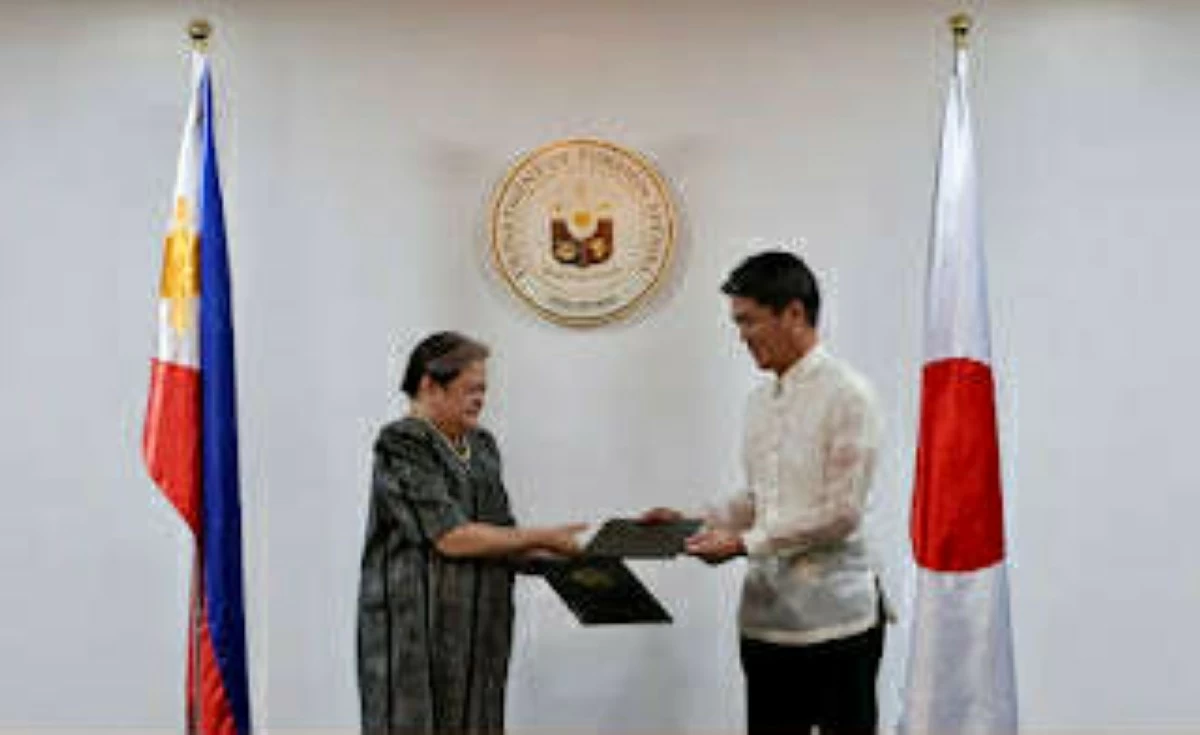
DFA Secretary Ma. Theresa Lazaro and Japanese Ambassador Endo Kazuya exchange the diplomatic notes on the entry into force of the Philippines-Japan Reciprocal Access Agreement (RAA) on Tuesday, Aug. 12, 2025. (DFA Photo)
Department of National Defense (DND) Secretary Gilberto Teodoro Jr., who also attended the event, said that “there’s no denying” that the Philippines and Japan “share the same challenges.”

“We share the same challenges, not only with Japan, but also Australia, and New Zealand, as far as it is. And Canada, too. And France, too,” he told reporters.

"It also provides deterrence for those actors who may not see things the way we do and may not share our values. It provides resilience because not only will we be working with others, but we will be working with each other, close neighbors," Teodoro said in his remarks.

While he admitted that there will be “hard work” for both parties because of the component agreements—access agreements, logistics agreements, and the constitution of the different bodies—needed to make the RAA fully implementable, he stressed that “it is a positive development that we are entering into these principled partnerships.”

The defense chief added that the Armed Forces of the Philippines (AFP) would also have to accommodate the joint and combined activities with the re-training and their actual operations in the country.

The RAA was signed in July 2024 and ratified by President Marcos in November 2024, then by the Senate in December 2024. The Japanese Diet ratified it in June 2025.

The agreement allows for closer defense cooperation, including joint exercises and training, between the Philippines and Japan. It will also let Filipino soldiers undergo combat training with their counterparts in Japan.

Seen as a key step in strengthening the two countries’ strategic partnership in the face of regional security challenges, the RAA is a defining moment in the Philippines-Japan defense relations and will be tapped to contribute to ensuring peace and security in the South China Sea.

The Philippines’ push for increased maritime and defense alliances came on the heels of China’s aggressive actions in the region, which it continues to claim almost in its entirety despite the 2016 arbitral tribunal win that invalidated the basis of these claims.

While the 1987 Philippine Constitution prohibits foreign troops from establishing permanent military bases in the country, through agreements like the RAA with Japan and the Visiting Forces Agreement (VFA) with the US, foreign militaries may be allowed to enter the country for activities.

Aside from agreements with the US and Japan, the Philippines also has an existing deal with Australia and New Zealand.

Related Tags

PH-Japan Reciprocal Access Agreement DFA Endo Kazuya
ADVERTISEMENT
.most-popular .layout-ratio{ padding-bottom: 79.13%; } @media (min-width: 768px) and (max-width: 1024px) { .widget-title { font-size: 15px !important; } }

{{ articles_filter_1561_widget.title }}

.most-popular .layout-ratio{ padding-bottom: 79.13%; } @media (min-width: 768px) and (max-width: 1024px) { .widget-title { font-size: 15px !important; } }

{{ articles_filter_1562_widget.title }}

.most-popular .layout-ratio{ padding-bottom: 79.13%; } @media (min-width: 768px) and (max-width: 1024px) { .widget-title { font-size: 15px !important; } }

{{ articles_filter_1563_widget.title }}

{{ articles_filter_1564_widget.title }}

.mb-article-details { position: relative; } .mb-article-details .article-body-preview, .mb-article-details .article-body-summary{ font-size: 17px; line-height: 30px; font-family: "Libre Caslon Text", serif; color: #000; } .mb-article-details .article-body-preview iframe , .mb-article-details .article-body-summary iframe{ width: 100%; margin: auto; } .read-more-background { background: linear-gradient(180deg, color(display-p3 1.000 1.000 1.000 / 0) 13.75%, color(display-p3 1.000 1.000 1.000 / 0.8) 30.79%, color(display-p3 1.000 1.000 1.000) 72.5%); position: absolute; height: 200px; width: 100%; bottom: 0; display: flex; justify-content: center; align-items: center; padding: 0; } .read-more-background a{ color: #000; } .read-more-btn { padding: 17px 45px; font-family: Inter; font-weight: 700; font-size: 18px; line-height: 16px; text-align: center; vertical-align: middle; border: 1px solid black; background-color: white; } .hidden { display: none; }
function initializeAllSwipers() { // Get all hidden inputs with cms_article_id document.querySelectorAll('[id^="cms_article_id_"]').forEach(function (input) { const cmsArticleId = input.value; const articleSelector = '#article-' + cmsArticleId + ' .body_images'; const swiperElement = document.querySelector(articleSelector); if (swiperElement && !swiperElement.classList.contains('swiper-initialized')) { new Swiper(articleSelector, { loop: true, pagination: false, navigation: { nextEl: '#article-' + cmsArticleId + ' .swiper-button-next', prevEl: '#article-' + cmsArticleId + ' .swiper-button-prev', }, }); } }); } setTimeout(initializeAllSwipers, 3000); const intersectionObserver = new IntersectionObserver( (entries) => { entries.forEach((entry) => { if (entry.isIntersecting) { const newUrl = entry.target.getAttribute("data-url"); if (newUrl) { history.pushState(null, null, newUrl); let article = entry.target; // Extract metadata const author = article.querySelector('.author-section').textContent.replace('By', '').trim(); const section = article.querySelector('.section-info ').textContent.replace(' ', ' '); const title = article.querySelector('.article-title h1').textContent; // Parse URL for Chartbeat path format const parsedUrl = new URL(newUrl, window.location.origin); const cleanUrl = parsedUrl.host + parsedUrl.pathname; // Update Chartbeat configuration if (typeof window._sf_async_config !== 'undefined') { window._sf_async_config.path = cleanUrl; window._sf_async_config.sections = section; window._sf_async_config.authors = author; } // Track virtual page view with Chartbeat if (typeof pSUPERFLY !== 'undefined' && typeof pSUPERFLY.virtualPage === 'function') { try { pSUPERFLY.virtualPage({ path: cleanUrl, title: title, sections: section, authors: author }); } catch (error) { console.error('ping error', error); } } // Optional: Update document title if (title && title !== document.title) { document.title = title; } } } }); }, { threshold: 0.1 } ); function showArticleBody(button) { const article = button.closest("article"); const summary = article.querySelector(".article-body-summary"); const body = article.querySelector(".article-body-preview"); const readMoreSection = article.querySelector(".read-more-background"); // Hide summary and read-more section summary.style.display = "none"; readMoreSection.style.display = "none"; // Show the full article body body.classList.remove("hidden"); } document.addEventListener("DOMContentLoaded", () => { let loadCount = 0; // Track how many times articles are loaded const offset = [1, 2, 3, 4, 5, 6, 7, 8, 9, 10]; // Offset values const currentUrl = window.location.pathname.substring(1); let isLoading = false; // Prevent multiple calls if (!currentUrl) { console.log("Current URL is invalid."); return; } const sentinel = document.getElementById("load-more-sentinel"); if (!sentinel) { console.log("Sentinel element not found."); return; } function isSentinelVisible() { const rect = sentinel.getBoundingClientRect(); return ( rect.top < window.innerHeight && rect.bottom >= 0 ); } function onScroll() { if (isLoading) return; if (isSentinelVisible()) { if (loadCount >= offset.length) { console.log("Maximum load attempts reached."); window.removeEventListener("scroll", onScroll); return; } isLoading = true; const currentOffset = offset[loadCount]; window.loadMoreItems().then(() => { let article = document.querySelector('#widget_1690 > div:nth-last-of-type(2) article'); intersectionObserver.observe(article) loadCount++; }).catch(error => { console.error("Error loading more items:", error); }).finally(() => { isLoading = false; }); } } window.addEventListener("scroll", onScroll); });

Sign up by email to receive news.