






Manila Bulletin
 Business
Trade & Industry
WTO warns of disruption as US seeks to 'rebalance' global trade order
Business
Trade & Industry
WTO warns of disruption as US seeks to 'rebalance' global trade order
Business
Trade & Industry
WTO warns of disruption as US seeks to 'rebalance' global trade order
WTO warns of disruption as US seeks to 'rebalance' global trade order
Published Aug 11, 2025 12:01 am


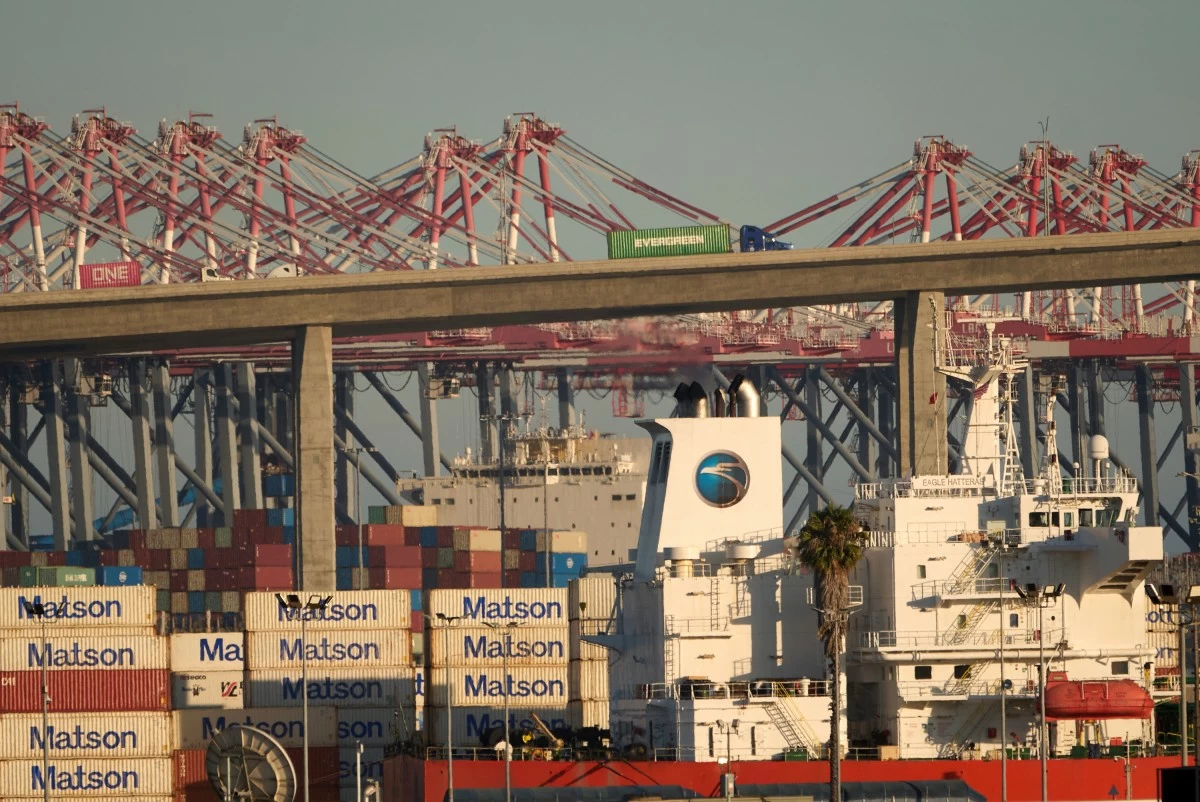
Shipping containers are stacked at the Matson terminal in the Port of Long Beach, Calif.,Thursday, July 31, 2025. (AP Photo/Damian Dovarganes)
The World Trade Organization (WTO) has revised downward its forecast for global trade growth next year to 1.8 percent from an initial estimate of 2.5 percent as the United States’ (US) reciprocal tariffs come into effect.
In its latest trade forecast, the Geneva-based trade body said recent tariff developments are expected to have an overall negative impact on the outlook for global trade.
The WTO points to the Aug. 7 implementation of US President Donald Trump’s sweeping tariff policy against America’s trading partners, including the Philippines, as the primary cause of the projected slowdown.
The tariffs are widely expected to “weigh increasingly on imports in the United States and depress exports of its trading partners in the second half of 2025 and in 2026.”
WTO Director-General Ngozi Okonjo-Iweala said uncertainty from the tariff policy remains one of the most disruptive forces in the global trading environment.
“The shadow of tariff uncertainty continues to weigh heavily on business confidence, investment, and supply chains,” said Okonjo-Iweala.
"Nevertheless, it is important that a broader cycle of tit-for-tat retaliation that could be very damaging to global trade has so far been avoided,” she added.
This year, the WTO is anticipating global merchandise trade to grow 0.9 percent compared to its previous forecast of a 0.2 percent contraction. This is still below the 2.7 percent growth estimated before the US announced its tariff policy.
The revised projection is attributed to the frontloading of exports to the US, as its domestic importers rush to bring in a slew of products and raw materials before Trump’s tariffs took effect.
Based on WTO data, US imports surged 11 percent year-on-year in terms of volume in the first half of the year, due to frontloading and inventory accumulation.
While less extreme, the trade body said a similar pattern can be seen in imports of other countries, potentially driven by fears of retaliation from Washington, DC.
“Frontloaded imports and improved macroeconomic conditions have provided a modest lift to the 2025 outlook. However, the full impact of recent tariff measures is still unfolding,” said Okonjo-Iweala.
Asian economies are projected to be the largest positive driver of world merchandise trade volume growth this year, with an estimated 4.9 percent growth. The region’s contribution, however, will take a nosedive to 1.3 percent next year.
North America will weigh on global trade growth in both 2025 and 2026, with a contraction of 4.2 percent in the former and a 0.7 percent growth in the latter.
Europe’s contribution to trade is on the same track, falling by 0.2 percent in 2025 and rising by 3.6 percent in 2026.
Okonjo-Iweala said the WTO will continue to monitor developments closely, including further work on the impact of the latest tariff measures on the share of global trade.
“Work will also continue with members to safeguard the stability and predictability so essential to the world’s trading system,” she continued.
In an op-ed in The New York Times, US Trade Representative Jamieson Greer said Trump’s tariff policy is rooted in upending the global trade order overseen by the WTO to reduce America’s trade deficit.
Greer said the current system, designed to pursue economic efficiency and regulate the trade policies of the trade body’s 166 member countries, is “untenable and unsustainable.”
“In a few short months, the United States secured more foreign market access than it had in years of fruitless WTO negotiations,” said Greer.
“Our trading partners had never before shown such interest in opening their markets to the United States, aligning on matters of economic and national security, and rebalancing trade in a more sustainable direction,” he noted.
On Aug. 7, the Philippines was officially slapped with a 19 percent tariff rate on its US-bound goods. The rate is lower than the 20 percent earlier threatened, but higher than the 17 percent issued last April.
While details of the agreement have not yet been made public, the Philippine government has offered to remove tariffs on American-made vehicles, soy, wheat, and pharmaceutical products.