






Manila Bulletin
 Philippines
National
Marcos bares 'disturbing' findings in flood control mess: 20% of projects nationwide awarded to only 15 contractors
Philippines
National
Marcos bares 'disturbing' findings in flood control mess: 20% of projects nationwide awarded to only 15 contractors
Philippines
National
Marcos bares 'disturbing' findings in flood control mess: 20% of projects nationwide awarded to only 15 contractors
Marcos bares 'disturbing' findings in flood control mess: 20% of projects nationwide awarded to only 15 contractors
Published Aug 11, 2025 11:34 am


President Marcos has found "disturbing" statistics in the overall flood control projects in the country, including the distribution of 20 percent of projects nationwide to only 15 contractors.
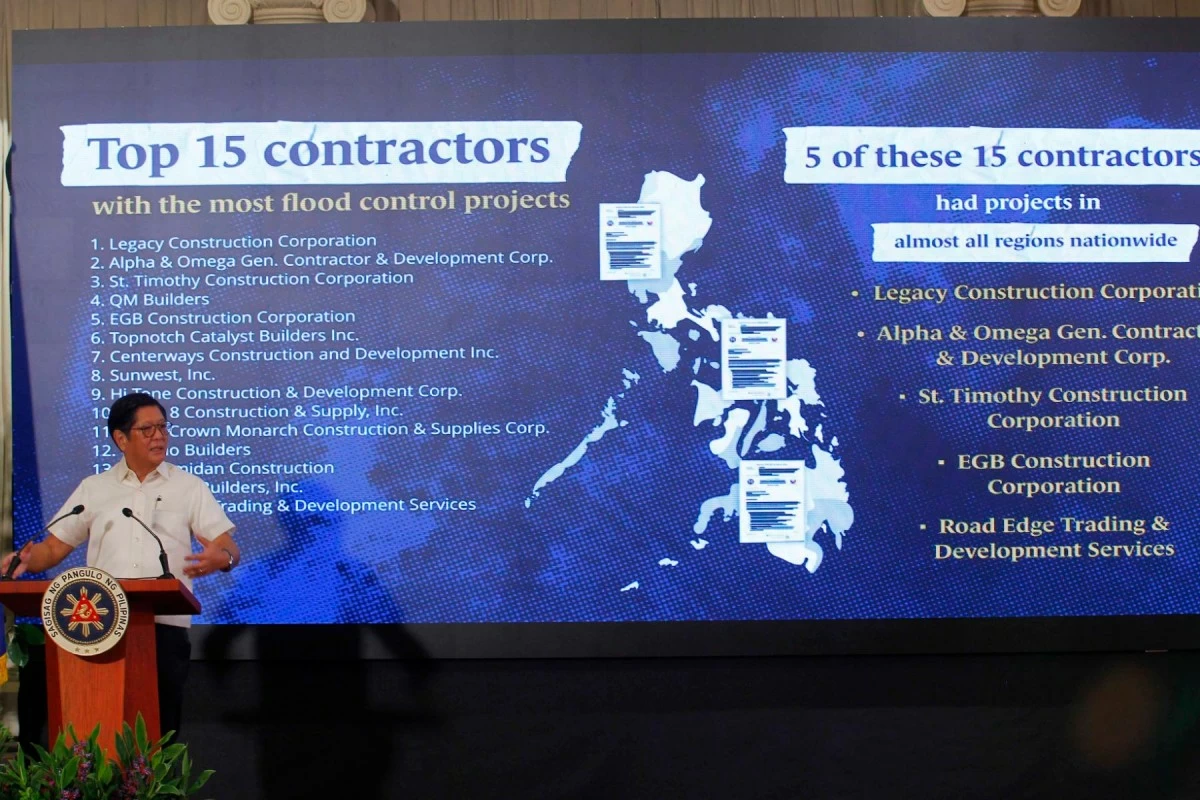
President Ferdinand R. Marcos Jr. bares key findings in the ongoing investigation of flood-control projects during a press conference at the Malacañan Palace on Aug. 11, 2025. (Mark Balmores)
Marcos held a press conference on Monday morning, Aug.11, to reveal several key points of the ongoing investigation of flood control projects, and to announce the roll out of a website dedicated for the probe and assessment, which includes a citizens' report mechanism.
In revealing the initial findings, the President said "I think it is interesting for people to look into so that it can be a guide as to where maybe the problem has risen."
20% of all flood-control projects went to only 15 contractors
Twenty percent of the entire P545-billion flood control projects were awarded to only 15 contractors, Marcos bared, adding that five of them had contracts around the Philippines.
This piece of information, Marcos said, "stood out the most" and must be closely investigated.
"(T)his is another disturbing assessment, statistic: 20 percent of the entire P545 billion budget napunta lang sa 15 na contractor. Sa 15 na contractor na ‘yan, lima sa kanila ay may kontrata sa buong Pilipinas (went to only 15 contractors. Of the 15 contractors, five of them have contracts nationwide)," Marcos said.
"And this is what I was talking about. Five of these 15 contracts have projects in almost all regions nationwide," he added.
The President, however, considered localized justifications in choosing contractors, explaining that the implementation of the project would be faster and well-communicated if a local contractor would do it.
"But that one, that for me was the one that stood out very much. Five of these contractors had projects in almost the entire country. So, those are the ones that immediately pop out na sa aking palagay ay kailangan natin tingnan (that I think we must look into)," Marcos said.
Over P350-B projects have no exact specification
Since July 2022 until present, the total cost of all of the projects is at P545.64 billion.
However, Marcos revealed that more than P350 billion of these projects did not specify the exact type of flood control being built, repaired, or rehabilitated.
"Another observation is that there are 6,021 projects worth more than P350 billion that do not specify the exact type of flood control that is being built. Then, many projects also in different locations have exactly the same contract cost," he bared.
Marcos also revealed that they found out several projects in different locations bear the exactly the same contract cost, which could mean the same designs, materials, and lengths were used despite differences in locations and terrains.
This, he argued, is something impossible.
"I think anybody who works in either the private sector or the public sector, ‘pag sinabi may limampung project, pare-pareho, 150 million lahat. Pare-pareho, pare-pareho, pareho lahat. Imposible ‘yan (if we say there are 50 projects, all exactly the same. That's impossible)," the President stressed.
"It is impossible for one barangay, even if they are the next barangay, to have the exact same project to the exact same amount with the exact same contractor. Imposible ‘yan (That's impossible). And that is why that is a significant – significant finding already that we have made)," he added.
Overall, Marcos said, there are 2,409 contracting entities in the country.
Mismatch in locations of projects vs flood-prone areas
Another disturbing information the initial investigation revealed was the mismatch between the locations with most projects and top flood-prone provinces.
The 10 provinces with the most projects are Bulacan (668), Cebu (414), Isabela (341), Pangasinan (313), Pampanga (292), Albay (273), Leyte (262), Tarlac (258), Camarines Sur (252), and Ilocos Norte (224).
While the top 10 flood-prone provinces include Pampanga, Nueva Ecija, Pangasinan, Tarlac, Bulacan, Metro Manila, Maguindanao, North Cotabato, Oriental Mindoro, and Ilocos Norte.
The regions with the most projects and highest spending, on the other hand, were National Capital Region with 1,058 projects, costing P52.57 billion; Central Luzon with 1,617 projects, costing P98.01 billion; and Bicol Region with 866 projects, costing P49.61 billion.
"I think you will notice they don't necessarily match. This side and that side don't necessarily match," Marcos said.
"Now, I'm sure there are explanations for that. We will have to study it further. But you would intuitively say that projects that the areas rather, the provinces or regions, whatever you want to do, whatever pinaka-flood prone, yun dapat ang pinakamaraming project ‘di ba (that are most flood prone should also have the most number of projects, right)?," Marcos questioned.
"Pero parang hindi tumutugma. Kaya ‘yan, kailangan natin pag-aralan nang mabuti kung bakit nagkaganyan (But it seems they are not matching. So, we will have to look into this thoroughly why it led to that)," he further said.
'Sumbong sa Pangulo' website
As Marcos revealed several initial findings in the flood-control mess probe, he unveiled a website showing the list of all flood-control projects in the country, where the public can directly report any anomaly or discrepancy they know about a certain project.
"We have received the list from DPWH (Department of Public Works and Highways). We, I think, have put it into a form that is accessible to the public. And most importantly, it is in a form that the public can use so that they can first, identify the projects that —the flood control projects that are within their area, within their barangay so that they can actually go and look at it," Marcos said.
"Or if they already have information, they can tell us about it," he added.
The President encouraged the public to make use of the website and help them in identifying more problematic projects, stressing that the full-blown investigation on anomalous flood-control projects involves the participation of everyone.
"Magsumbong sila kung ‘yan ang gusto nilang gawin. O maaari naman sasabihin nila: hindi, walang problema dito (Make a complaint if that's what they want to do. Or they can also say: no, this has no problem)," Marcos said.
"So, I encourage everyone to look into this. And you know, say your piece. Kasi parang sinasabi ng mga iba, nakikita naman namin hindi maganda, pero wala naman kaming mapuntahan, wala naman kaming malapitan (because some say: we saw it was not good, but we have no one to run to)," he added.
He assured the public that he will personally read all their reports.
"So, this is the first step. We are going to keep going. This is something that is, I think, absolutely necessary," he further said.
'We are not accusing anyone'
Marcos also clarified that by revealing the list of all flood-control projects and allowing people to lodge their complaints, they are "not accusing anyone of anything yet."
"They are not assessments. We are not accusing anyone of anything yet. However, it gives us an idea of what – how this has been conducted," he said.
"So, I hope the people – that I hope people will take advantage of this. And as I said, there is always a way for them to give their comments. We have to clean our ranks," he added.
The President has also refused to name people who are involved in anomalous flood-control projects, saying it would be premature to do so.
He also revealed that they do not have the list of those involved yet as they are just in the early stages of their investigation.
"But we don't have that yet. We haven't conducted… If you remember, the DEPDev is going to now – go into all of that. Pero parallel effort ‘yan sa gobyerno at saka sa taumbayan (But that would be a parallel effort of the government and the people)," he said.
However, the President vowed that whoever would be found to be involved, whether they are his allies, they must be held accountable.
"It might be a little painful. Baka masangkot diyan yung mga tao na malapit sa atin. Ngunit kahit malapit sila sa atin, mas malapit naman siguro sa puso natin yung taumbayan kaya sila ang uunahin natin (The people close to me might be involved to this mess. But even if they are close to me, the people are closer to my heart, so we will prioritize them)," Marcos said.
He also said that he wants the probe to be conducted fairly.
"But we will still go through every single one. And we still have to see what really is – what really is credible and what needs to be acted upon," he said.
"So, let's also be fair to everyone. And not say, ito si ganito, ito si ganyan, ito si ganyan, tanggal ka sa trabaho (this person, that person, he must be fired), unless we have a good idea of what went wrong," he added.
Any help is always welcome
Marcos said any offers of help are always welcome, referring to the proposal of San Miguel Corp. President Ramon Ang to solve the flood problem in Metro Manila.
"Thank you. What else? What else can you say? This is – this is why we have – this is the reason why from the very beginning, I always said, the private sector needs to be part of everything – of our national development," he said.
The President bared that Ang has actually given him a briefing about the proposal before.
"Now, the proposal of Ramon Ang is also certainly very welcome because, you know, we've seen his projects. Maganda naman ang mga nagiging resulta (They produced good results)," he said.
"He's able to bring it in on time. And, you know, the man is an engineer. So, I'm sure he has – pinag-aralan niya nang mabuti ‘yan (he studied it thoroughly)," he added.
"That’s something that's very welcome, as I said. Any offers of help are always welcome," he further said.