






Manila Bulletin
 Philippines
National
PH, India must continue to ensure 'major countries' don't wield undue influence
Philippines
National
PH, India must continue to ensure 'major countries' don't wield undue influence
Philippines
National
PH, India must continue to ensure 'major countries' don't wield undue influence
PH, India must continue to ensure 'major countries' don't wield undue influence
Published Aug 7, 2025 01:28 pm


The Philippines and India must continue to contribute in strengthening the world's capability to withstand geopolitical challenges, and ensure that "major countries" do not use "undue influence."
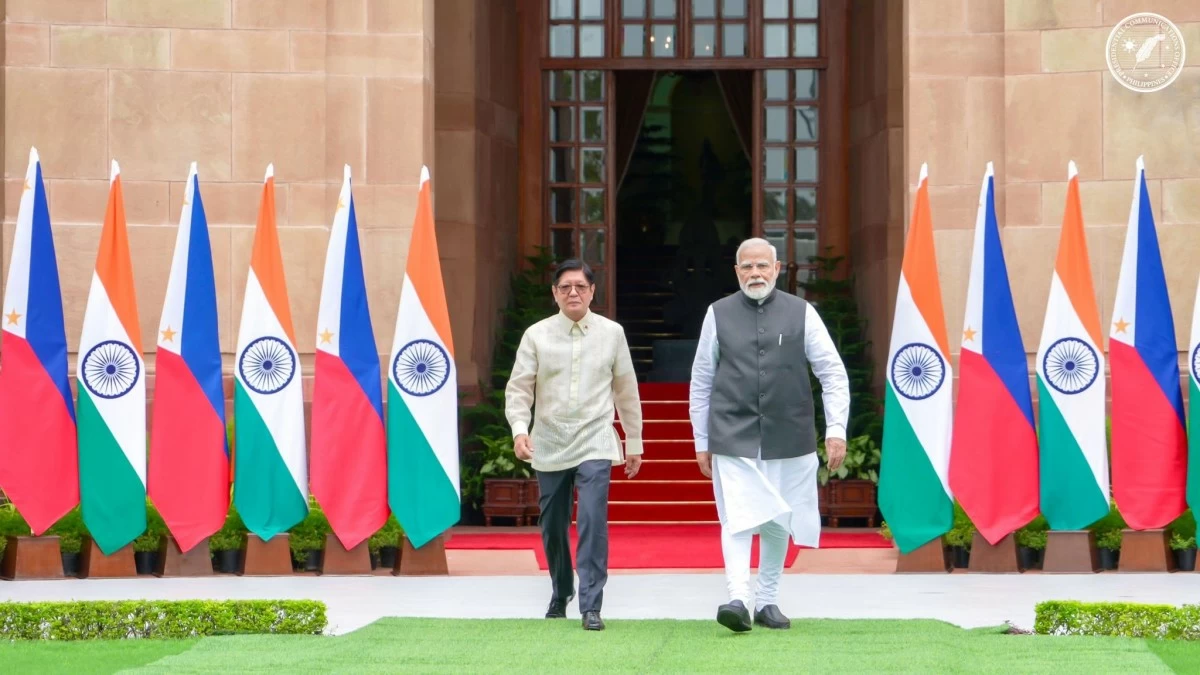
President Ferdinand R. Marcos Jr. and Indian Prime Minister Narendra Modi meet at Hyderabad House during Marcos' State Visit in India. (Photo courtesy of PCO)
President Marcos stated this in his lengthy foreign policy address at the Observer Research Foundation event in New Delhi, India on Wednesday, Aug. 6.
"Looking ahead, the Philippines and India must continue to work to strengthen the resilience of our world community," Marcos said.
"Our diplomatic initiatives must buttress the current structures of global governance. These structures must withstand geopolitical shocks, remain credible providers of global goods, and meaningful venues for nations to find common ground," Marcos added.
According to Marcos, it means meaningful linkages between the efforts of Association of Southeast Asian Nations (ASEAN )Member States and those of the Indian Ocean region, including collaborating on synergies between the ASEAN Outlook on the Indo-Pacific (AOIP) and the Indo-Pacific Oceans Initiative (IPOI).
"In the broader international arena, this entails an even more active leadership by middle powers that have the capacity to reach across political and ideological lines, forge genuine consensus, and lead credible efforts towards decisive multilateral solutions," he said.
"Our work to strengthen the multilateral system must ensure that the so-called 'major countries' do not exert undue influence. It should lead to meaningful reforms in the United Nations, and the Security Council itself, towards inclusivity, equity, and justice," he stressed.
Marcos further underscored that the Indo-Pacific is now the world’s fastest-growing economic hub and foremost driver of global growth. But the promise it holds "will not be given, but must be secured."
'Friends by choice, but partners by destiny'
The President highlighted that the relationship of the Philippines and India has become stronger, citing their newly-forged strategic partnership and their common bonds.
"It behooves all of us, as individual nations, as agents acting in concert with others, be it in the context of strategic partnerships, formal alliances or any other framework, to be invested in an Indo-Pacific that is free, open, and firmly undergirded by a rules-based order," Marcos said.
"True to our common destiny—“tadhana”—and in the spirit of “sandhāna”—our bonds and common journey—never has the Philippines and India been better positioned as now to put our ties in the service of both our peoples as well as our larger region’s future," he added.
The Chief Executive cited how Prime Minister Narendra Modi described the Philippines and India as “friends by choice, but partners by destiny.”
"In these words are captured the sense of an inevitable friendship, anchored on a meeting of purpose for our nations and a shared journey for our peoples," he said.
"With our Strategic Partnership, we unfurl the sails and steer our hopes and dreams through challenging tides. Our vision for a free, open, and inclusive Indo-Pacific is our compass. Our commitment to international law is our ballast," the President concluded.