






Manila Bulletin
 Philippines
National
DepEd strengthens disaster-ready schools: Angara leads relief operations, inauguration in Pampanga
Philippines
National
DepEd strengthens disaster-ready schools: Angara leads relief operations, inauguration in Pampanga
Philippines
National
DepEd strengthens disaster-ready schools: Angara leads relief operations, inauguration in Pampanga
DepEd strengthens disaster-ready schools: Angara leads relief operations, inauguration in Pampanga
Published Aug 6, 2025 03:45 pm


At A Glance
- More than 2,000 DepEd personnel received relief assistance from DepEd as part of the government's rapid disaster response
- DepEd Secretary Sonny Angara engaged in a dialogue with educators, students, and community stakeholders to hear their concerns and reaffirm the agency's dedication to supporting their welfare
- Angara also spearheaded the inauguration of the stilt-type school building at Masantol High School as part of ongoing efforts to strengthen disaster-resilient infrastructure in vulnerable communities
- He also called for stronger collaboration among DepEd, local government units (LGUs), and Congress to ensure education continuity during times of crisis

DepEd Secretary Sonny Angara led the distribution of relief goods to teachers and education staff affected by recent typhoons, reaffirming DepEd’s commitment to teacher welfare and disaster response. (DepEd photo)
Department of Education (DepEd) Secretary Sonny Angara, on Wednesday, August 6, spearheaded the distribution of relief assistance to over 2,000 teachers and education staff affected by recent typhoons in Pampanga.
Angara led the relief operations benefiting more than 2,000 teaching and non-teaching personnel from Masantol, Macabebe, and nearby flood-affected areas. The recipients were severely impacted by Typhoons Crising, Dante, and Emong.
“Kapag may kalamidad, una nating tanong: ligtas ba ang mga paaralan? Kumusta ang ating mga guro at kawani? Kaya’t sinigurado ng DepEd, alinsunod sa utos ng Pangulo, na may agarang tugon at aktwal na pagdalaw sa inyo ngayon (Whenever there’s a disaster, our first questions are: Are the schools safe? How are our teachers and staff? That’s why DepEd, following the President’s directive, made sure to respond immediately and personally visit you today)," said Angara, who also visited San Isidro Elementary School and San Nicolas Elementary School.
The relief mission was conducted in line with the Marcos administration’s directive for immediate disaster response and education continuity.
Food packs and essential supplies were distributed at Masantol High School, San Isidro Elementary School, San Nicolas Elementary School, and Macabebe Elementary School.
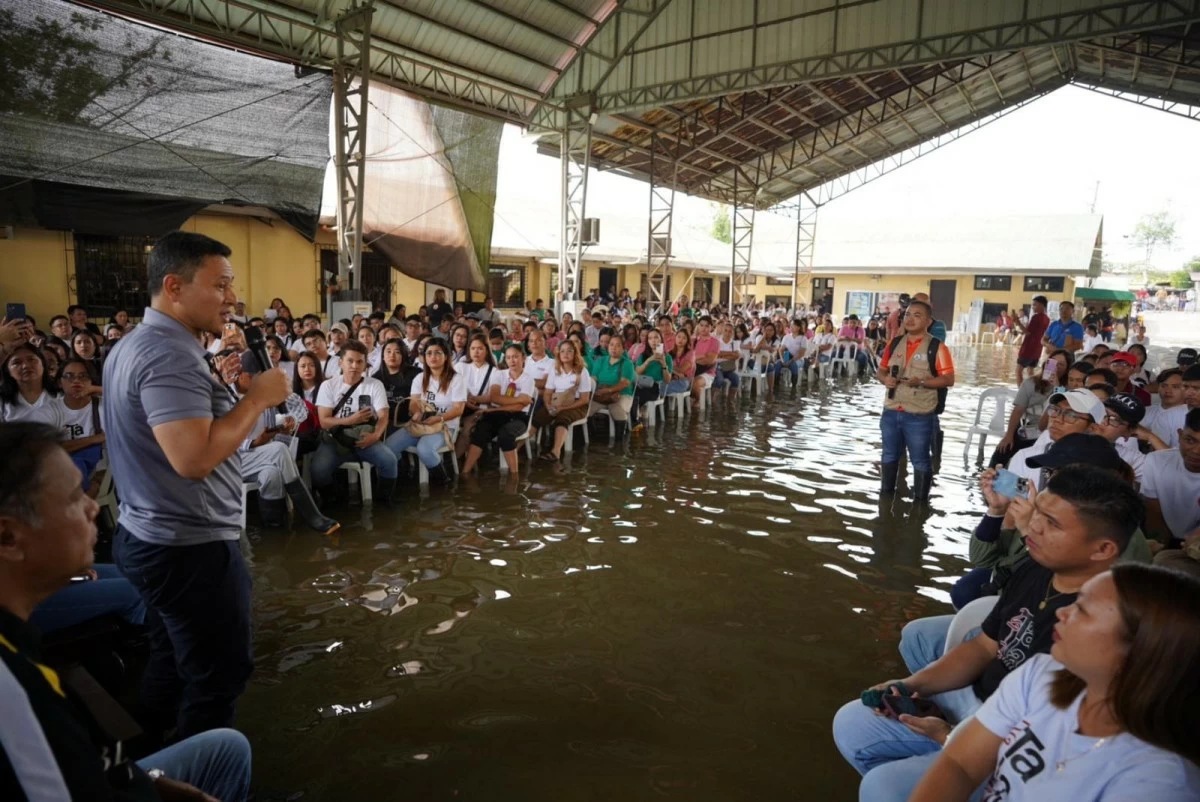
DepEd Secretary Sonny Angara engaged in a dialogue with educators, students, and community stakeholders to hear their concerns and reaffirm the agency’s dedication to supporting their welfare. (DepEd photo)
Angara also held a dialogue with educators, students, and community stakeholders to listen to their concerns and reaffirm the agency’s commitment to their welfare.
Inauguration of school building
As part of DepEd’s broader efforts to improve learning environments and enhance the climate resilience of public schools, especially in flood-prone areas, Angara led the inauguration of a newly completed school building.
“Yung nakita nating classroom sa Masantol, I think 'yun yung talagang magiging modelo for flood-prone areas (The classroom we saw in Masantol—I believe that will truly serve as the model for flood-prone areas)." Angara said.
The stilt-type, climate-resilient school building at Masantol High School was designed to withstand flooding and extreme weather. With classrooms and offices located on upper floors, the elevated structure ensures the safety and continuity of learning during disasters.
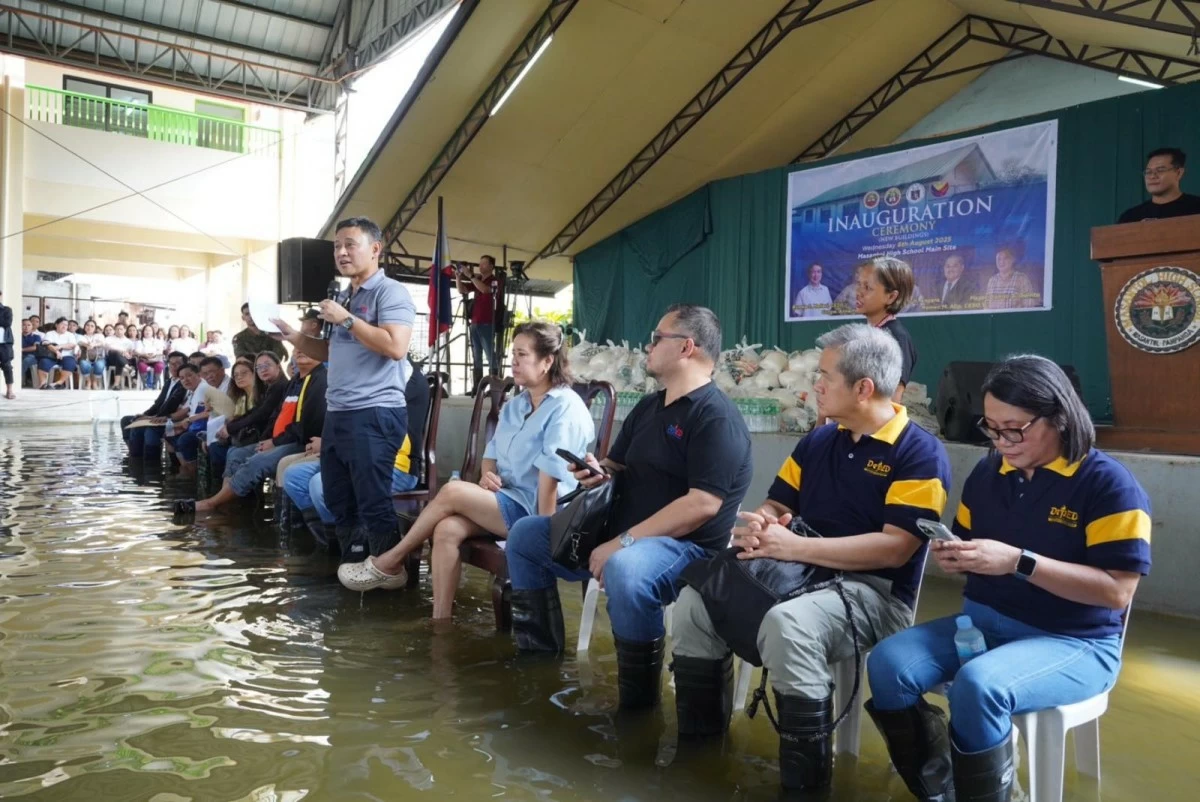
DepEd Secretary Sonny Angara led the inauguration of a stilt-type school building at Masantol High School in Pampanga. Designed to withstand flooding, the building features an elevated structure, with classrooms and offices located on the upper floors to ensure the safety of students and teachers during floods or inclement weather. (DepEd photo)
“Sa Bicol, dito, sa Bulacan. 'Yan din ang gusto ng Pangulo—na may permanent solutions na tayo, hindi yung nag-a-adjust lang (In places like Bicol, here, and Bulacan, that’s also what the President wants: for us to implement permanent solutions, not just temporary adjustments)," he said. “We must adapt our policies,” he added.
Angara was joined by Pampanga 4th District Representative Anna York Bondoc, DepEd Region III Assistant Regional Director Jessie L. Amin, Schools Division Superintendent Romeo S. Alip, along with local school officials and community leaders.
The new classrooms are expected to help decongest existing facilities and provide safer, more conducive learning spaces—especially during the rainy season.
Flood-resilient school buildings
The “flood-resilient” school buildings are part of DepEd’s enhanced standard designs tailored for communities frequently affected by flooding.
Constructed with reinforced concrete and structural steel, these facilities are engineered to endure water and wind hazards, ensuring long-term durability and safety.
A key feature of these buildings is their stilt-type or elevated configuration, which has proven effective in areas with recurring floods.
Initially adopted in typhoon-resilient schools in regions like Bicol, this design evolved through localized risk assessments and climate-adaptive planning.
Why stilt-type school buildings matter
Stilt-type school buildings—like the one inaugurated at Masantol High School—offer crucial protection against flooding. By elevating classrooms above ground level, they help prevent water intrusion and minimize damage to learning spaces and equipment.
These buildings also provide:
- Enhanced ventilation and daylight: The open space beneath allows for better airflow and natural lighting, promoting a healthier, energy-efficient learning environment.
- Adaptability to terrain: Stilt construction enables building on sloped or uneven land, expanding options for safe, strategic site placement.
- Multi-use under-space: The area below can serve as a shaded play zone, assembly area, storage, or parking—depending on the needs of the school and community.
- Modern design aesthetics: Elevated structures encourage school pride, a stronger sense of place, and environmental awareness.
- Sustainable design features: These buildings can incorporate eco-friendly materials, passive cooling strategies, and open-air layouts to support greener infrastructure.
Whole-of-government approach to education and disaster response
The school building inauguration and relief operations in Pampanga align with DepEd’s whole-of-government strategy to safeguard education amid climate-related risks.
Angara underscored the importance of collaboration among the national government, local government units (LGUs), Congress, and education stakeholders to ensure no student or teacher is left behind during crises.
“Hindi natin kayang pigilan ang bagyo, pero kaya nating ihanda ang bansa. Basta’t magkakasama tayo—DepEd, LGU, Kongreso, at mga guro—walang hindi kakayanin (We cannot stop storms from coming, but we can prepare our schools and communities to withstand them. Together—DepEd, LGUs, Congress, and our teachers—we can overcome any challenge)," he said.